
A transit fusion-center team is indexing IR runbooks for RAG and debates how to split the documents. Which chunking approach best supports retrieving coherent municipal procedures?
Select an answer to reveal the explanation.
Short Explanation
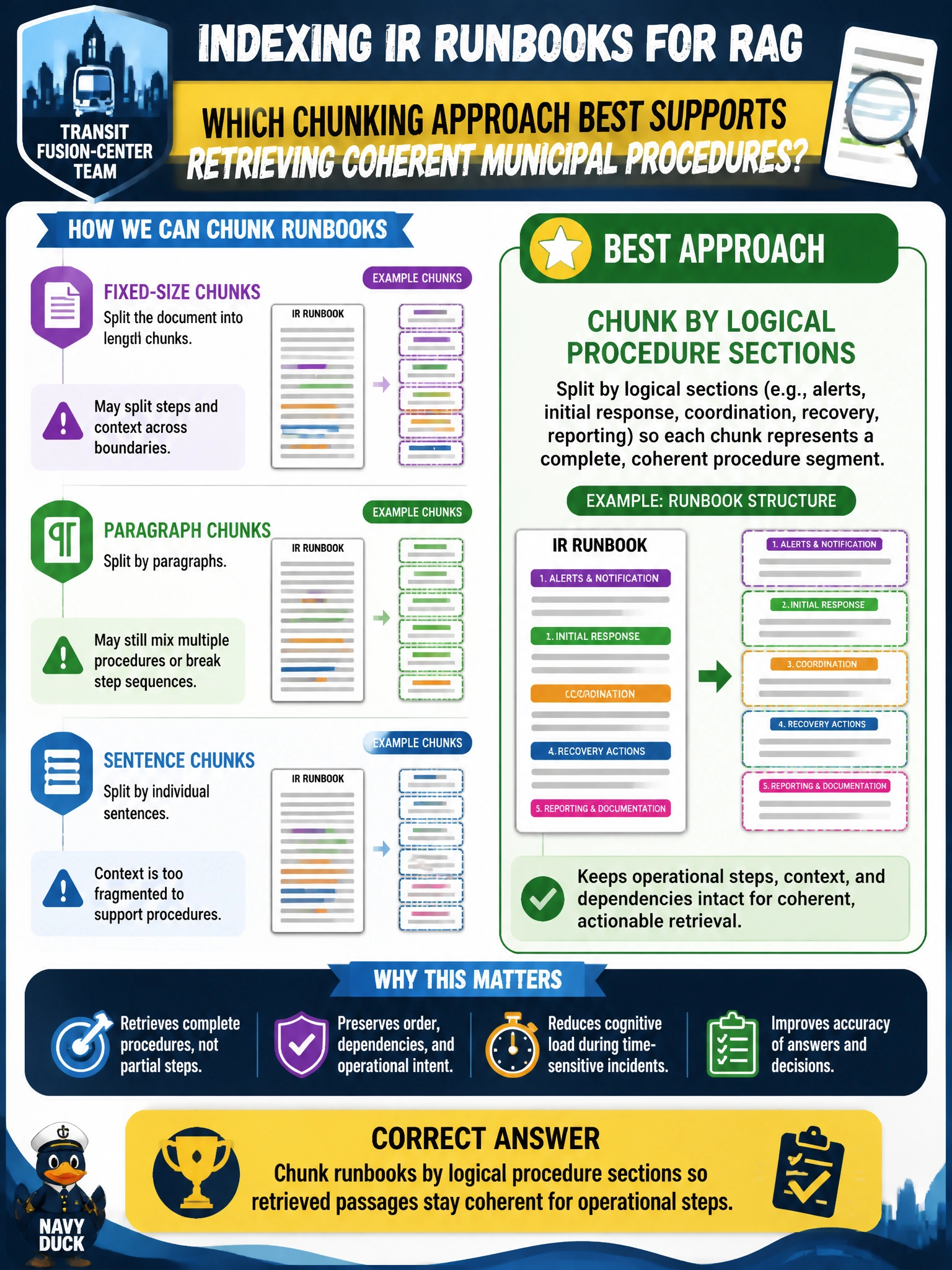
Chunking by procedure section is like filing SOPs in labeled folders instead of sliding blind token windows across them. You'll get a usable step block back — not just a summary and not a jumbled mix of similar steps from other runbooks. Structure beats blind splits.
Full Explanation
Transit fusion-center teams indexing IR runbooks for RAG should chunk by logical procedure sections so retrieved passages stay coherent for operational steps. Chunking design determines what the retriever can return: section-aware splits preserve headings, numbered steps, and decision branches that responders actually execute. Coherent chunks improve both relevance ranking and downstream generation quality because the model receives a usable procedure block rather than a fragmented mid-sentence fragment.
The correct approach works because municipal runbooks are structured operational documents. Procedure boundaries are natural units of meaning; retrieving “Isolate VPN concentrator – steps 1–6” is actionable, whereas retrieving a random page middle is not.
Chunking runbooks by sliding token windows with overlap fails because fixed-length windows still slice across headings and step sequences, so a retrieved passage can start or end mid-procedure despite the overlap. Overlap improves local continuity but does not restore procedure boundaries, so prerequisites and decision branches can still land in separate chunks and break operational coherence.
Chunking runbooks by logical sections and index summaries fails because retrieval then returns an abstracted summary rather than the full step text, so responders lose the detailed sequence they must execute.
Grouping steps across runbooks by embedding similarity fails because it reassembles steps by vector closeness rather than procedure order, mixing disconnected actions from different incidents into one passage. Similarity grouping rarely preserves original sequence and prerequisites, so the retrieved set can be jumbled and unexecutable as a coherent municipal procedure.
Exam caveat: RAG quality questions often hinge on chunking strategy. Prefer structure-aware section chunking for SOPs and runbooks.
Operational check: Sample retrievals for common transit IR queries, confirm returned chunks include complete step sequences, and tune overlap/size so section titles and lists remain intact.
Prefer to study offline? Printable PDF study book + test engine ($7.50, unofficial). These questions stay free here.