
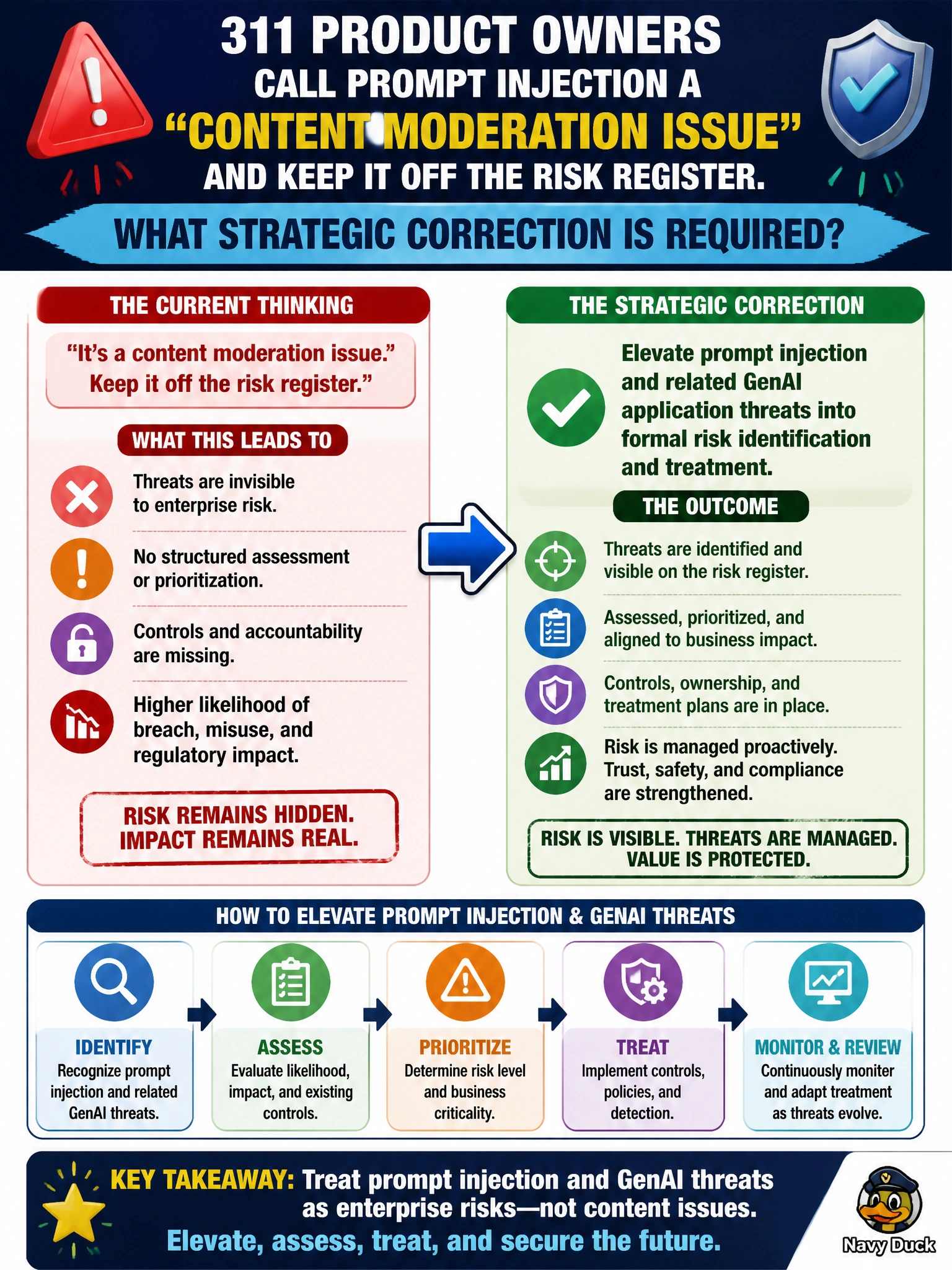
311 product owners call prompt injection a “content moderation issue” and keep it off the risk register. What strategic correction is required?
Select an answer to reveal the explanation.
Short Explanation
Prompt injection is not a spelling bee—it is an application security risk that belongs on the register with a treatment plan. Rebrands, log deletion, and handing it to graphic design do not elevate the threat.
Full Explanation
Prompt injection and related GenAI application threats are security and enterprise risks, not merely content-moderation aesthetics. Strategic correction elevates them into formal risk identification and treatment on the municipal risk register—with owners, ratings, and controls such as input handling, privilege separation for tools, monitoring, and red-teaming. For 311, injection can divert workflows, exfiltrate data via malicious instructions in tickets, or cause unauthorized actions if tools are connected.
Renaming the chatbot and declaring injection solved by branding is security theater. Deleting logging so injection attempts cannot be proven destroys detection and assurance. Assigning injection handling exclusively to the graphic design team misassigns a technical and risk-management problem to a communications craft function.
Exam caveat: content moderation may help with toxic outputs, but prompt injection is an attacker-controlled instruction-channel problem that belongs in AppSec and risk treatment. Operational check: add prompt injection (and tool-abuse variants) as named risks for the 311 GenAI app, link mitigations and tests, and stop classifying them solely as moderation backlog items.