
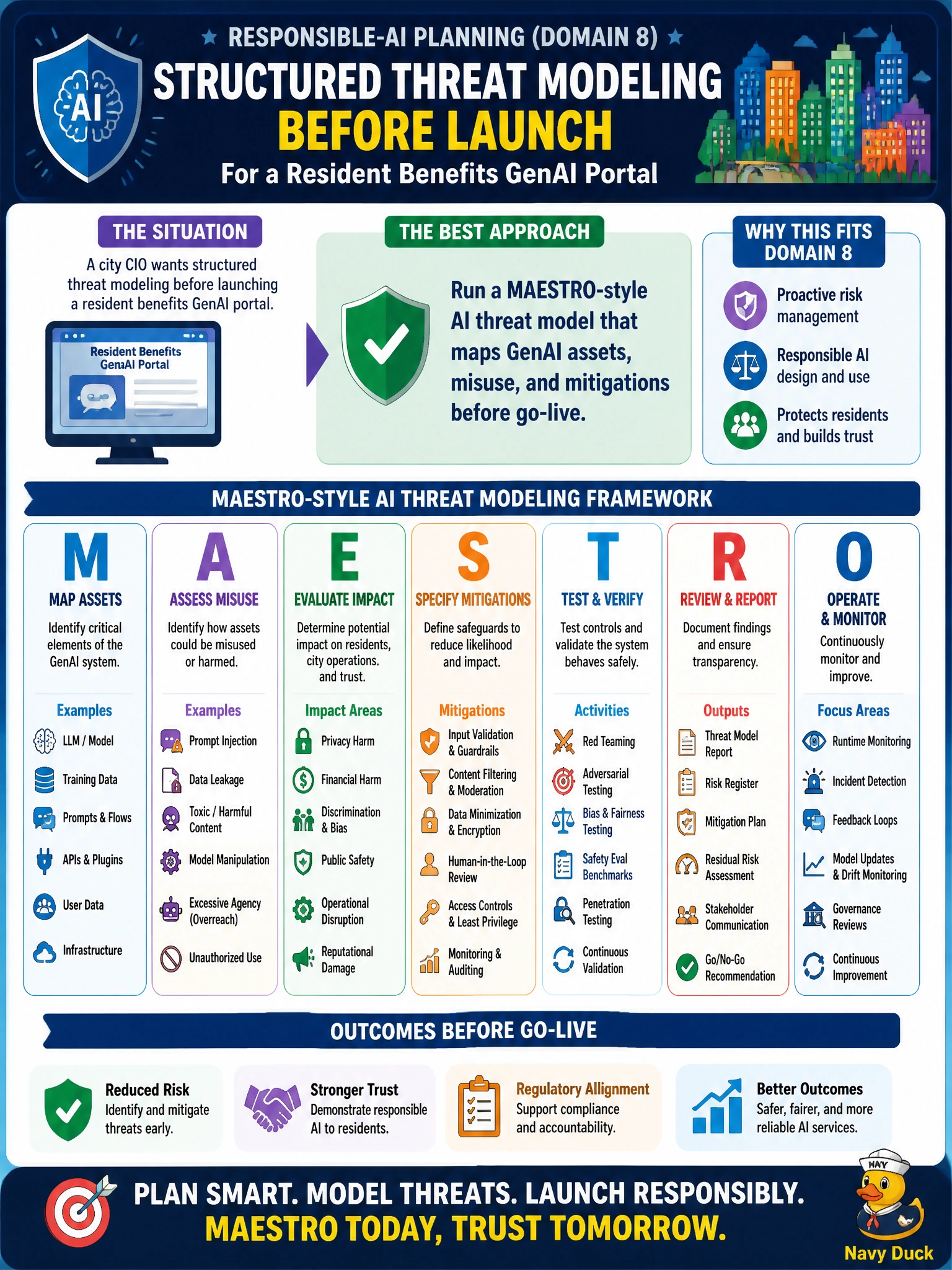
A city CIO wants structured threat modeling before launching a resident benefits GenAI portal. Which approach best fits Domain 8 responsible-AI planning?
Select an answer to reveal the explanation.
Short Explanation
Think of MAESTRO-style modeling like a building inspection before residents walk in — you map what can go wrong while the walls are still open. For a benefits GenAI portal, structured AI threat modeling before launch is the move. Vendor slogans, parking-meter-only reviews, and ethics press releases are not a substitute.
Full Explanation
Structured threat modeling before go-live is the responsible-AI planning control that Domain 8 expects for high-visibility civic GenAI. A MAESTRO-style (or equivalent AI-focused) model inventories GenAI assets—models, prompts, retrieval corpora, tools, and integrations—then maps misuse cases such as prompt injection, data exfiltration through the benefits portal, unauthorized eligibility probing, and unsafe automation. Mitigations are assigned before residents rely on the system, which is the correct sequence for municipal risk acceptance.
Skipping modeling because a vendor brochure claims the model is “already safe” confuses marketing assurance with municipal due diligence. Vendor claims do not map city-specific assets, data flows, or abuse paths, and they leave residual risk unowned. Threat-modeling only parking meters because “GenAI portals have no attack surface” is a category error: a resident benefits portal has authentication, sensitive personal data, prompt surfaces, and possible tool or API connectors—classic and AI-specific attack surfaces alike. Replacing security review with a press release promising ethical AI substitutes communication for control design; ethics messaging does not enumerate threats or verify mitigations.
Exam caveat: frameworks and labels (MAESTRO, STRIDE-extended, OWASP LLM Top 10, etc.) may appear as examples—what matters is performing AI-aware threat modeling with assets, misuse, and mitigations before production, not memorizing one brand name. Operational check: before launch, require a written threat-model packet that lists GenAI assets, top misuse scenarios for the benefits portal, owners for each mitigation, and an explicit residual-risk sign-off by the CIO or delegated risk authority.