
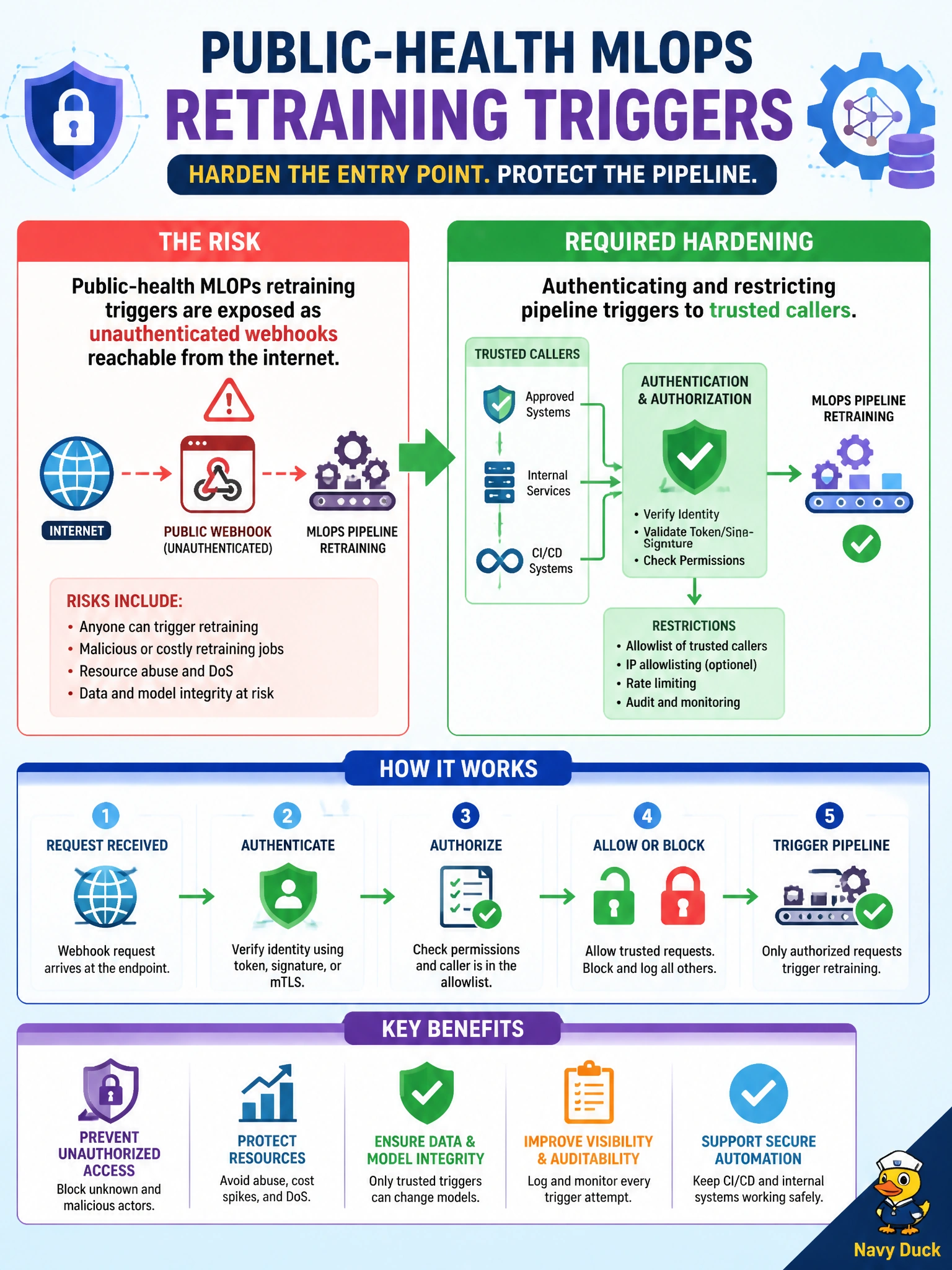
Public-health MLOps retraining triggers are exposed as unauthenticated webhooks reachable from the internet. What hardening is required?
Select an answer to reveal the explanation.
Short Explanation
An open retrain webhook is a fire alarm pull that anyone on the sidewalk can yank. Authenticate and lock who can trigger jobs. Homepage ads, open GETs, and no rate limits invite abuse.
Full Explanation
Public-health MLOps retraining triggers exposed as unauthenticated webhooks reachable from the internet require authenticating and restricting pipeline triggers to trusted callers. Open triggers enable denial-of-wallet attacks (costly GPU jobs), unauthorized retrains that can perturb models, and abuse of data workflows tied to sensitive health programs. Authentication (signed webhooks, mTLS, or equivalent), network restriction, and rate limits restore control over who may start training or promotion jobs.
Advertising the webhook URLs on the department homepage fails because it increases discovery by attackers. Allowing any GET request to start a full production retrain fails because unauthenticated GETs are trivial to abuse via crawlers and images. Removing rate limits so external partners can fire jobs freely fails because it maximizes cost and chaos.
Exam caveat: pipeline triggers are privileged control-plane APIs; municipal exams treat internet-open retrain webhooks as critical misconfigurations.
Operational check: place triggers behind auth and allowlisted networks; require signed payloads; enforce rate limits and anomaly alerts on trigger volume; rotate any previously exposed secrets; confirm internet scans no longer reach the raw webhook.