
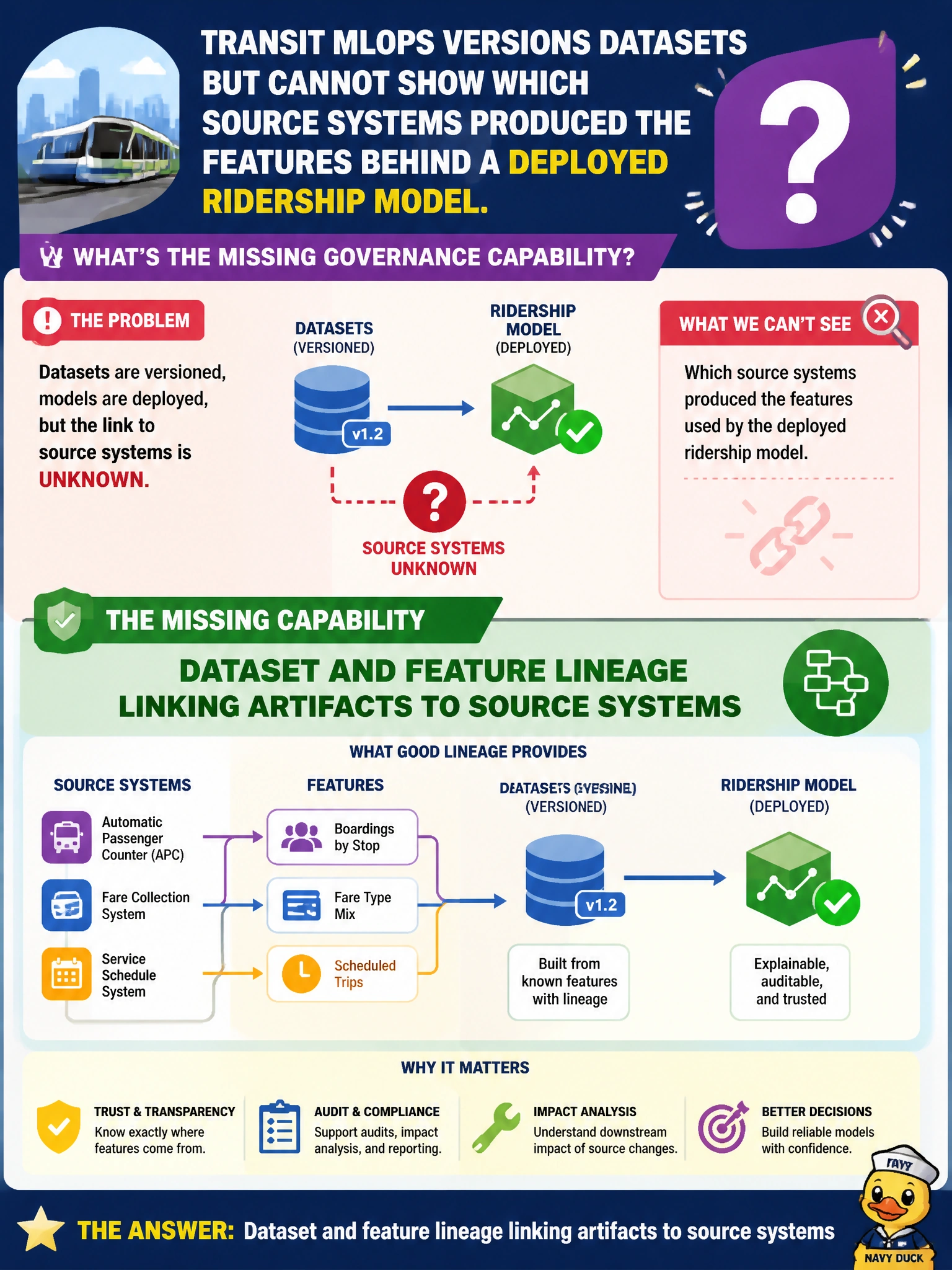
Transit MLOps versions datasets but cannot show which source systems produced the features behind a deployed ridership model. What governance capability is missing?
Select an answer to reveal the explanation.
Short Explanation
You need dataset and feature lineage to trace the features in a deployed model back to their source systems. Version numbers alone cannot show where data came from, and publicly hosting training CSVs, disabling versioning, or lengthening a system prompt will not fill that gap.
Full Explanation
Transit MLOps that versions datasets but cannot identify which source systems produced features in a deployed ridership model is missing dataset and feature lineage linking artifacts to source systems. Version labels tell you that a snapshot exists, but not whether its features came from faregates, AVL feeds, or another source. Lineage supports poisoning investigations, privacy impact analysis, regulatory audits, and rollback decisions. Governance needs traceable links from source systems through transformations to training sets and serving features. Publicly hosting every training CSV on a CDN expands exposure without creating structured lineage. Disabling dataset versioning to reduce storage costs removes even coarse reproducibility. Replacing features with a longer system prompt does not provide data provenance for a trained model. Exam caveat: distinguish versioning, which preserves snapshots, from lineage, which records data origins and transformations; more versioning or open hosting does not resolve a lineage gap. Practical check: require feature-store and training-job metadata to record source-system IDs, extract jobs, and transform hashes. Test whether operations can identify the feed behind a live feature within a fixed time, and block production promotion when lineage fields are empty.