
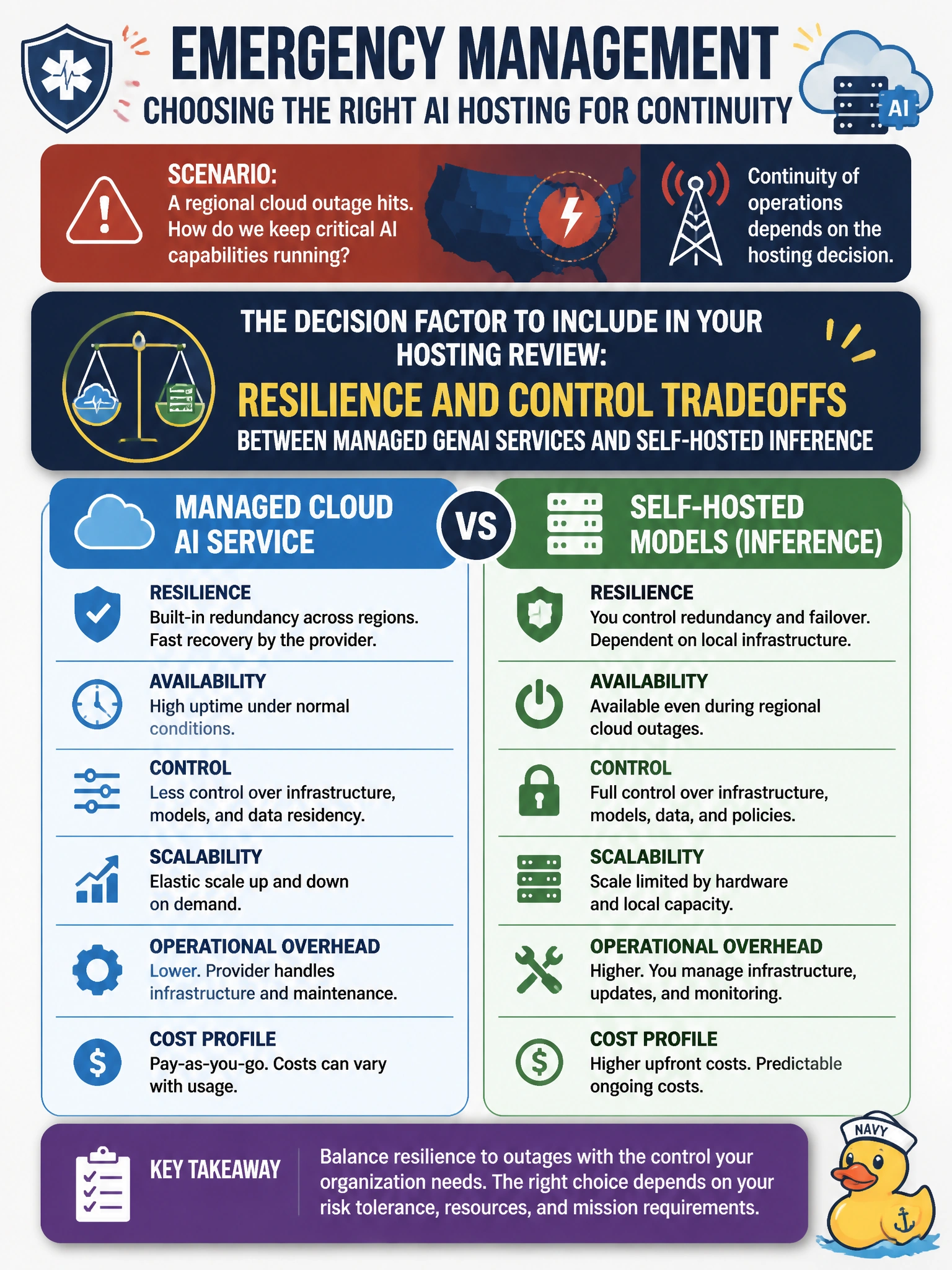
Emergency management compares a managed cloud AI service with self-hosted models for continuity if a regional cloud outage hits. What decision factor belongs in that hosting review?
Select an answer to reveal the explanation.
Short Explanation
You’re weighing managed ease against local continuity when a region goes dark, so focus on the resilience and control tradeoff. Logo colors, assuming self-hosting removes identity controls, and changing temperature won’t resolve that hosting decision.
Full Explanation
Emergency management comparing managed cloud AI with self-hosted models for continuity during a regional cloud outage is making a hosting architecture decision. The relevant factor is the resilience and control tradeoff: managed GenAI reduces operational burden but can create regional provider dependency, while self-hosted inference can improve local continuity for critical municipal functions at the cost of capacity planning, patching, and staff skill. Continuity objectives for emergency GenAI should drive that comparison explicitly. Whether the managed service logo matches the city seal colors is branding, not resilience. Assuming self-hosting always removes the need for identity controls is false; self-hosted stacks still need authentication and authorization for APIs and administrators. Raising sampling temperature on remaining nodes does not remediate an infrastructure outage: temperature is a generation parameter, not a failover control. Exam caveat: the point is to evaluate continuity and control, not to declare managed services or self-hosting universally correct. Practical check: document RTO and RPO for emergency GenAI, test failover or degraded modes, and map which civic prompts may leave the region versus which must stay on municipal hardware during provider outages.