
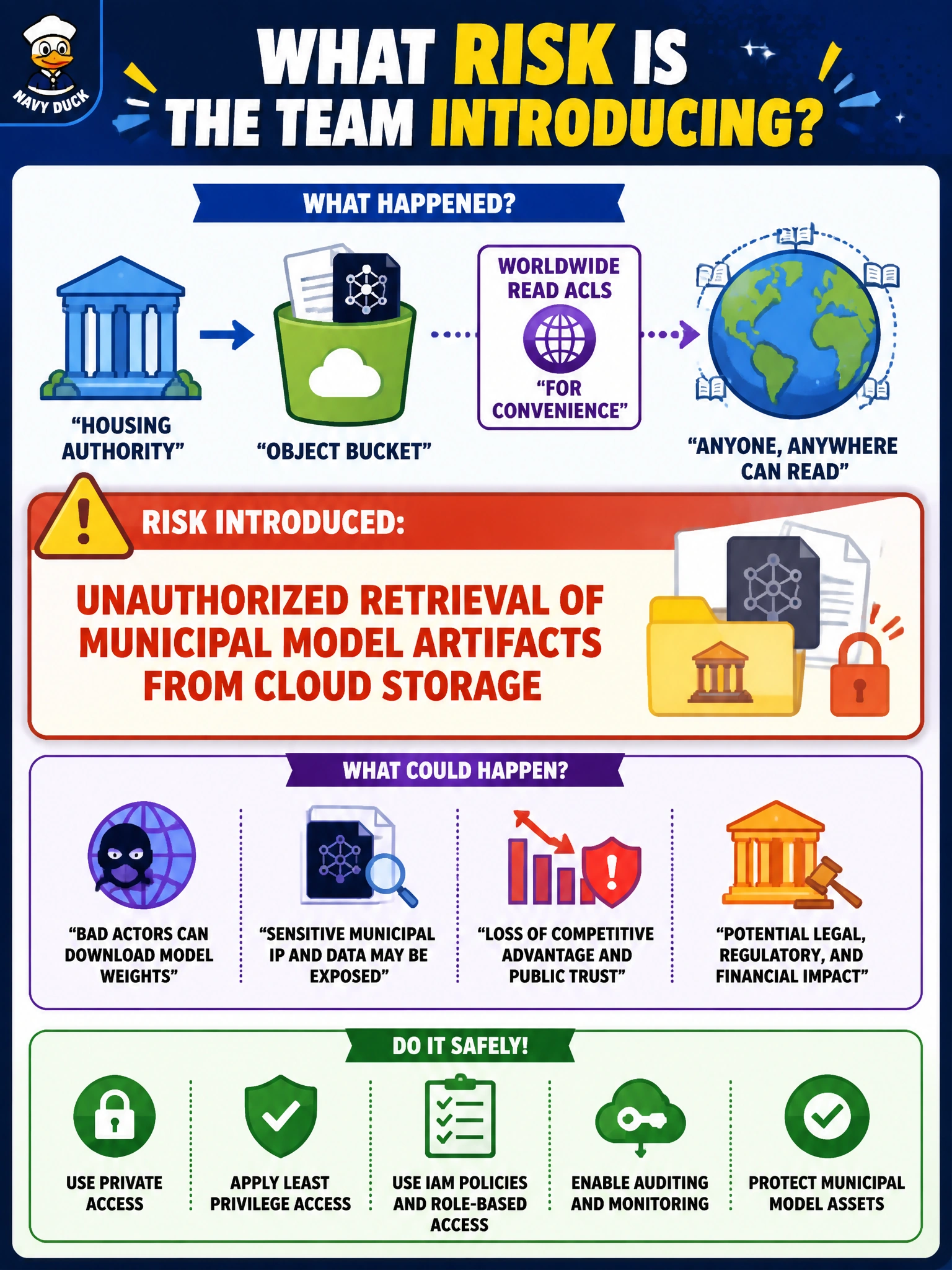
A housing authority stores fine-tuned model weights in an object bucket with worldwide read ACLs “for convenience.” What risk is the team introducing?
Select an answer to reveal the explanation.
Short Explanation
Worldwide-read model buckets are like leaving the master key under the doormat for the whole planet. Lock down who can pull those municipal artifacts. Public ACLs do not magically encrypt, pin residency, or erase supply-chain risk.
Full Explanation
Fine-tuned model weights for a housing authority are sensitive municipal artifacts: they may encode proprietary adaptations, operational phrasing, and investment of civic engineering effort. Storing them in an object bucket with worldwide read ACLs enables unauthorized retrieval by anyone who can guess or discover the object URL. The risk introduced is unauthorized retrieval of municipal model artifacts from cloud storage, which is an infrastructure confidentiality failure distinct from merely “making AI more open.”
Worldwide ACLs do not improve data residency; they expand geographic and identity reach of readers rather than pinning objects to a courthouse or approved region. Public ACLs do not automatically activate encryption as a compensating control—encryption at rest without access control still allows authorized-as-anonymous downloads of ciphertext when the service decrypts for the requester. Publishing weights anonymously does not eliminate supply-chain risk; it can increase uncontrolled redistribution and make provenance harder to track.
Exam caveat: some municipalities publish open models deliberately; the failure here is convenience-driven worldwide read without a publication decision and without least-privilege ACLs. Operational check: inspect bucket ACLs and public-access blocks, confirm only approved principals can GetObject on weight prefixes, and verify access logs for unexpected reads of model artifacts.