
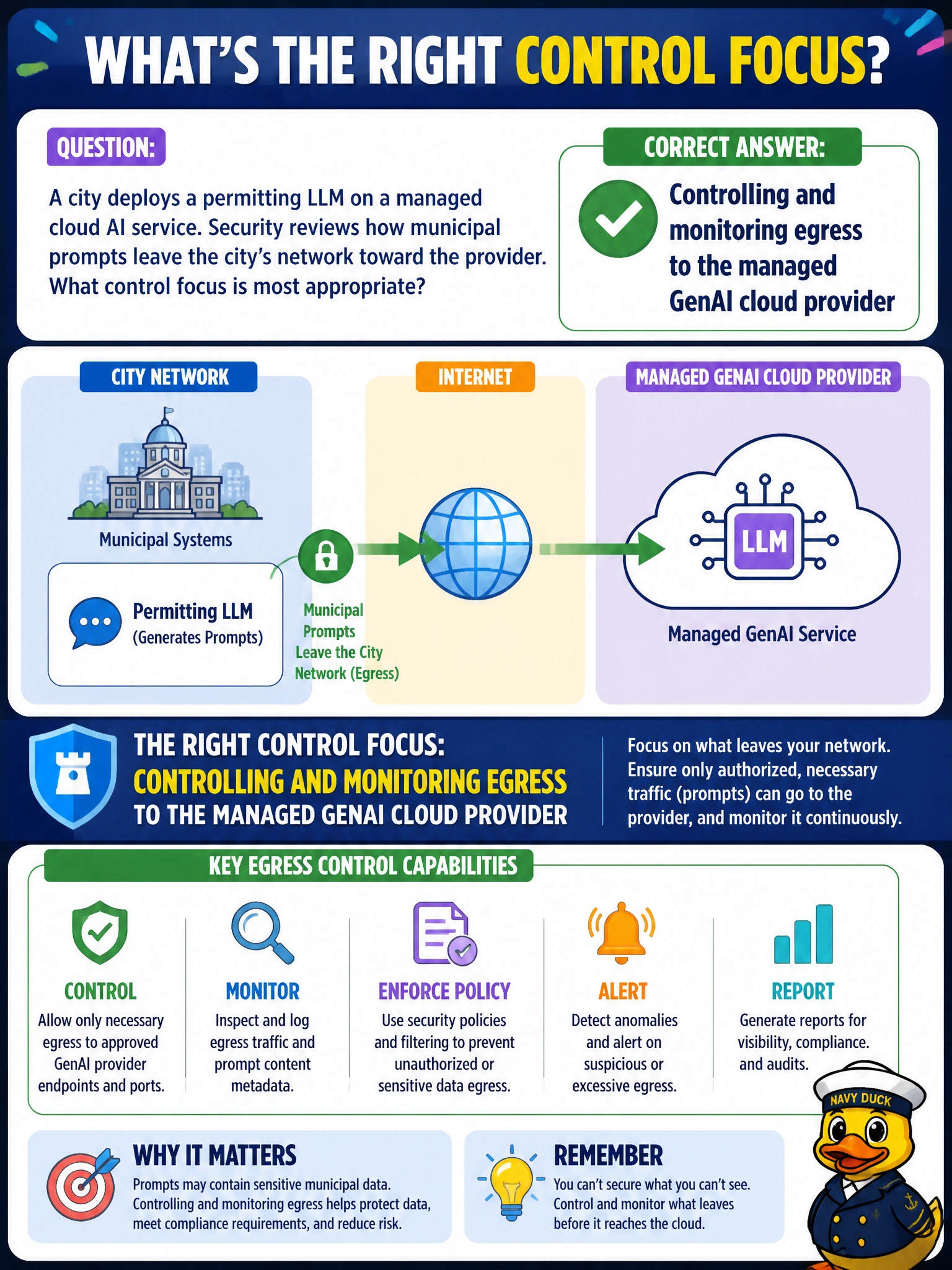
A city deploys a permitting LLM on a managed cloud AI service. Security reviews how municipal prompts leave the city’s network toward the provider. What control focus is most appropriate?
Select an answer to reveal the explanation.
Short Explanation
Think of the cloud AI like a contractor truck leaving city hall — you still want a gate log of what rolls out. Watch and constrain egress to that provider. Cleartext TLS defeat, public weight dumps, and longer privacy prompts are not network egress controls.
Full Explanation
When a city runs permitting workflows through a managed cloud AI service, resident and case prompts leave the municipal network and become outbound traffic toward the provider. The most appropriate control focus is therefore controlling and monitoring egress to that managed GenAI endpoint set: know which destinations are allowed, enforce TLS to approved FQDNs or service endpoints, log caller and destination identity, and alert on unexpected GenAI-related outbound paths. That approach keeps civic data flows auditable and constrains where municipal prompts may travel without pretending the provider boundary does not exist.
Disabling TLS so that egress inspection can read tokens in cleartext fails as a concept because it trades confidentiality for visibility and expands man-in-the-middle and credential-harvest risk on the very path that carries resident content. Publishing permitting model weights on a public CDN is not an egress control; it is an artifact-disclosure decision that can expose fine-tunes and operational know-how unrelated to monitoring outbound prompt traffic. Replacing egress controls with a longer system prompt about privacy confuses application instruction text with network and hosting controls—prompts do not enforce destination allowlists, logging, or DLP on the wire.
Exam caveat: managed GenAI often involves legitimate outbound calls; the goal is governed egress, not a blanket ban that breaks permitting. Operational check: verify firewall or proxy policy lists the approved GenAI provider endpoints, confirm TLS inspection or equivalent logging captures municipal GenAI egress without disabling encryption end-to-end where policy forbids it, and sample recent logs for unexpected destinations from the permitting workload identity.