
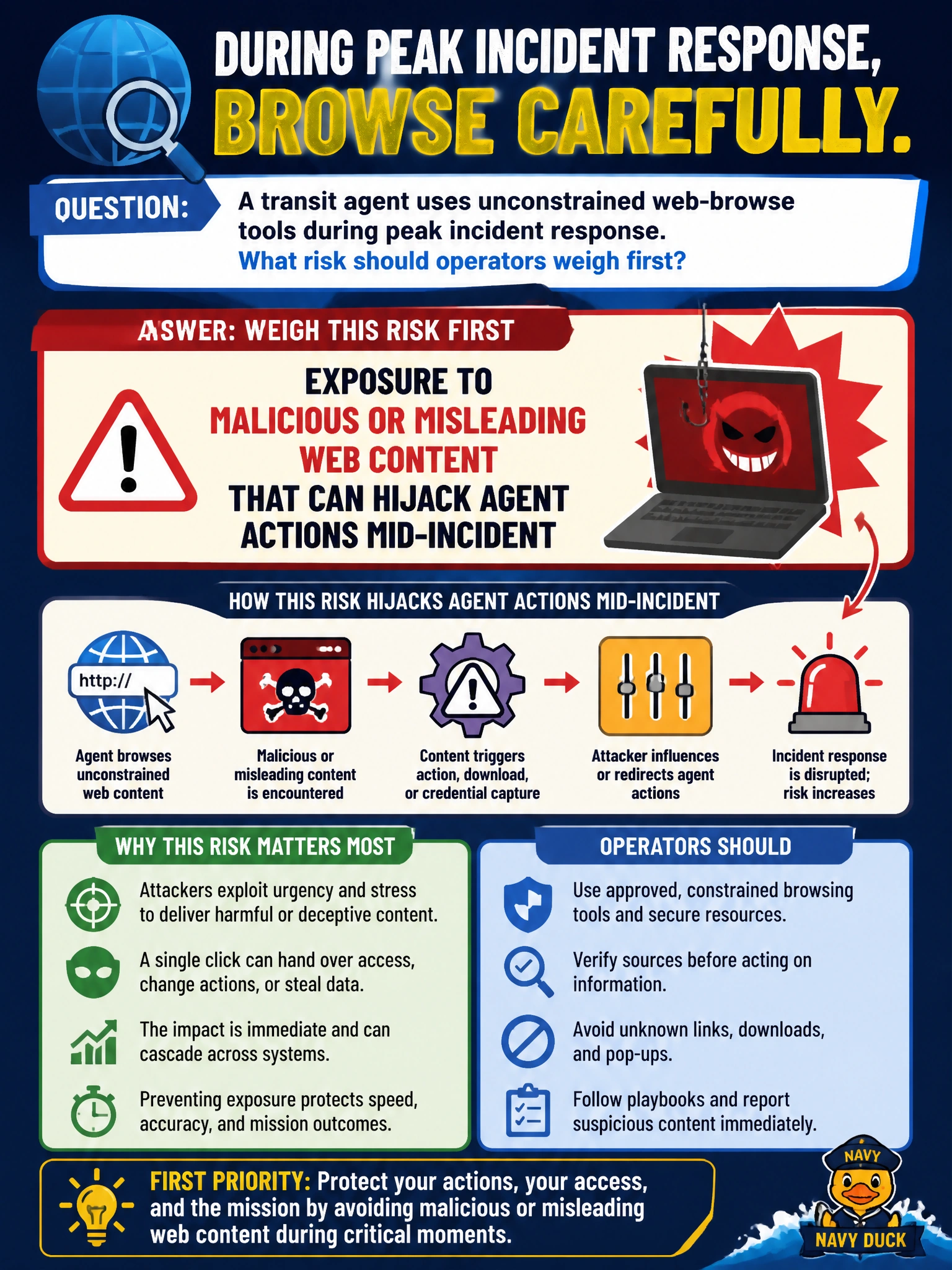
A transit agent uses unconstrained web-browse tools during peak incident response. What risk should operators weigh first?
Select an answer to reveal the explanation.
Short Explanation
Letting an incident agent free-roam the open web mid-crisis is like sending an intern to Google while the radio is blaring — poisoned pages can steer the next tool call. Constrain browse tools when stakes are high. Unfiltered web is an untrusted instructor.
Full Explanation
A transit agent using unconstrained web-browse tools during peak incident response risks exposure to malicious or misleading web content that can hijack agent actions mid-incident. Open-web browsing introduces prompt injection, phishing pages, and fabricated “official” incident guidance precisely when operators need reliable actions. Civic incident agents should prefer approved runbooks and trusted internal sources; unconstrained browse expands the attack surface during high-tempo transit operations.
Improved safety from downloading every untrusted browser extension automatically fails by concept: untrusted extensions increase compromise risk rather than safety. Guaranteed accuracy because public web pages cannot contain prompt injections fails by concept: public pages are a common injection and misinformation vector for browsing agents. Elimination of phishing risk when agents click every linked PDF fails by concept: indiscriminate PDF retrieval can deliver malicious or misleading content into the agent context.
Exam caveat: constrained browsing to an allowlisted set of official domains may be acceptable for transit incidents; “unconstrained” is the primary hazard, not the existence of any HTTP GET capability. Operational check: in an incident drill, confirm the transit agent’s browse tool is allowlisted or disabled by default, attempt navigation to a non-approved domain and verify block, and ensure incident actions cite approved runbooks rather than arbitrary web pages.