
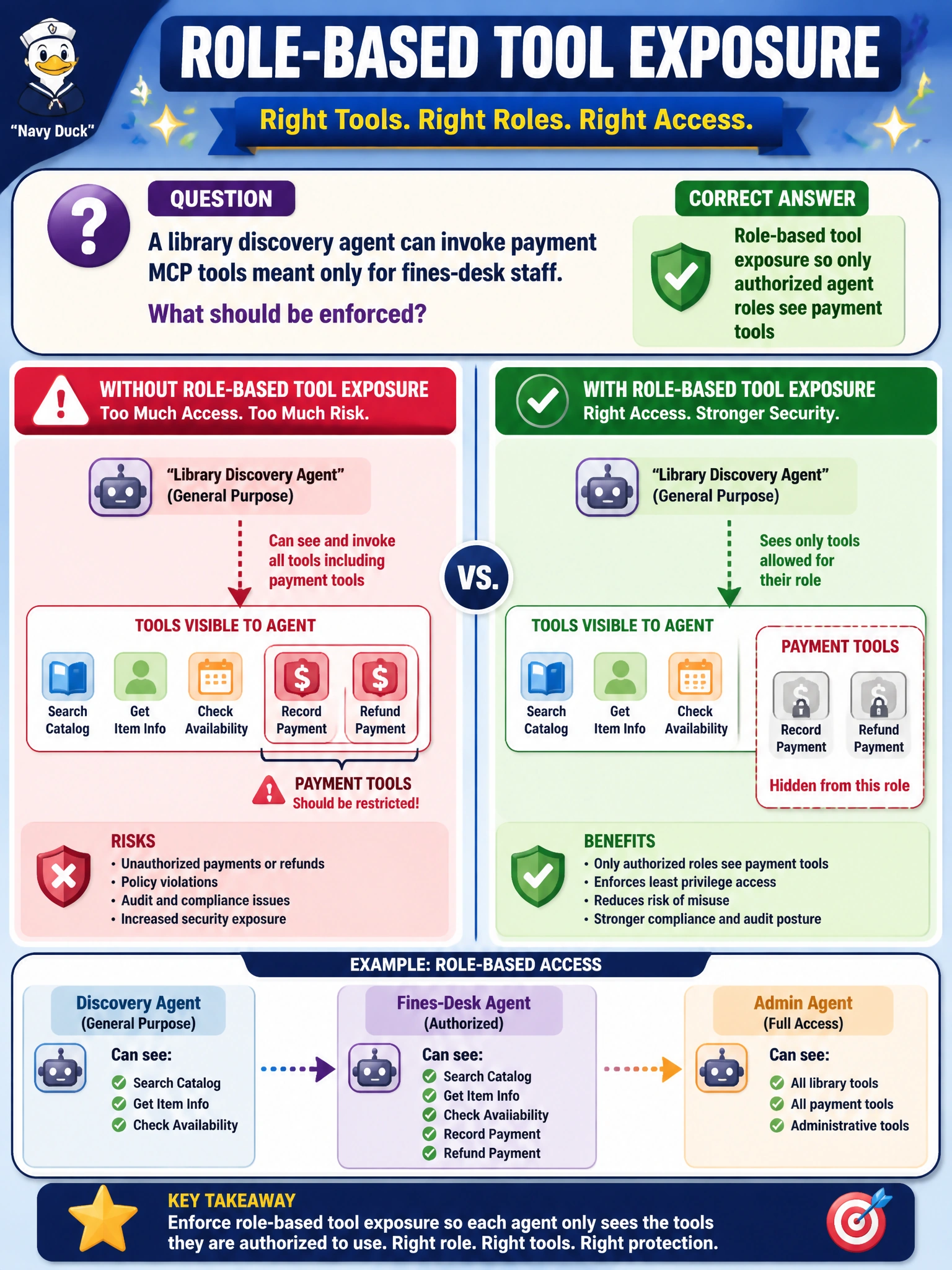
A library discovery agent can invoke payment MCP tools meant only for fines-desk staff. What should be enforced?
Select an answer to reveal the explanation.
Short Explanation
The discovery bot helping patrons find books should not also swipe the fines till. Expose payment MCP tools only to agent roles that need them. Role-blind tool catalogs are how a search helper becomes a cashier.
Full Explanation
A library discovery agent that can invoke payment MCP tools meant only for fines-desk staff violates role separation between patron discovery and financial operations. Security should enforce role-based tool exposure so only authorized agent roles see payment tools. In municipal library systems, discovery bots help patrons find materials; payment and refund tools belong to staff-facing or explicitly authorized financial agent roles with stronger controls and audit expectations.
Sharing the fines payment OAuth client with every public Wi-Fi portal fails by concept: it distributes payment credentials into untrusted public network surfaces. Letting discovery agents mint refunds to speed patron satisfaction surveys mixes customer-service metrics with financial authority and expands fraud and error risk. Documenting payment tool URLs on the library’s public GitHub wiki advertises sensitive integration endpoints without providing authorization and may aid attackers mapping the fines stack.
Exam caveat: role-based tool exposure must be enforced in the runtime or gateway, not only described in prompts—otherwise a discovery agent that “decides” it needs refunds may still call them if the tools remain reachable. Operational check: authenticate as the discovery agent role and confirm payment MCP tools are absent or denied; authenticate as fines-desk agent role and confirm payment tools appear; review gateway logs for discovery-role attempts to call refund or settle endpoints.