
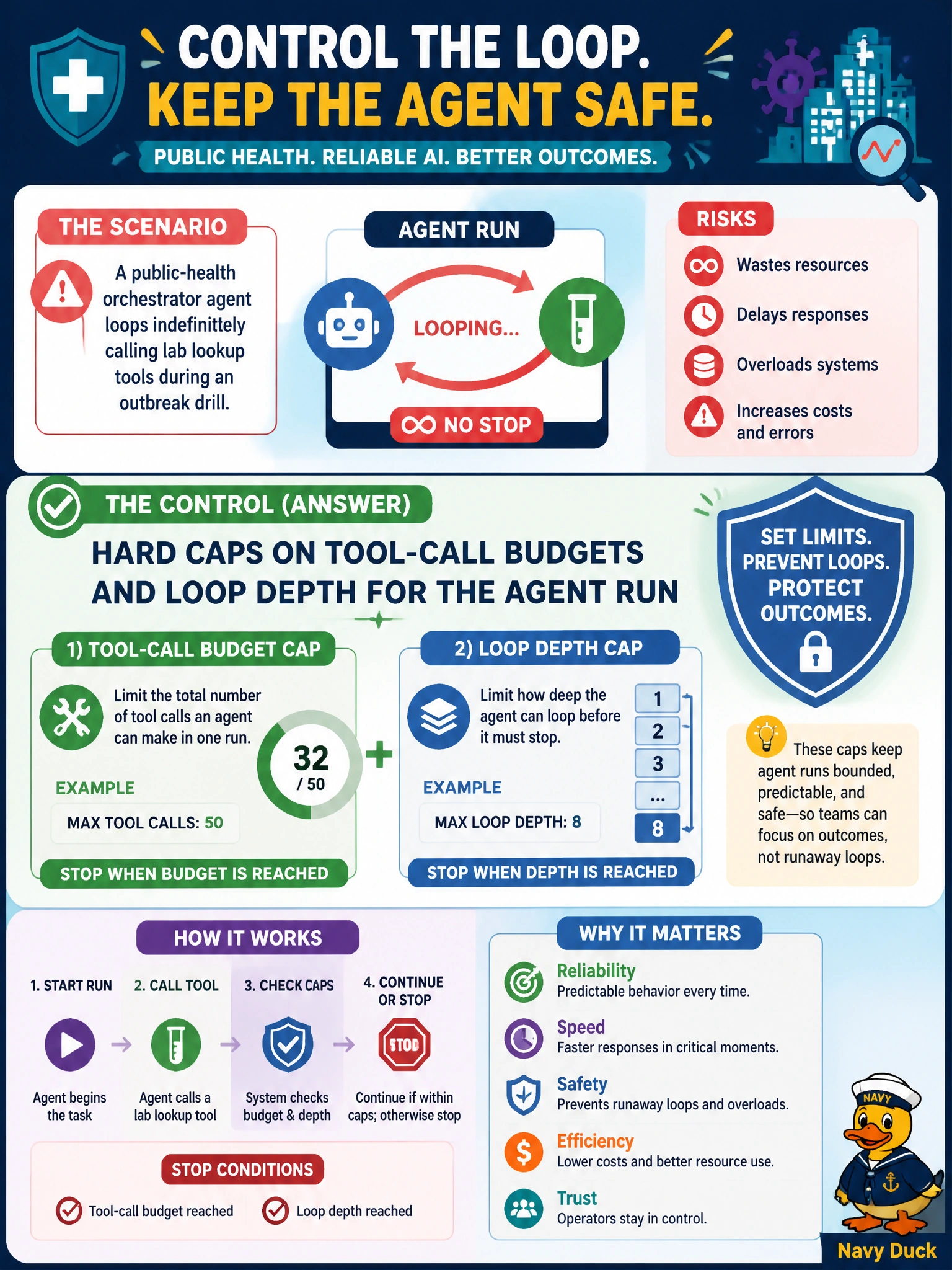
A public-health orchestrator agent loops indefinitely calling lab lookup tools during an outbreak drill. What control should operators add?
Select an answer to reveal the explanation.
Short Explanation
An agent that never stops calling the lab API is a runaway phone tree on city infrastructure. Put a hard ceiling on tool calls and loop depth so drills cannot melt the stack. Infinite loops are not thoroughness — they are an outage waiting to happen.
Full Explanation
A public-health orchestrator that loops indefinitely calling lab lookup tools during an outbreak drill can exhaust lab APIs, burn budget, and degrade civic response systems. Operators should add hard caps on tool-call budgets and loop depth for the agent run so runaway planning cannot create unbounded load. In municipal outbreak operations, those limits protect shared lab information systems and keep drill traffic from becoming a self-inflicted denial of service.
Removing all rate limits so the agent can finish faster fails by concept: it amplifies the runaway loop instead of containing it. Granting the agent root on the lab information system expands privilege far beyond lookup need and worsens impact if the looping agent issues destructive or bulk calls. Disabling audit logs for drill traffic to save storage removes forensic visibility into the loop and violates operational accountability for public-health tooling.
Exam caveat: tool-call budgets and loop-depth caps stop unbounded recursion; they do not by themselves ensure correct clinical logic—operators still need circuit breakers, human escalation for stalled drills, and monitoring when caps are hit. Operational check: configure maximum tool invocations and planner iterations per outbreak-drill run, alert when the orchestrator approaches the ceiling, verify the agent terminates cleanly with a visible budget-exceeded status, and confirm lab API metrics stay within agreed drill thresholds.