
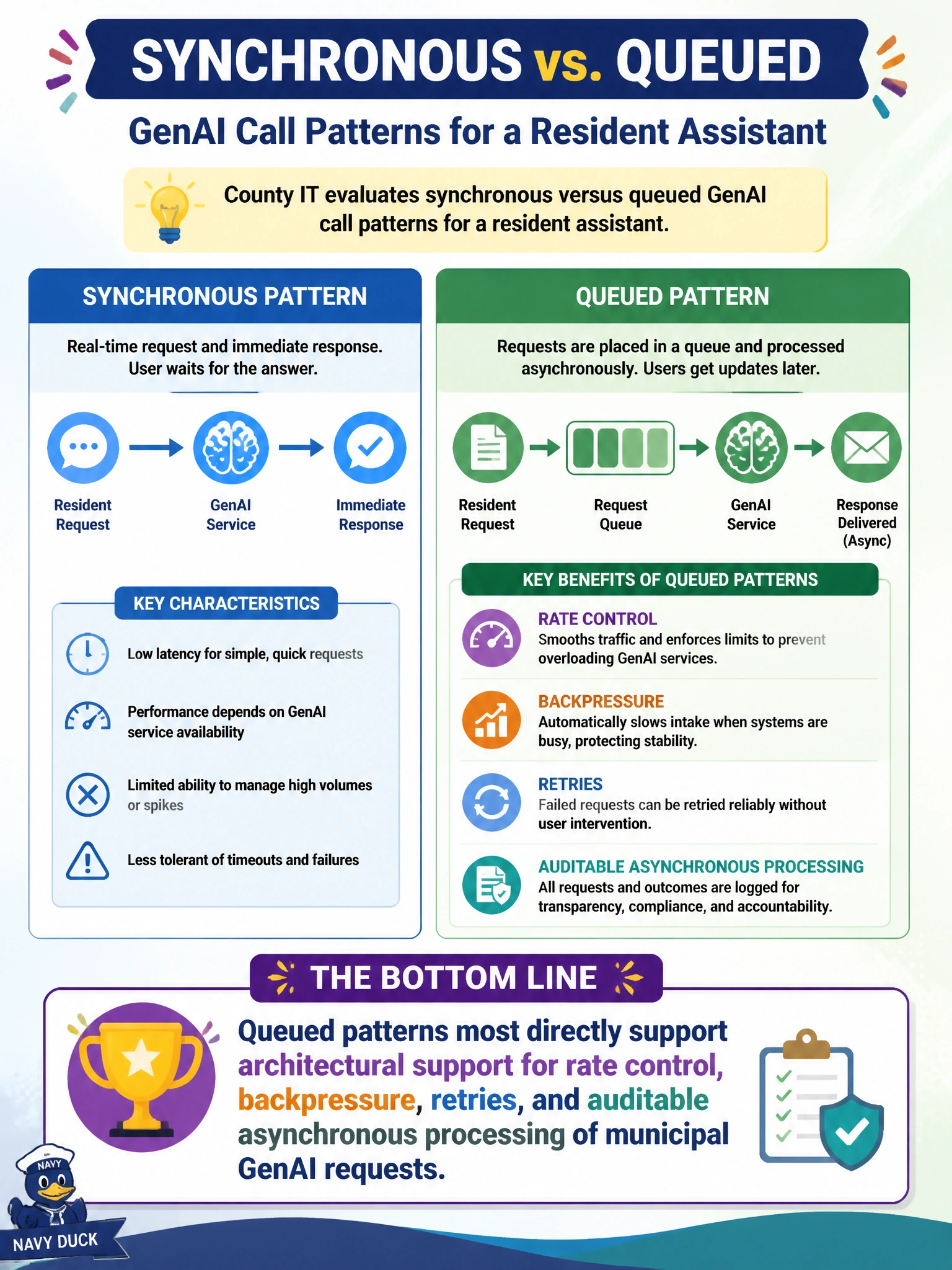
County IT evaluates synchronous versus queued GenAI call patterns for a resident assistant. Which benefit do queued patterns most directly support?
Select an answer to reveal the explanation.
Short Explanation
A queue is a ticket window with a line — you can throttle, retry, and stamp each request for the audit log. Sync firehoses are harder to rate-limit when residents all ask at once. Queues help control and accountability; they do not forgive skipped auth or policy.
Full Explanation
Queued GenAI call patterns give county platforms architectural support for rate control, backpressure, retries, and auditable asynchronous processing of municipal resident-assistant requests. Unlike pure synchronous firehoses, queues help absorb bursts, smooth provider rate limits, and retain clearer job-level audit trails for who submitted what and when under civic load. That operational and control benefit is the primary reason to evaluate queued designs alongside synchronous ones.
Removing the need to authenticate queued jobs is incorrect—queued workers must still authenticate callers and authorize job payloads before invoking models or tools. Guaranteeing that every queued prompt receives a perfect factual answer confuses architecture with model correctness; queues do not ensure factuality. Allowing the model to skip policy checks while waiting in queue is a control failure; policy must apply when the job executes, not be waived merely because work is asynchronous.
Exam caveat: queues improve control and resilience but add complexity such as poison messages, idempotency, and PII sitting in brokers—design those risks explicitly for municipal data. Operational check: place resident-assistant GenAI work on an authenticated queue with rate limits and retries, log job lifecycle for audit, apply policy checks inside workers, and load-test backpressure during bursty civic events.