
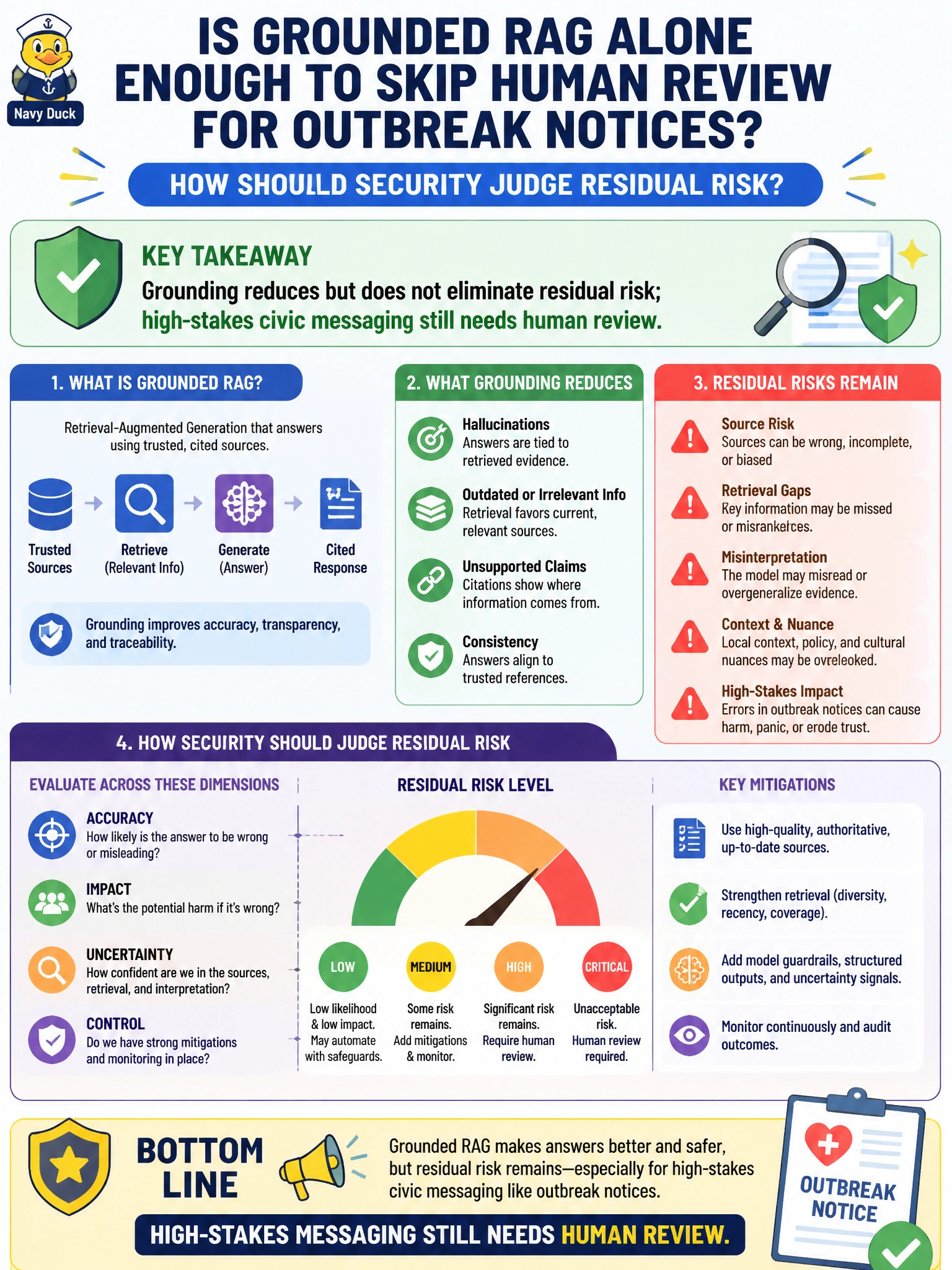
Public-health leaders ask whether grounded RAG alone is enough to skip human review for outbreak notices. How should security judge residual risk?
Select an answer to reveal the explanation.
Short Explanation
Grounding is a seatbelt, not a chauffeur. For outbreak notices that can empty clinics or spark panic, keep a human in the loop—RAG still can retrieve the wrong scrap or stitch it badly.
Full Explanation
Grounding reduces but does not eliminate residual risk; high-stakes civic messaging still needs human review. Public-health outbreak notices can empty clinics, redirect care, or spark panic if wrong. Even well-cited RAG can retrieve an outdated bulletin, mis-rank a conflicting source, or stitch correct scraps into a misleading composite. Grounding and citations lower hallucination rate; they do not create a human-free publish path for outbreak communications.
Claiming grounded RAG eliminates all hallucination so human review is never needed fails by concept: residual retrieval and synthesis errors remain. Treating outbreak notices as low-stakes once citations appear fails given clear public-health impact. Declaring human review obsolete wherever a vector database is present fails; a vector DB is infrastructure, not an authority to speak for the health department without oversight.
Exam caveat: Match human review to stakes. For emergency and outbreak civic messaging, keep a human in the loop despite grounding.
Operational check: Require named human approval before outbreak notice publish, show citations and source versions to reviewers, tabletop a wrong-retrieval scenario, and document residual risk acceptance with public-health leadership.