
Emergency management RAG pulls live weather APIs through a mirrored cache that an attacker has poisoned. What trust-boundary issue should security highlight?
Select an answer to reveal the explanation.
Short Explanation
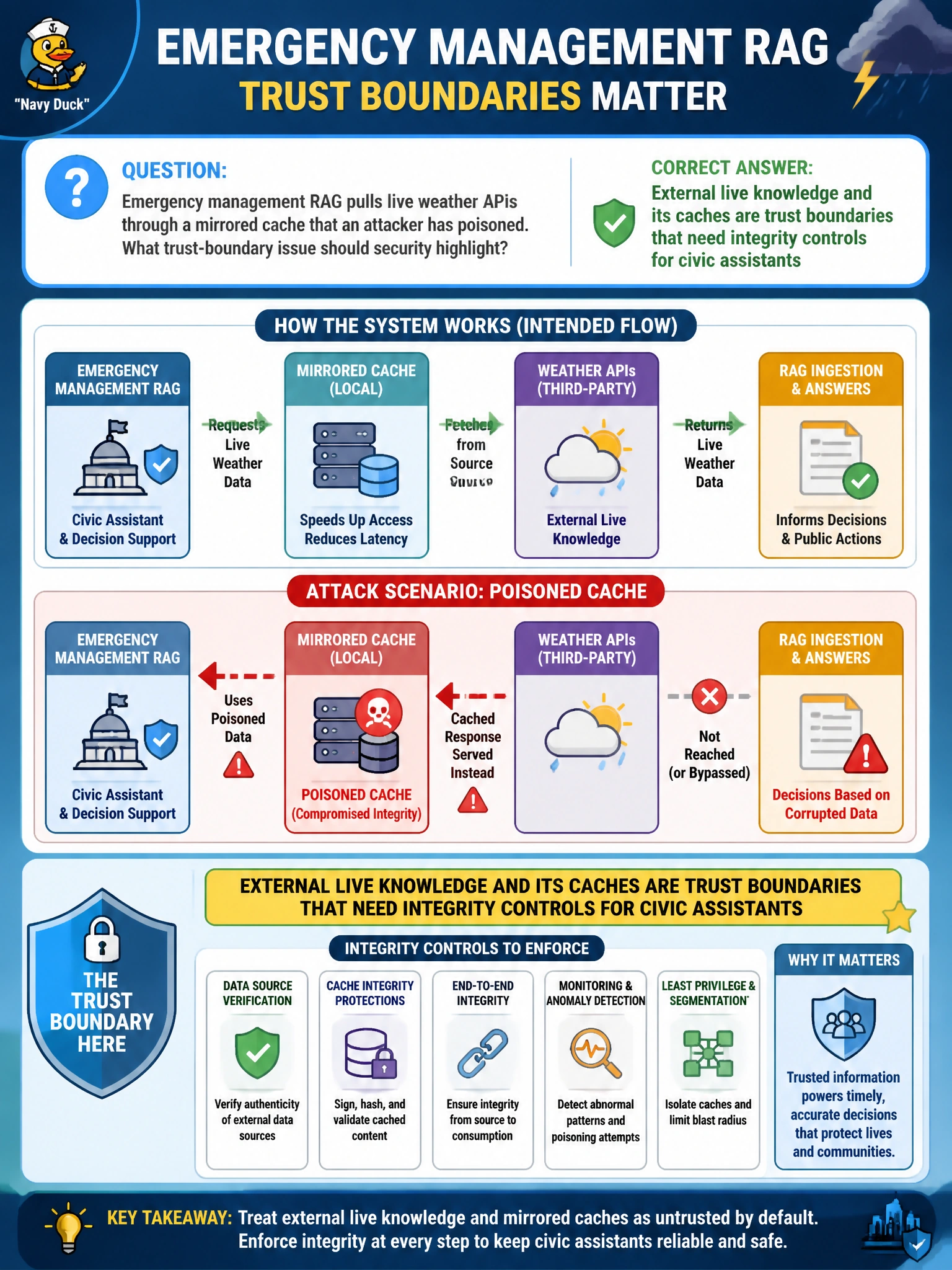
That weather mirror is on the critical path for evacuation wording. If someone tampers with the cache, the bot repeats the lie. Treat live external knowledge—and every cache in front of it—as a trust boundary.
Full Explanation
External live knowledge and its caches are trust boundaries that need integrity controls for civic assistants. Emergency-management RAG that pulls weather through a mirrored cache will treat poisoned cache contents as ground truth for evacuation and shelter wording. Attackers who tamper with the mirror can induce harmful public guidance without touching model weights. Authenticate upstream providers, integrity-check payloads, monitor cache freshness and signatures, and fail safe when integrity cannot be verified.
Claiming live weather data cannot affect GenAI outputs by design fails by concept: RAG exists precisely so retrieved live facts shape outputs. Asserting mirrored caches eliminate the need to authenticate upstream providers fails because mirrors concentrate trust and are high-value tamper targets. Saying only fine-tuned weights—not retrieved weather—require integrity protection fails by ignoring that retrieved civic knowledge drives decisions as much as weights do.
Exam caveat: For emergency and transit assistants, treat every hop from provider to cache to retrieve as a trust boundary. Integrity failures in live knowledge equal integrity failures in the answer.
Operational check: Verify TLS and provider authentication to the weather API, add checksum or signed snapshot validation on the mirror, simulate cache poison with a marked false alert and confirm detection or refusal, and document fail-closed behavior for emergency prompts when integrity checks fail.