
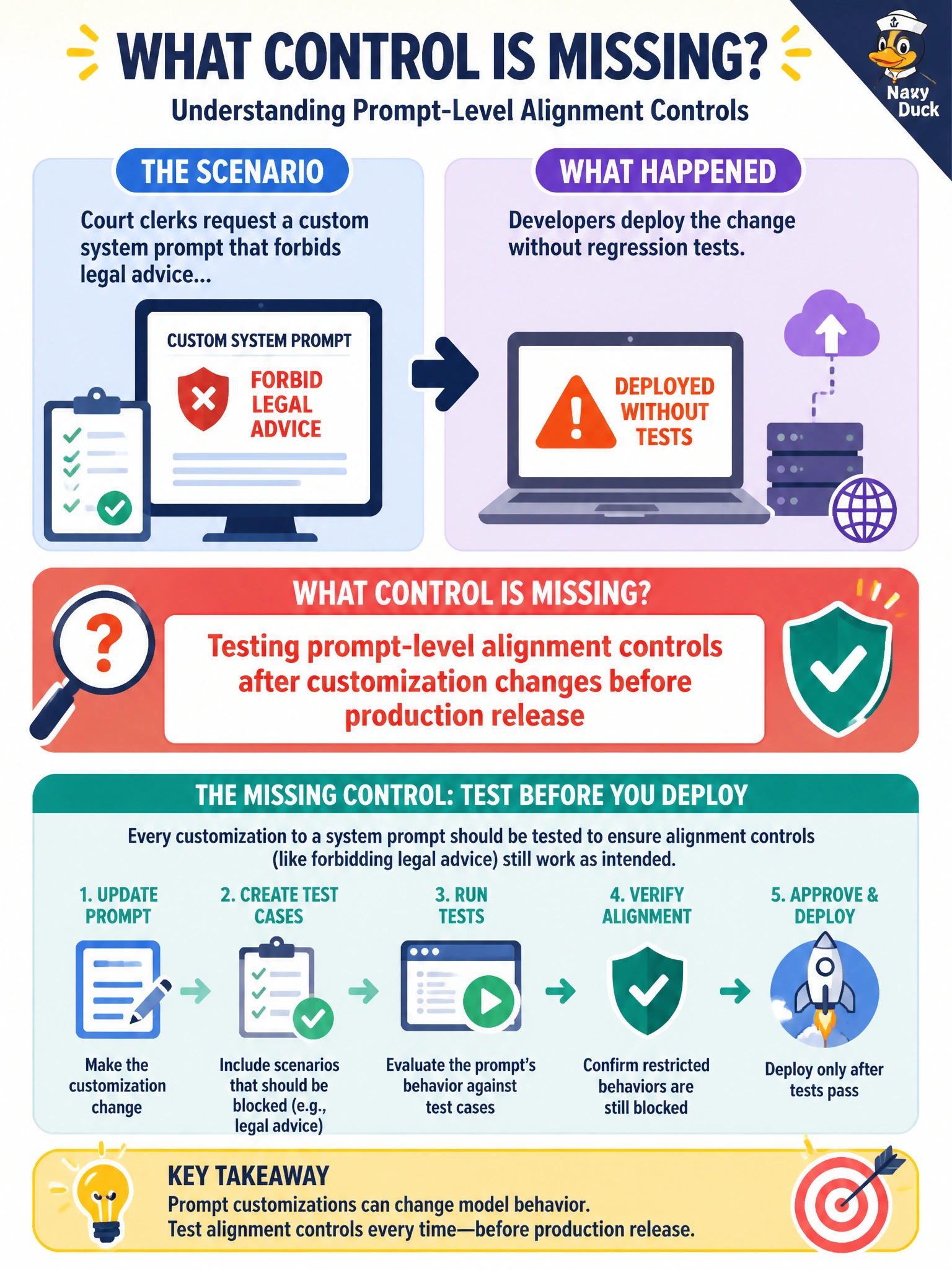
Court clerks request a custom system prompt that forbids legal advice, but developers deploy the change without regression tests. What control is missing?
Select an answer to reveal the explanation.
Short Explanation
You need to test the new “no legal advice” prompt before release; otherwise, its refusal behavior is unverified. Treat prompt changes like any other change: run regression tests before deploying them.
Full Explanation
A custom system prompt forbidding legal advice is an alignment control at the prompt layer. Deploying it without regression tests leaves the summarizer’s behavior unverified: the prompt may be ignored under long context, jailbreaks, or conflicting user instructions, or it may over-refuse legitimate clerical summarization. The missing control is testing prompt-level alignment controls after customization changes and before production release. Replacing the prompt with a public GitHub gist would invite tampering and remove change control; it would not provide a safe, verified update process. Removing all refusals would increase the risk of legal advice and overreach rather than enforce the clerks’ requirement. Moving the court summarizer to a hosted model would change deployment architecture, not validate whether the customized prompt works. Exam caveat: System prompts are necessary but not sufficient alignment controls; evaluate them like any other customization, and distinguish prompt testing from hosting choices. Practical check: Maintain a court-specific regression pack with requests for legal advice, docket-excerpt summaries, and attempts to override the system prompt. Run it after every prompt or model change, compare refusal and helpfulness rates with a baseline, and require review by court operations and security before release. Version the prompt text alongside model IDs in the release record.