
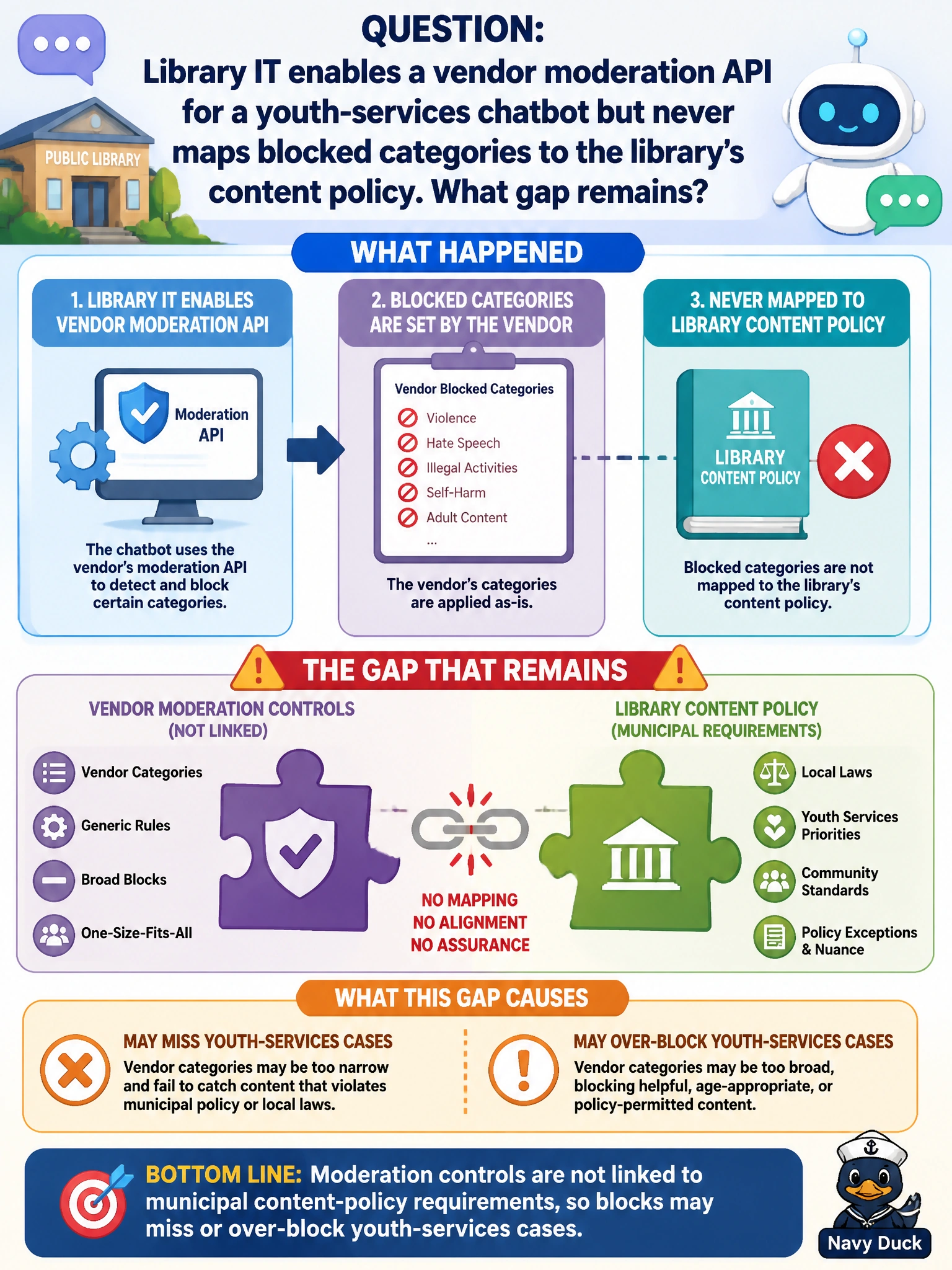
Library IT enables a vendor moderation API for a youth-services chatbot but never maps blocked categories to the library's content policy. What gap remains?
Select an answer to reveal the explanation.
Short Explanation
Flipping on a vendor moderation switch without mapping it to library rules is like installing a lockset without checking which doors the board wants locked. Categories must match the municipal content policy, not just the vendor defaults.
Full Explanation
Enabling a vendor moderation API for a library youth-services chatbot without mapping blocked categories to the library's content policy leaves moderation unbound from municipal requirements. Vendor taxonomies are generic; libraries have specific collection, age-appropriateness, and intellectual-freedom policies. Without an explicit mapping and acceptance test, blocks may miss prohibited harmful content or over-block legitimate youth-services inquiries, producing both safety gaps and service denial for residents.
Vendor APIs do not invent library board policy from MARC catalog records—that is fantasy automation. TLS on the chat endpoint protects transport confidentiality and integrity; it does not substitute for content-policy alignment of moderation categories. Youth-services chatbots are not exempt from content moderation under GAIPS-style civic GenAI objectives; if anything, youth contexts demand clearer policy linkage and review.
Exam caveat: Turning on a third-party safety product is not the same as implementing organizational policy. Candidates often pick "encryption is enough" or "vendor defaults equal policy." The stem's gap is governance linkage between moderation controls and municipal content-policy requirements.
Operational check: Produce a category-to-policy matrix approved by library leadership, configure the vendor API or gateway accordingly, and test representative youth-services prompts that should allow, soft-block, or hard-block. Log moderation decisions with policy IDs, review false positives with youth-services librarians, and revisit mappings when board policy changes—not only when the vendor adds categories.