
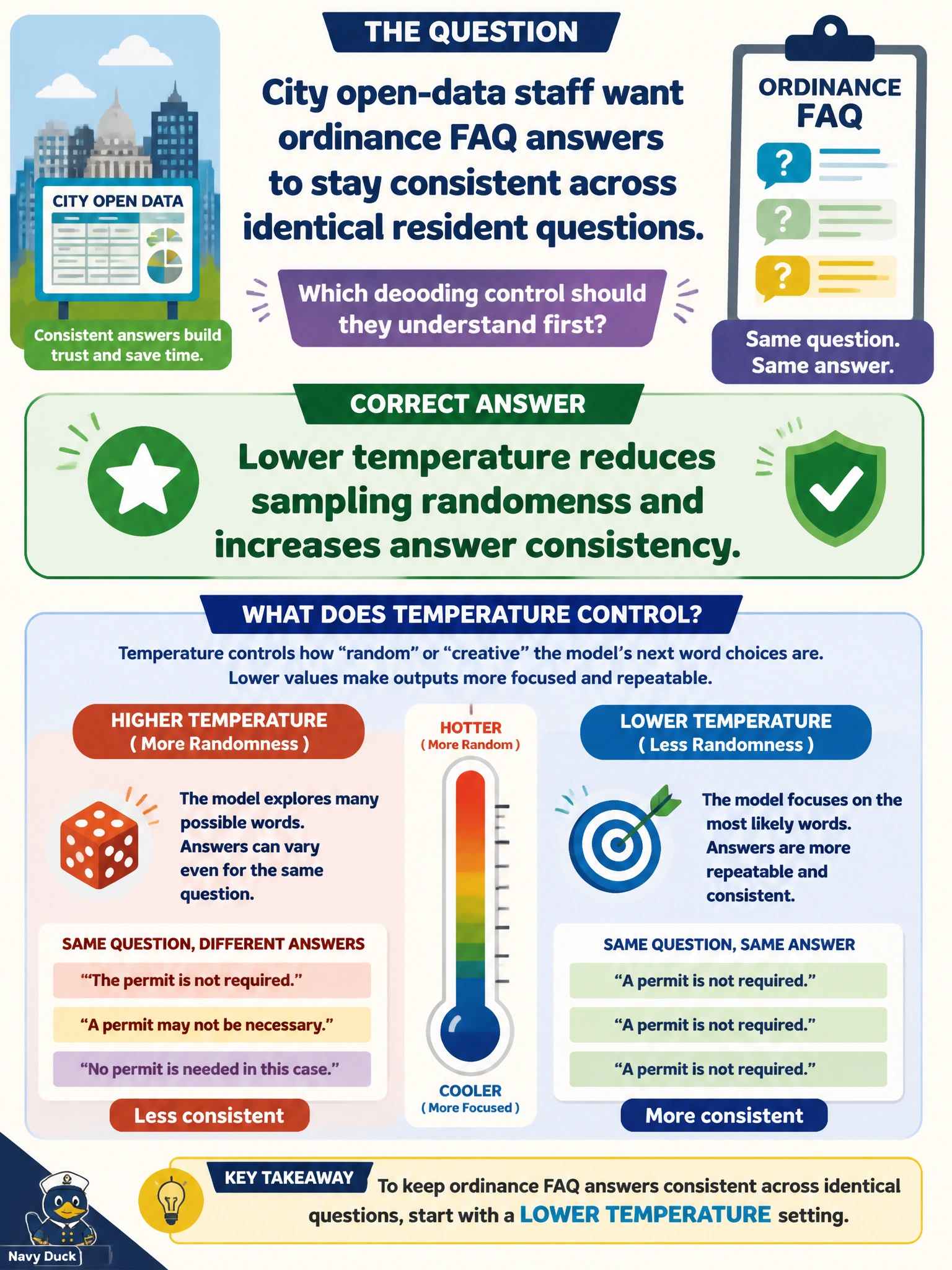
City open-data staff want ordinance FAQ answers to stay consistent across identical resident questions. Which decoding control should they understand first?
Select an answer to reveal the explanation.
Short Explanation
Think of temperature as the model’s creativity dial: you can turn it up for brainstorming or down when residents should hear consistent ordinance FAQ wording. Consistency comes from sampling settings, not TLS versions or network packet size, so boring and repeatable often beats surprising.
Full Explanation
Sampling temperature influences how randomly the decoder selects among probable next tokens. Lower temperature generally reduces randomness and produces more stable, consistent completions for repeated ordinance FAQ questions—the goal when identical resident questions should receive consistent wording. Raising temperature does not always improve citation accuracy; greater randomness can increase drift and invention, harming consistent citation behavior. Disabling TLS 1.2 does not force deterministic wording because TLS policy is unrelated to token sampling. Increasing the inference subnet’s MTU may affect packet delivery, but it cannot control token selection or guarantee identical output from a stochastic decoder. Exam caveat: temperature zero or greedy decoding can improve consistency, but may not guarantee bit-identical output across versions, hardware, or batched inference. Consistency is also not correctness: stable wrong answers remain wrong, so grounding and retrieval still matter. Practical check: use lower temperature for ordinance FAQs, pin decoding parameters in configuration, regression-test identical prompts for wording drift, and log settings with answers for audit. Keep FAQ settings controlled rather than leaving them to ad hoc developer preference.