
Emergency management wants an LLM to draft after-action report narratives from unstructured field notes. What contrast with legacy NLP should security highlight when judging platform fit?
Select an answer to reveal the explanation.
Short Explanation
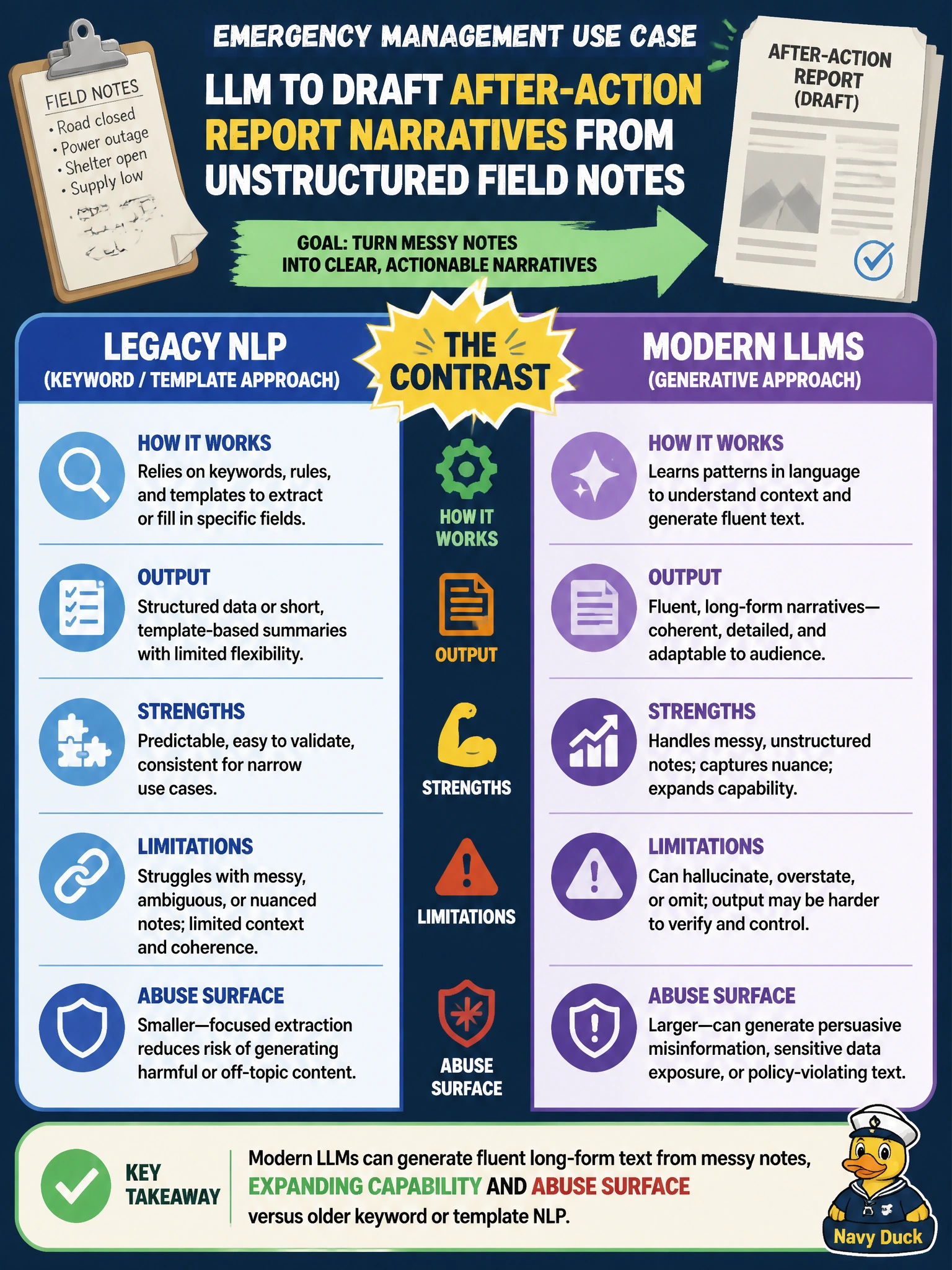
You can see the key difference: modern LLMs can turn messy field notes into fluent, long-form narratives, while older keyword or template NLP is more limited. That extra capability can help emergency management draft reports, but it also expands the abuse surface. Capability and risk travel together.
Full Explanation
Modern LLMs can draft fluent, long-form narratives from messy, unstructured field notes, unlike older keyword or template NLP, which is typically more limited. For emergency management after-action reports, this can speed drafting from chaotic inputs, but it also expands the abuse and integrity surface: fabricated details, omitted caveats, prompt injection in notes, and over-trust in polished prose. Platform fit therefore involves both whether a system can write and the new failure modes fluent generation brings. The claim that legacy NLP always needs GPU clusters while LLMs run only on CPUs invents an infrastructure distinction; both can have varied deployment footprints. LLMs do not inherently require notes to be converted into rigid legacy records before drafting: that confuses structured-input requirements with language-generation capability. The HTTPS/TLS claim also confuses application cryptography with model architecture; modern LLM APIs routinely use TLS. Exam caveat: greater capability is not automatically greater suitability; constrained templates may be safer where reports must not invent causal language, while human review can keep people accountable when LLMs assist. Practical check: ground claims in logged incidents, measure fabrication on messy notes, label AI-assisted drafts, and define which report sections require human authorship.