
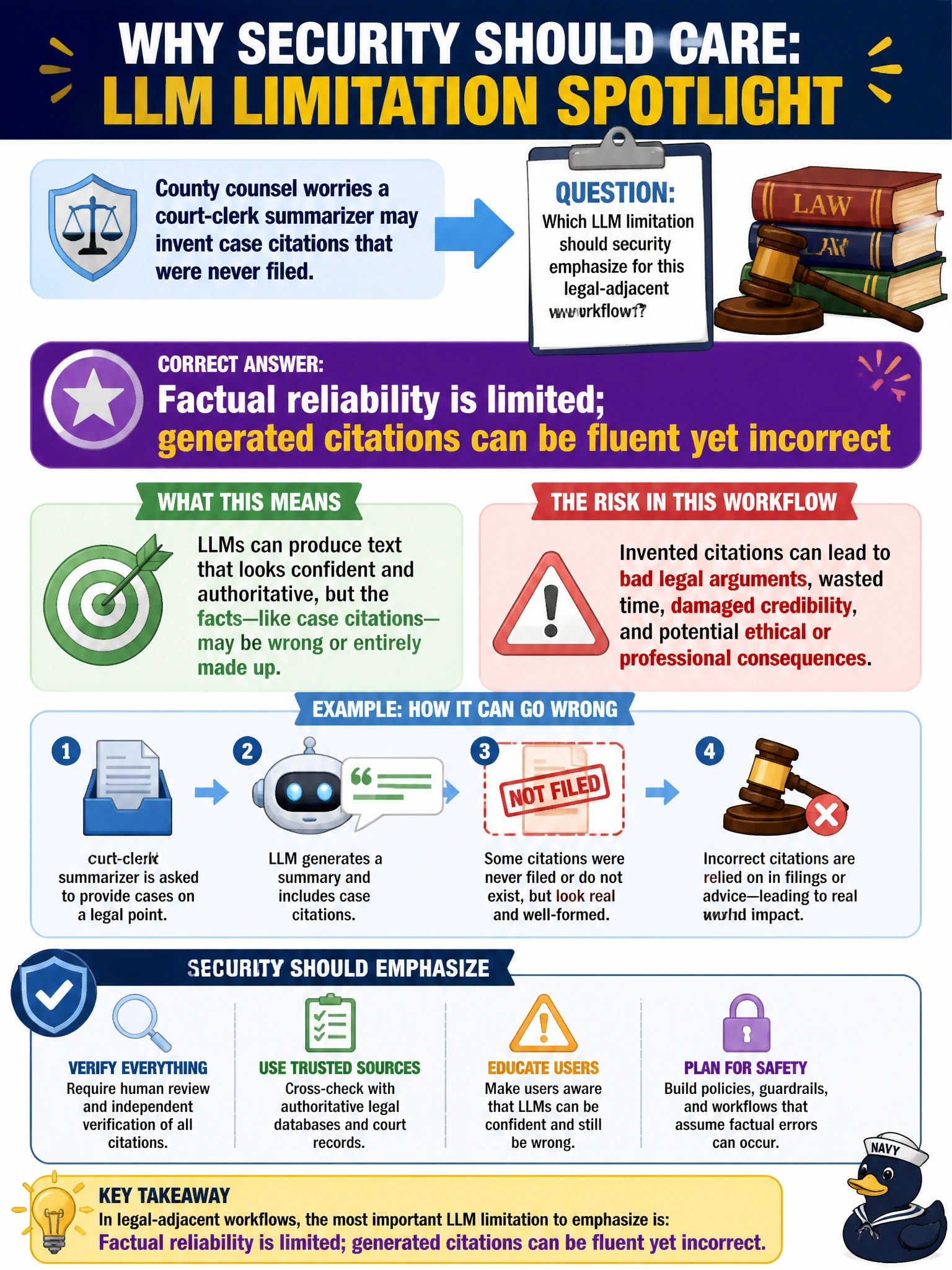
County counsel worries a court-clerk summarizer may invent case citations that were never filed. Which LLM limitation should security emphasize for this legal-adjacent workflow?
Select an answer to reveal the explanation.
Short Explanation
Think of the summarizer as a fast intern who can invent a convincing-looking citation that never hit the docket. Fluency is not the same as a verified source, so treat model output as draft text that still needs authoritative checking. You can protect clerk workflows by verifying citations against the record or an approved legal source.
Full Explanation
LLM factual reliability is limited: a model can produce fluent citations, docket numbers, and case names that look professionally correct but were never filed. In a court-clerk summarizer, invented citations can create integrity and due-process risks if legal-adjacent staff or the public treat generated references as real. Emphasize that fluency is not verification; legal citation workflows need grounding, human review, and systems of record, not confidence based on tone. The claim that LLMs cannot emit Unicode characters used in docket numbers is false; models can generate mixed alphanumeric and punctuation sequences. The claim that LLMs always refuse prompts mentioning a court case is also false: refusals depend on policy, and many models will discuss cases unless constrained. Dedicated hardware does not make citations accurate; where the clerk's office runs servers has no bearing on whether a generated citation is real. Exam caveat: grounded summarization of provided filings differs from open-ended citation generation. Rephrasing text present in source documents lowers the risk, while asking the model to find supporting cases raises hallucination risk; distinguish this from copyright or training-data concerns. Practical check: require retrieval from approved legal databases and human verification, flag identifiers absent from inputs, retain audit logs, and treat summaries as drafts until cite-checked. Define which tasks are assistive drafting versus authoritative legal research.