
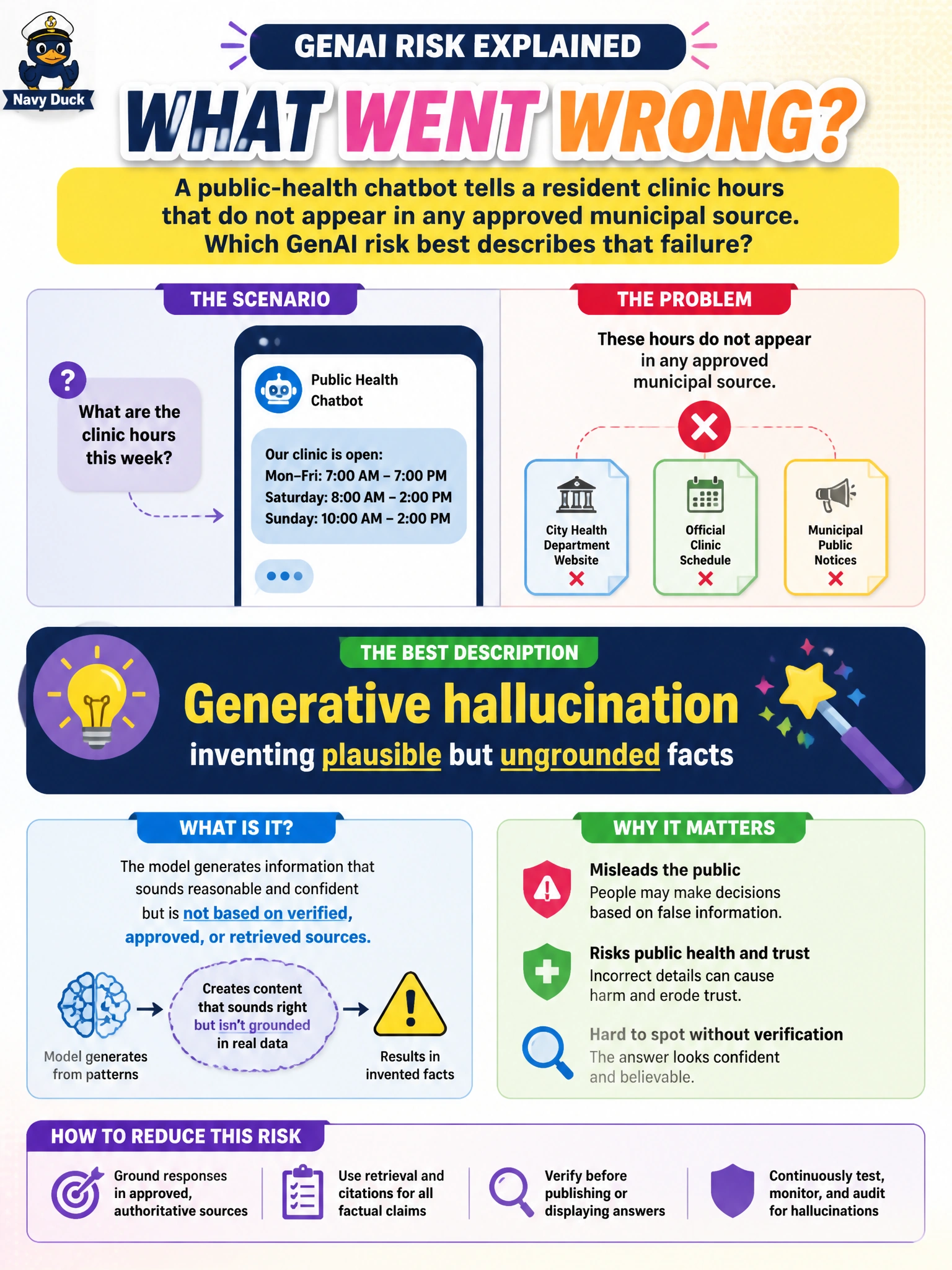
A public-health chatbot tells a resident clinic hours that do not appear in any approved municipal source. Which GenAI risk best describes that failure?
Select an answer to reveal the explanation.
Short Explanation
The bot is making clinic hours up out of thin air — like a helpful coworker inventing a schedule because it 'sounds right.' That is hallucination, not a broken TLS pin or a hijacked BGP route. Citizen-facing GenAI needs grounding and verification precisely because fluent wrong answers still look trustworthy.
Full Explanation
Generative hallucination is the emission of fluent, plausible statements that are not grounded in approved sources or retrieved evidence. A public-health chatbot that invents clinic hours invents operational facts residents will act on—arriving at closed doors or missing appointments. That is a GenAI integrity failure: the model completes a statistically likely sentence about hours without verifying against municipal knowledge bases, published schedules, or curated FAQ corpora.
Certificate pinning failure on the clinic website is a transport-trust issue that can enable man-in-the-middle risk for HTTPS clients; it does not cause the model to fabricate schedule text inside a chat response. Vector index shard corruption in a backup appliance is a storage/RAG integrity problem that might degrade retrieval, but the stem says the hours appear in no approved municipal source—classic ungrounded generation rather than a corrupted backup index. BGP route hijacking between the city and a CDN can divert or intercept traffic; it is a network routing threat, not the mechanism that invents clinic hours in generative output.
Exam caveat: hallucinated hours can coexist with a healthy RAG stack if retrieval is skipped, ranked poorly, or ignored by the generator. Do not assume "we have RAG" equals grounded answers. Conversely, retrieval of stale but real hours is a data-freshness problem, not hallucination—read the stem for whether the fact exists in approved sources at all.
Operational check: require grounded answers for time-sensitive civic facts; refuse or escalate when retrieval confidence is low; cite the municipal source in the UI; monitor for schedule-like claims without citations; and keep clinic hours in a structured system of record the assistant must query rather than invent. For public-health workloads, treat fabricated hours as a resident-safety defect, not a cosmetic quality issue.