
An organization is designing a graduated autonomy program for its fleet of 12 agents. They want a framework that progressively grants agents higher autonomy levels as trust is established. Which element is MOST essential to include in this program to prevent unsafe autonomy expansion?
Select an answer to reveal the explanation.
Short Explanation and Infographic
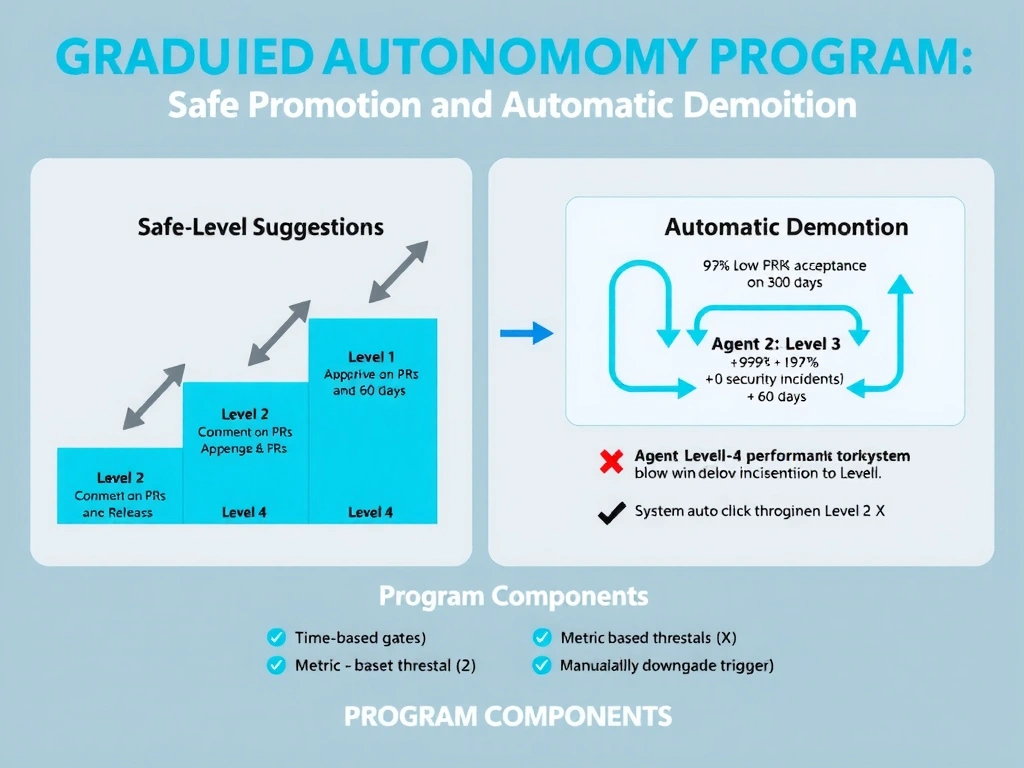
Graduated autonomy without a regression trigger is like a pilot getting promoted to captain and never being re-evaluated again. Performance can degrade — models change, codebases evolve, edge cases emerge. The promotion threshold ensures evidence drives the upgrade. The automatic downgrade trigger is equally critical: if an agent's performance falls below the safety floor after promotion, it reverts automatically rather than remaining at an inappropriate autonomy level while operators debate.
Full explanation below image
Full Explanation
A graduated autonomy program is only as safe as its guardrails against inappropriate promotion and its mechanisms for handling post-promotion performance degradation.
Option A (fixed timeline) is the most common mistake in autonomy programs. Ninety days of operation says nothing about the quality of that operation. An agent could operate for 90 days at poor quality without triggering a review if the only gate is time. Time-based advancement treats duration as a proxy for demonstrated trustworthiness.
Option B is correct because it implements the two critical controls: (1) Pre-advancement thresholds — measurable, specific performance criteria (e.g., '97% PR acceptance rate with zero security incidents over 60 days') that must be verified before promotion. These thresholds must be set based on the risks associated with the new autonomy level, not arbitrary numbers. (2) Automatic downgrade trigger — this is the element most often missing from autonomy programs. After promotion, performance monitoring continues. If the agent's performance drops below a minimum floor (which may be lower than the promotion threshold, acknowledging that advanced tasks are harder), the system automatically reverts the agent to the previous autonomy level without requiring a governance meeting or human decision. This ensures autonomy is continuously earned, not permanently conferred.
Option C (quarterly governance committee) creates a dangerous lag. If an agent at Level 3 begins producing unsafe outputs and the next governance meeting is 11 weeks away, the agent operates at an inappropriate level for nearly three months. Governance oversight is valuable but must be supplemented by automated monitoring and automatic reversion.
Option D (advancement per successful task) is too granular and creates a race-to-the-top dynamic. Individual task success does not measure sustained quality over time or across edge cases. An agent could succeed on 20 routine tasks and then fail catastrophically on the 21st rare case.