
An orchestrator fans out to 3 parallel agents to prepare a release: Agent 1 runs security scans, Agent 2 runs performance benchmarks, and Agent 3 generates release notes. Agent 1 and Agent 3 complete successfully. Agent 2 fails with an unrecoverable error after exhausting all retries. The release has a time-critical deadline. Which degraded coordination response BEST balances the deadline constraint with the governance requirement that releases must pass security and performance validation?
Select an answer to reveal the explanation.
Short Explanation and Infographic
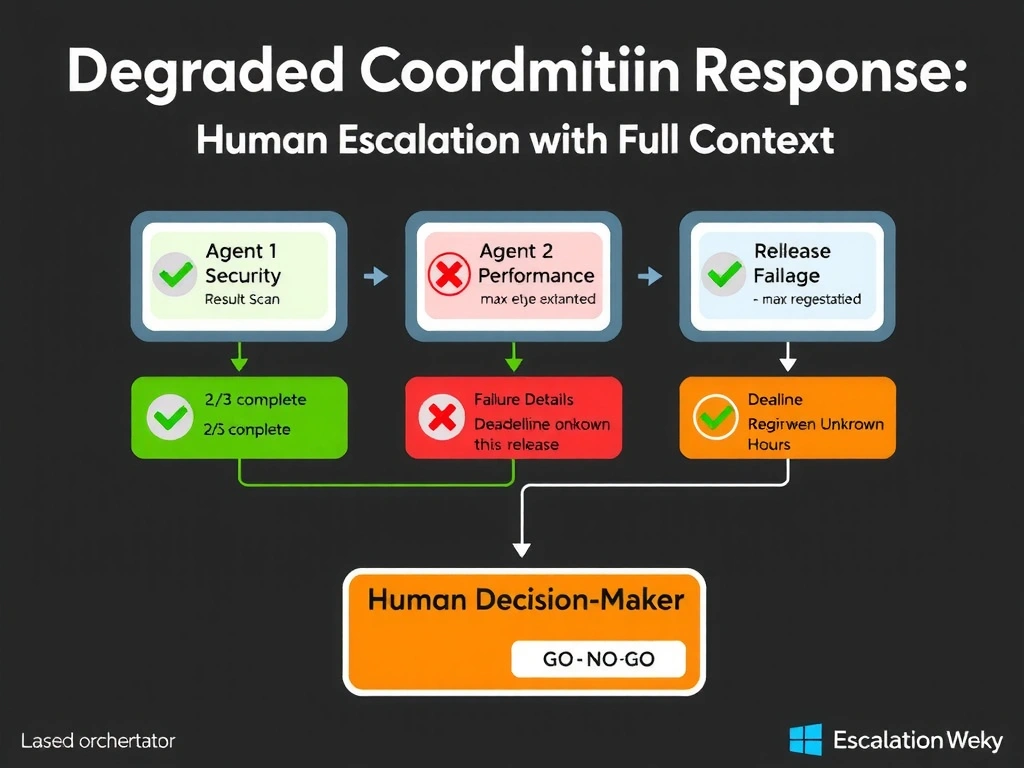
When an autonomous system hits a degraded state that involves a tradeoff between deadline risk and safety risk, the correct response is to stop deciding autonomously and escalate. Agents are good at executing within defined parameters; they're not good at judgment calls that involve business risk, regulatory exposure, and organizational context. That's what humans are for.
Full explanation below image
Full Explanation
Degraded coordination response requires a graduated decision framework: 1. Can the pipeline complete without the failed component? — Only if the failed component's output is not required for correctness (e.g., a non-mandatory enrichment step). Here, performance benchmarks are listed as a validation requirement, not optional. 2. Can a substitute be safely used? — Historical benchmark data (option D) is not a safe substitute because the release may include performance-impacting changes that only the current benchmark would reveal. Using stale data silently misrepresents the release's validated state. 3. Is the decision within the agent's authorization? — The decision to release without required validation data is a governance exception, not an operational decision. It involves risk acceptance that must be documented and authorized by a human.
The correct response is human-in-the-loop escalation with full context: - What succeeded (security scan passed, release notes ready) - What failed (performance benchmark — Agent 2 error details) - What the deadline pressure is and what delay a restart would cause - What the risk profile of proceeding without benchmarks is (based on what changed in this release)
This gives the human decision-maker everything needed to make a genuine risk-informed decision, with accountability for the choice.
Option A (fail immediately, full restart) ignores the successful work of Agents 1 and 3 and the deadline constraint. A governance-aware response preserves completed work and presents options, not binary pass/fail. Option B (proceed automatically without performance data) allows the agent to unilaterally waive a governance requirement — this is outside an agent's appropriate authorization scope. Option D (use historical benchmarks) is deceptive — it presents the release as benchmark-validated when it is not, creating false documentation in the audit trail and potentially masking a real performance regression.