
A developer is configuring an agent that needs to interact with four different systems: GitHub repositories, a Jira project management board, an internal knowledge base, and a Slack workspace. The developer is deciding whether to use a single multi-capability MCP server or multiple specialized MCP servers. Which approach is MOST appropriate for this architecture?
Select an answer to reveal the explanation.
Short Explanation and Infographic
One server for everything sounds simpler until GitHub's API changes and your Slack integration also goes down for maintenance. Specialized MCP servers are like dedicated power tools — the drill doesn't break when the saw blade needs replacing. Separate servers mean separate authentication domains, separate failure blast radii, and separate deployment cycles. When GitHub MCP gets an update, Jira MCP keeps running.
Full explanation below image
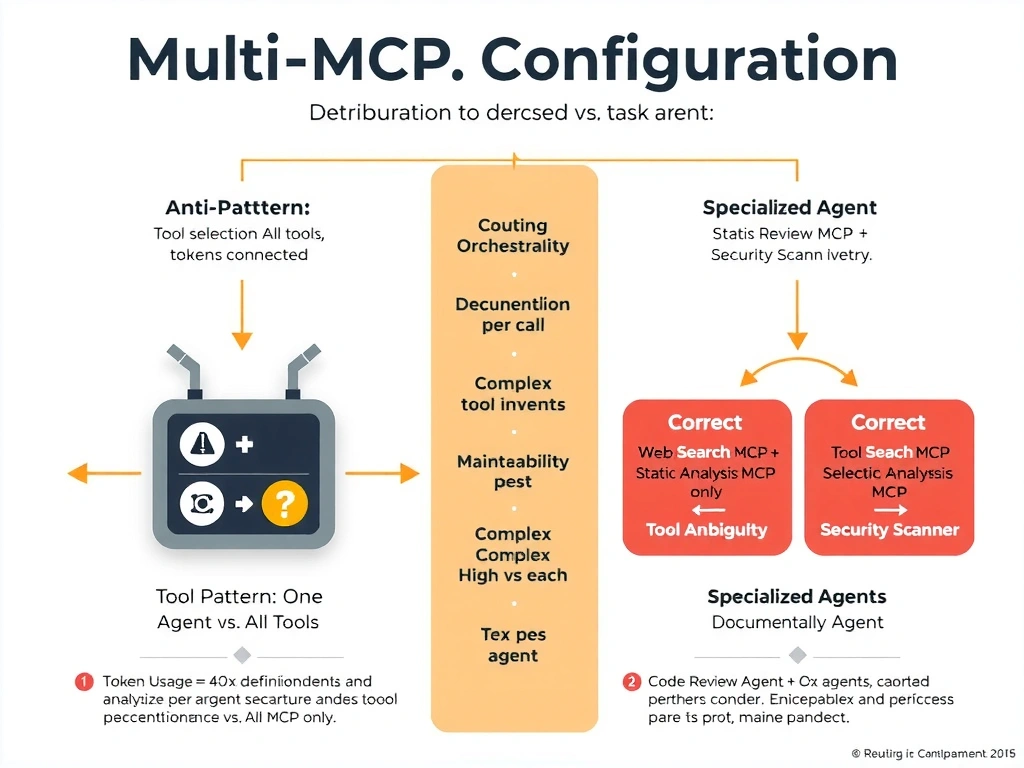
Full Explanation
MCP server architecture design follows the same single-responsibility principle that applies to microservices: one server per integration domain, each owning its authentication, tool surface, and failure behavior.
Option A (single unified MCP server) creates several problems: (1) Failure coupling — if the unified server crashes or needs maintenance, all four integrations go down simultaneously. (2) Authentication complexity — managing GitHub OAuth, Jira API tokens, knowledge base credentials, and Slack OAuth in a single server creates a complex, brittle authentication layer. (3) Deployment coupling — updating the GitHub integration requires redeploying the server that also handles Slack, creating unnecessary risk and coordination. (4) Tool namespace pollution — all four integrations' tools appear in a single namespace, which can cause tool selection confusion for the model.
Option B is correct because separation provides: (1) Failure isolation — GitHub MCP going down does not affect Jira MCP or Slack MCP. The agent degrades gracefully, losing GitHub capabilities while retaining the others. (2) Authentication encapsulation — each server owns its credentials and authentication flow. GitHub OAuth stays in the GitHub MCP server. (3) Independent deployment — each server can be updated, restarted, or scaled independently. (4) Clear tool namespacing — tools from each server are logically grouped, reducing ambiguity in tool selection. (5) Security isolation — if the GitHub MCP server is compromised, the attacker does not automatically gain access to Slack credentials.
Option C (grouped by trust boundary) is a partial improvement over a single server but still creates unnecessary coupling within groups. GitHub and Slack are very different systems that happen to both be external — grouping them provides no meaningful benefit while creating coupling between unrelated failure domains.
Option D (hardcoded functions in system prompt) is the least maintainable approach. Tool definitions in system prompts must be updated by modifying the agent configuration, require no versioning, and cannot be dynamically discovered or updated without redeploying the agent.