
An agent workflow has an escalation path that creates a GitHub Issue and assigns it to the on-call engineer when it encounters a problem it cannot resolve autonomously. After implementing this system, the team discovers that 23% of escalation issues are never acknowledged or closed — the on-call engineer receives no notification because the Issue assignment notification emails are going to spam. The unacknowledged issues accumulate while the agent continues creating new ones. Which design change MOST appropriately implements a dead-letter handler for this escalation pattern?
Select an answer to reveal the explanation.
Short Explanation and Infographic
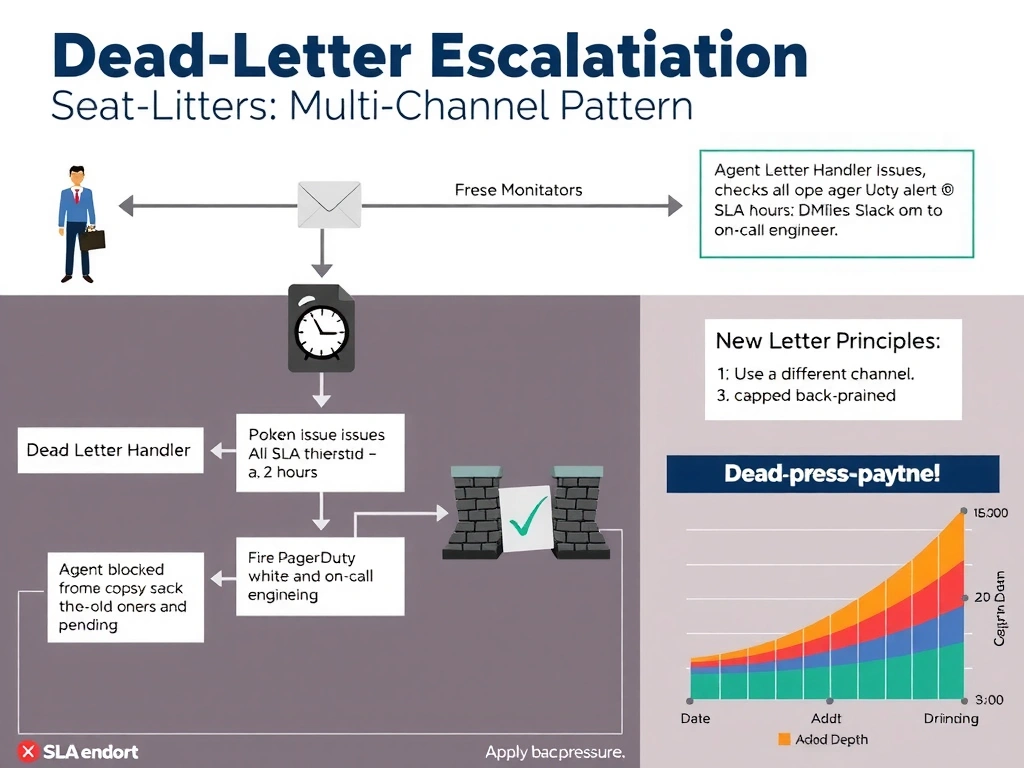
A dead letter queue in messaging systems handles messages that couldn't be processed — but the key is that it escalates through a different channel, not just repeating the same failed one. Email notifications going to spam is the primary channel failing. The dead-letter handler must use a secondary channel (Slack, PagerDuty) AND implement back-pressure — the agent shouldn't keep flooding the queue with new escalations when old ones aren't being processed.
Full explanation below image
Full Explanation
Dead-letter handling in agent systems addresses the scenario where an escalation path itself becomes unresponsive. The core problems here are two: (1) the primary notification channel is failing silently, and (2) the agent has no feedback that its escalations are going unresolved, so it continues generating more.
Option A (duplicate email notification) addresses the symptom (notification delivery) but uses the same channel that is already failing (email to spam). Adding a second email to a different address might work temporarily but does not address the architectural weakness: relying on a single notification channel type.
Option B is correct for three reasons. First, it implements SLA-based monitoring on the escalation queue itself — treating unresolved issues as a metric to be tracked, not just created. Second, it escalates through a secondary, higher-urgency channel (Slack DM or PagerDuty alert) when the primary channel (GitHub Issue + email) fails to produce acknowledgment. This is the key dead-letter pattern: when message processing fails in channel A, route to channel B. Third, the back-pressure mechanism — preventing new escalations from being created while prior ones are unresolved — prevents the escalation queue from becoming a graveyard that engineers stop paying attention to because it's overwhelming.
Option C (24-hour ping comment) adds noise to the same failing channel. If email notifications from Issue assignments go to spam, comments on those Issues will likely trigger the same email type and also go to spam.
Option D (configure spam settings) is an operational workaround, not an architectural solution. It requires someone to fix the problem, but provides no automated handling for future cases where the primary channel fails for different reasons.