
After a multi-agent pipeline run, an audit team requests the pipeline's audit artifact to reconstruct what happened. The artifact exists but is missing the worker agents' individual decision rationales, retaining only the final coordinator output. What critical information gap does this create?
Select an answer to reveal the explanation.
Short Explanation and Infographic
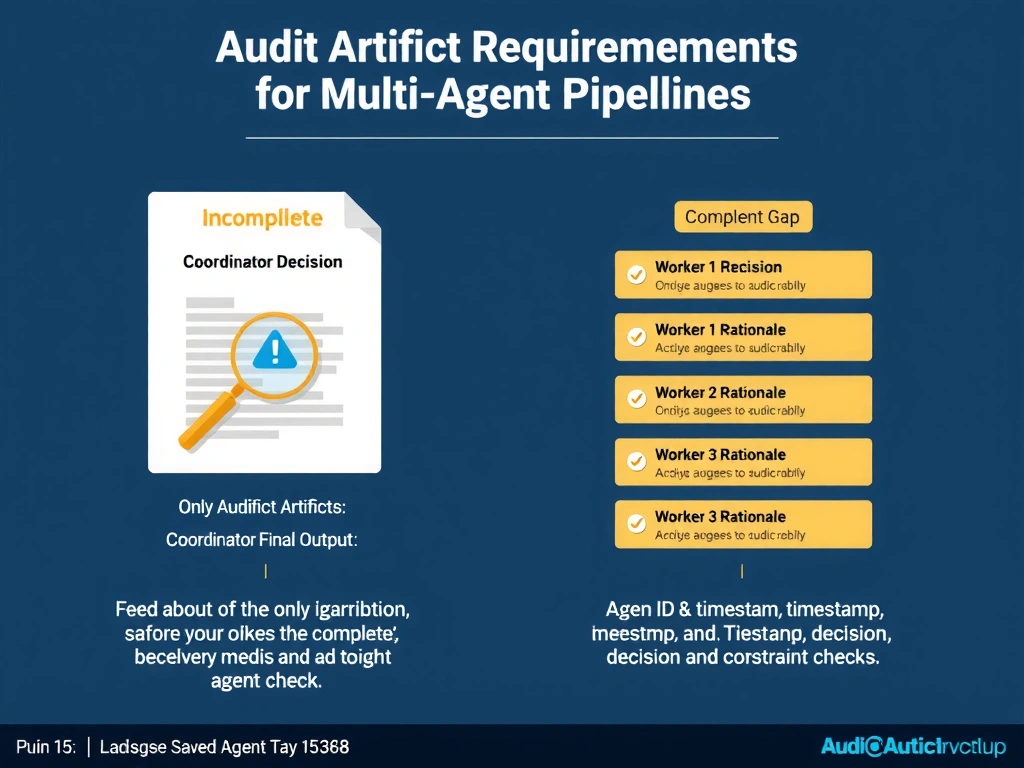
A police investigation needs witnesses' individual statements, not just the detective's summary — the summary can be wrong, and you need to be able to check how the conclusion was reached. On the exam: audit artifacts must include per-agent decision rationales and attribution to enable compliance verification and error attribution.
Full explanation below image
Full Explanation
The core purpose of a multi-agent audit artifact is to enable post-hoc reconstruction of the decision process — not just the final outcome, but how each agent arrived at its contribution. Without per-agent decision rationales, the audit team faces an accountability gap: they know what the coordinator decided, but they cannot trace why a specific intermediate decision was made, which agent made it, or whether each agent followed its defined constraints. This is critical for compliance audits, where regulators often need to verify that each processing step adhered to policy.
Option A (timestamps) is a real concern for SLA compliance auditing, but timestamps alone do not establish decision attribution. The question asks about the critical gap in terms of reconstructing what happened — and the inability to attribute decisions is the more fundamental gap than timing information.
Option C (input data) describes a reproducibility concern, not an audit gap. Audit artifacts serve primarily to explain what occurred, not to enable exact replay. Input data storage is a separate concern typically handled by data lineage systems, not the pipeline audit artifact itself.
Option D (token usage per agent) is an operational and cost concern, not an audit integrity concern. While cost attribution is useful for optimization, it does not affect the ability to verify compliance, attribute errors, or reconstruct decision logic — which are the core audit requirements.