
An autonomous deployment agent successfully rolls out a new microservice version across three environments. When the SRE team reviews the deployment afterward, they find no structured record of which container images were deployed, which Kubernetes namespaces were modified, what configuration values were applied, or what the pre-deployment and post-deployment states were. Which Domain 1 requirement does this agent design violate?
Select an answer to reveal the explanation.
Short Explanation and Infographic
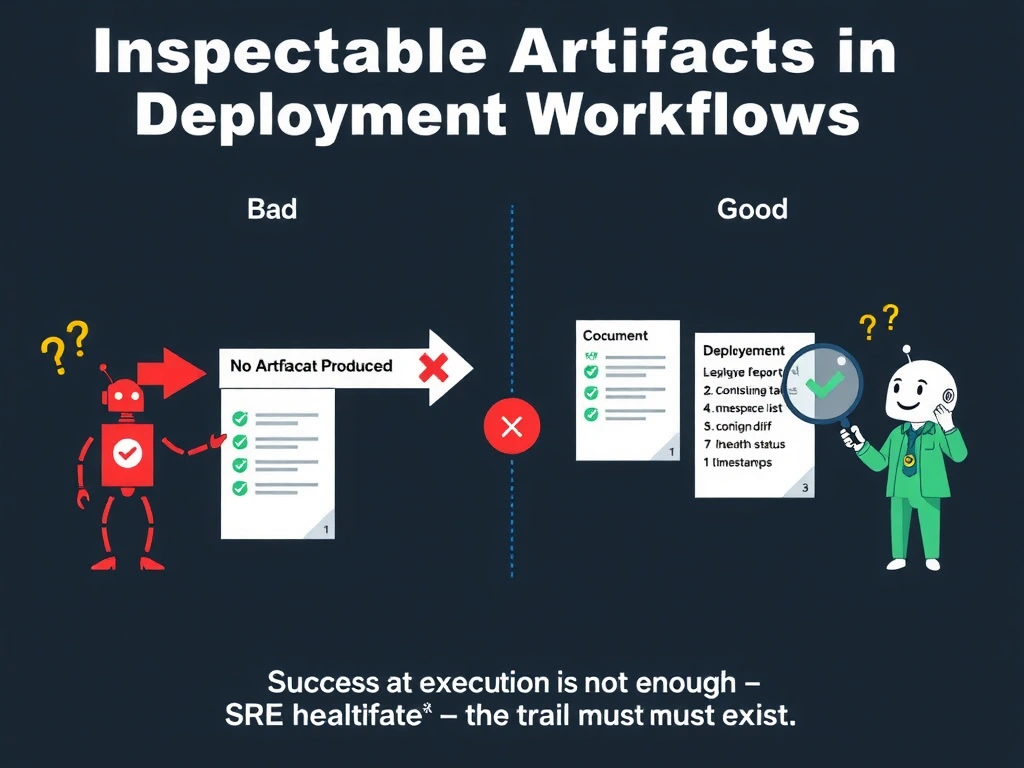
A pilot who completes a flight but produces no logbook entry leaves the next crew flying blind — inspectable artifacts are how agents leave a trail that humans can follow, audit, and learn from. On the GH-600 exam, 'produce inspectable artifacts' means agents must externalize their decisions and actions as structured records, not just succeed at the task. A successful deployment with no audit trail is still an architecture failure.
Full explanation below image
Full Explanation
Domain 1 requires that agents produce inspectable artifacts — structured, human-readable outputs that document what the agent decided, what actions it took, what resources it modified, and what the resulting state is. This requirement exists for several reasons: auditing and compliance, incident response, rollback planning, and accountability in multi-agent systems where downstream agents may need to consume the upstream agent's output as context.
In the scenario, the deployment agent succeeded operationally but produced nothing that the SRE team could review. If an incident occurs hours later — a service degradation, a configuration mismatch, an unexpected behavior — the team has no authoritative record to consult. They cannot determine what changed, in what order, or what the pre-change baseline was. This makes root-cause analysis significantly harder and incident recovery slower.
Inspectable artifacts for a deployment agent should include: the deployment manifest (what was deployed), the target inventory (which namespaces, clusters, environments), applied configuration values, pre-deployment and post-deployment health check results, any decisions made during the rollout (e.g., skipping a canary step because a health check passed), and timestamps for each action.
Why (b) is wrong: Success criteria are defined before the agent begins — they specify what 'done' looks like (e.g., all pods healthy, error rate below threshold). The scenario doesn't indicate these were missing; it indicates there's no post-execution record. These are different requirements.
Why (c) is wrong: Planning-execution separation concerns the sequencing of phases before action begins. There's no indication the agent conflated planning and execution — it may have planned correctly but simply failed to persist a record of its actions.
Why (d) is wrong: Human intervention configuration is about inserting approval gates before or during execution. While environment-boundary checkpoints are good practice, the scenario's specific failure is the absence of an artifact record, not the absence of approval gates.
Why (a) is correct: The absence of a structured record of decisions, actions, modified resources, and state transitions is precisely the 'produce inspectable artifacts' violation. Operational success does not satisfy this requirement.