
After an agent chooses a suboptimal solution to a coding problem, the engineering team reviews the traces. The logs show every tool call and its parameters in detail, but contain no record of the agent's reasoning process — why it chose one approach over alternatives it must have considered. What observability gap does this represent?
Select an answer to reveal the explanation.
Short Explanation and Infographic
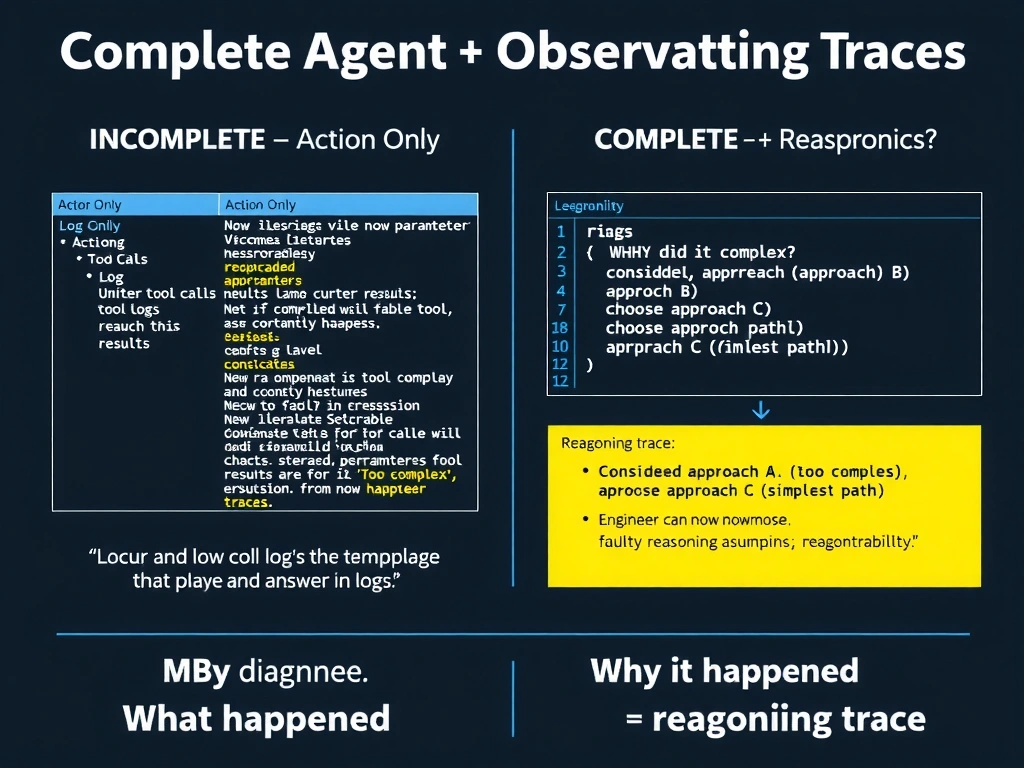
Recording every tool call without recording the reasoning is like logging a surgeon's every instrument move but never capturing their thought process — you can see what happened but not why. Reasoning traces (chain-of-thought, decision rationale) are the 'why' layer that makes post-incident analysis possible and enables targeted improvement.
Full explanation below image
Full Explanation
Complete agent observability has two distinct layers: (1) Action telemetry: what tools were called, with what parameters, at what time, returning what results — this is what the team's current logging captures; (2) Reasoning telemetry: why those tools were called — the agent's chain-of-thought, the alternatives it considered and rejected, the confidence signals that drove its decision. Without the reasoning layer, post-incident analysis can describe the sequence of events but cannot explain the root cause of a poor decision.
For agents that use models capable of chain-of-thought reasoning (CoT), the reasoning trace is typically available in the model's response before the final action or tool call. Capturing this trace — logged alongside the corresponding action — enables engineers to see 'the agent chose approach X because it estimated Y was simpler, but it was wrong about Z' rather than just 'the agent called tool X.'
Option A (list of available tools) is a configuration artifact useful for debugging tool availability issues, not for understanding why the agent made a specific decision. Knowing what tools were available does not explain which one was chosen.
Option C (model version) is important for reproducibility and regression testing but does not help explain the reasoning behind a specific decision in the current run. The same model version can make different decisions in different contexts.
Option D (format/parsing issue) would manifest as log parse errors or missing log entries, not as logs that are present but lack reasoning content. The scenario specifies that logs are present and contain tool details but are missing reasoning.
Reasoning traces alongside action telemetry are the complete observability picture for agentic systems.