
An agent consistently passes all automated test assertions — code compiles, unit tests pass, and no linting errors appear — but a post-deploy review team reports that the agent's pull requests are confusing, poorly documented, and violate team conventions. What is the most likely root cause of this discrepancy?
Select an answer to reveal the explanation.
Short Explanation and Infographic
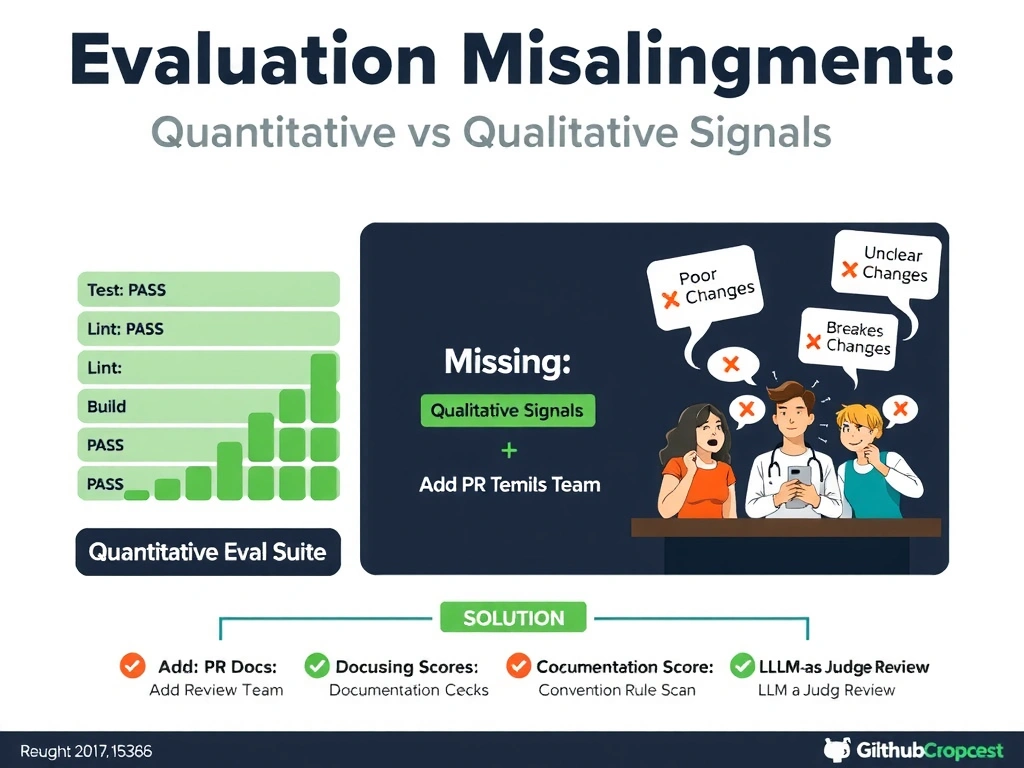
Think of it like a restaurant passing a health inspection (quantitative) but still getting bad Yelp reviews (qualitative) — passing the checklist does not mean customers are happy. Automated tests can only measure what they are written to measure. If your eval suite has no qualitative signals — readability rubrics, convention checklists, documentation quality scores — the agent will optimize for what it IS measured on and ignore what it is not. The exam wants you to recognize evaluation misalignment as a distinct failure mode.
Full explanation below image
Full Explanation
This question tests your ability to identify evaluation misalignment — a situation where the agent satisfies its formal evaluation criteria but fails to meet the actual intent of the task.
The correct answer is B. Automated evaluation suites excel at quantitative signals: does the code compile? Do tests pass? Are there linting violations? These are binary, easily measurable outcomes. However, pull request quality involves qualitative dimensions — clarity of commit messages, adequacy of inline documentation, adherence to team conventions like naming patterns or PR templates — that require rubrics, human review integration, or LLM-as-judge evaluation to capture. When these qualitative signals are absent from the evaluation pipeline, the agent has no feedback mechanism to improve on them.
Option A is incorrect. Compute resource constraints during CI would produce timeout errors or incomplete builds — observable failure signals — not consistently passing tests paired with qualitative deficiencies.
Option C is incorrect and overly broad. Replacing all automated testing with manual review eliminates the efficiency benefits of evaluation automation. The fix is to augment the automated suite with qualitative signals, not abandon automation entirely.
Option D is incorrect. Model retraining is an expensive, high-effort intervention and is not the appropriate first response to an evaluation design gap. Before concluding the model itself is deficient, you must first ensure the evaluation suite actually captures the desired behavior. This is a fundamental principle of evaluation-driven development: fix the eval before blaming the model.
The remediation here is to add qualitative evaluation signals — PR template adherence checks, documentation completeness scoring, convention rule scans — to the automated suite, and potentially integrate an LLM-as-judge step that reviews outputs for readability and team alignment.