
An agent that processes multi-step code review tasks is failing to resume correctly after an interruption — every time it restarts, it starts the entire review from the beginning instead of picking up where it left off. Which root cause is most likely responsible?
Select an answer to reveal the explanation.
Short Explanation and Infographic
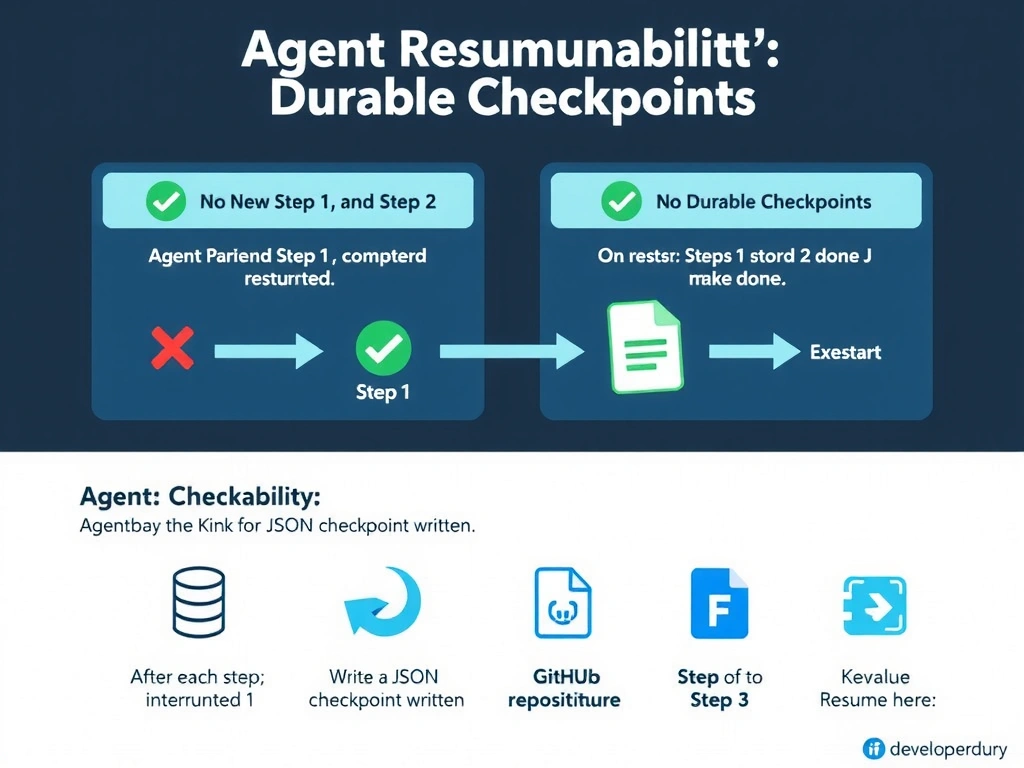
Think of durable checkpoints like a game save file — without them, you restart the whole level every time you die. An agent that restarts from the beginning is almost always missing step-level persistence. The fix is to write a checkpoint artifact (to a store, file, or database) after each completed step so the agent can read it on startup and skip already-finished work.
Full explanation below image
Full Explanation
When an agent restarts after an interruption and begins from scratch, the root cause is almost universally missing durable artifact writes. In-context memory — the conversation history held in the model's context window — is ephemeral by design. Once a session ends or the process is killed, that memory is gone. To support resumability, agents must write explicit checkpoint state to a durable store (a database, a file in a repository, a GitHub Gist, an external key-value store, etc.) after each meaningful step completes. On startup, the agent reads that checkpoint and determines which steps are already done.
Option A is incorrect: system prompt length affects instruction-following quality within a session, not cross-restart behavior. A long system prompt does not cause the agent to restart from the beginning after an interruption.
Option C is subtly wrong and a common distractor. Short-term in-context memory IS cleared between sessions — but it is NOT retained between restarts. The statement gets the direction backwards. In-context memory is exactly what disappears, which is why durable artifacts are necessary.
Option D is incorrect: GitHub Actions does support resumability patterns via artifact storage and caching. The issue is not a platform limitation — it is an application-level design gap where the developer has not implemented checkpoint writes. Runners are stateless by design, but that is a known constraint to design around, not a platform bug.
The correct fix (Option B) is to implement step-level checkpointing: after each review step completes, write the step name and any relevant output to a durable store. On restart, the agent loads that store, sees which steps are complete, and skips them. This pattern is sometimes called write-ahead logging for agents and is a foundational reliability technique for long-running agentic workflows.