
A cleanup agent is configured to remove unused GitHub Actions environments and their associated secrets as part of a repository maintenance task. The agent has determined that an environment named staging-legacy qualifies for deletion. Deleting this environment and its secrets is permanent — the secrets cannot be recovered after deletion. What guardrail MUST be in place before the agent executes this deletion?
Select an answer to reveal the explanation.
Short Explanation and Infographic
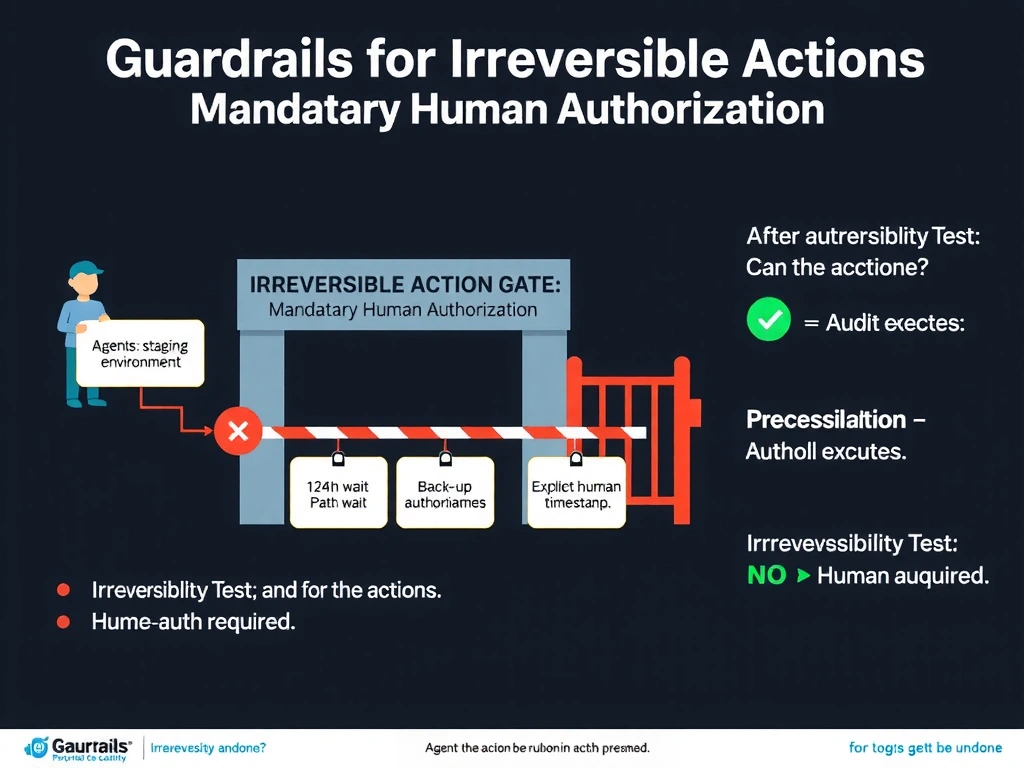
Irreversible actions demand irreversible authorization — meaning explicit, named, human approval, not a waiting period or a log entry. Once secrets are deleted, they're gone. The guardrail principle is simple: you don't cross a one-way door without someone accountable saying 'yes, go through that door.' Passive logging and time delays don't create accountability.
Full explanation below image
Full Explanation
The guardrail principle for irreversible agent actions is unambiguous: any action that cannot be undone requires explicit human authorization before execution, regardless of how confident the agent is in its decision. This is not a quality-of-evidence question — it is a categorical requirement based on the nature of the action.
Deletion of GitHub Actions environments and their secrets meets the criteria for mandatory human authorization: - Permanently destructive: Deleted secrets cannot be recovered. They are not moved to a trash bin or archived. - Broad impact: The deleted environment and secrets may be referenced by workflows, deployment processes, or other systems that the agent's analysis did not identify as dependent. - Agent analysis limitations: The agent identified the environment as 'unused' based on its analysis criteria, but that analysis may be incomplete. Human authorization ensures someone with full organizational context reviews the decision before it is irreversible.
The correct guardrail is a named human authorization: a specific person with appropriate authority reviews the proposed deletion, confirms it is correct, and explicitly approves it. The agent then executes only after this approval is confirmed.
Why the other options fail: - Option A (log for future audit) is a post-hoc record, not a pre-execution control. Auditing a deletion after it occurred does not restore the deleted secrets. Logging is a valuable complement to authorization, not a substitute for it. - Option C (24-hour wait) is a passive review window, not an authorization. A time delay allows for passive discovery of the pending deletion but does not require anyone to actively review and approve it. If no one notices within 24 hours, the deletion proceeds without any human decision. - Option D (back up names before deletion) preserves a record of what existed but does not constitute authorization. Knowing what was deleted does not help recover the secret values. Secret names are not secrets — the values are, and they are gone.
For irreversible, destructive actions, explicit named human authorization is the non-negotiable guardrail requirement.