
In a multi-agent pipeline, Agent A designs a database schema and completes its work. Agent B is then triggered to generate the data access layer using that schema. However, Agent B produces an incompatible data access layer because it was not given Agent A's schema output — it designed a schema independently from the task description alone. What should have been configured to prevent this handoff failure?
Select an answer to reveal the explanation.
Short Explanation and Infographic
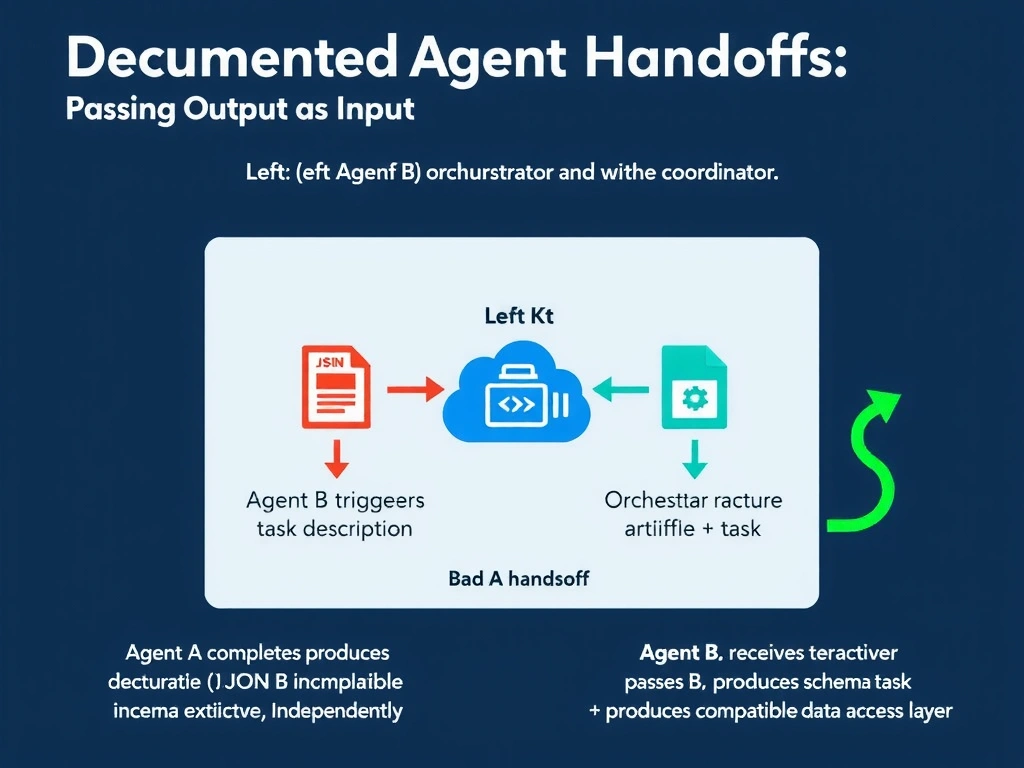
A handoff without the deliverable isn't a handoff — it's a restart. Think of it like a relay race where the baton never gets passed: the next runner has to guess where the previous runner was going. The orchestrator must explicitly pass Agent A's output as Agent B's input. Documented handoffs with explicit artifact transfer are what make multi-agent pipelines coherent.
Full explanation below image
Full Explanation
Agent handoff failures occur when the orchestrator triggers the next agent without passing the previous agent's output as a structured input. In a pipeline where Agent B's task is fundamentally dependent on Agent A's output, Agent B operating without that output will produce incompatible results — not because of a capability limitation, but because it lacks the necessary context.
The correct configuration is explicit artifact handoff: when Agent A completes, the orchestrator captures Agent A's output (in this case, the database schema) as a structured artifact and injects it into Agent B's context as a named input before Agent B begins. This might look like: - Storing Agent A's schema as a JSON file and passing its path to Agent B - Posting Agent A's schema to a shared GitHub Issue that Agent B is required to read first - Passing the schema directly in Agent B's initial prompt as structured data
Why the other options fail: - Option A (more detailed task description) can reduce the probability of wrong assumptions but doesn't solve the core problem. If Agent B is supposed to use Agent A's specific schema — with its specific field names, types, and relationships — no amount of descriptive text substitutes for the actual schema. The actual output must be passed. - Option C (shared context window) is architecturally not how modern agent systems work. Agents don't share a live context window; each agent has its own context. Even if this were possible, a shared live context creates its own coordination and isolation problems. - Option D (query the database at runtime) only works after the schema is actually deployed to a database — which hasn't happened yet in a design pipeline. It also creates a runtime dependency on a live system rather than a deterministic design artifact, introducing unnecessary coupling.
Explicit, structured artifact handoff between agents is the fundamental mechanism that makes multi-step agent pipelines produce coherent, consistent results.