
A platform team needs an agent system to apply a security patch to 20 independent microservices simultaneously. Each microservice has its own repository and independent test suite. The changes in each repository do not depend on the outcome of any other repository. Which orchestration pattern is MOST appropriate for this task?
Select an answer to reveal the explanation.
Short Explanation and Infographic
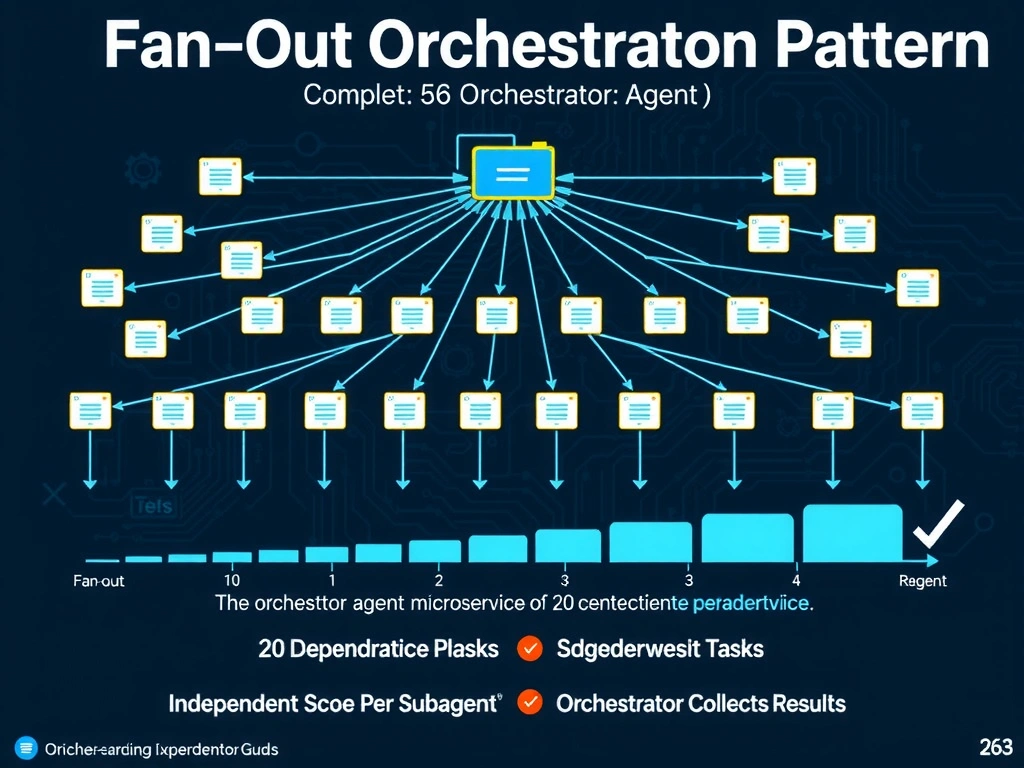
When the work is parallel and independent, you run it in parallel. Fan-out is the orchestration pattern for broadcasting the same task to many independent workers simultaneously — like a manager handing out 20 identical assignments to 20 people at once rather than making one person do all 20 sequentially. The key condition is met: no microservice depends on another's output.
Full explanation below image
Full Explanation
The fan-out orchestration pattern is designed precisely for scenarios where a single task can be decomposed into N independent subtasks that share no data dependencies and can execute simultaneously. An orchestrator agent dispatches N subagent instances, each operating on its own isolated scope, and the orchestrator collects results as they complete.
For this scenario, the conditions for fan-out are fully met: 20 independent repositories, independent test suites, no inter-repository dependencies for this specific security patch. Fan-out reduces wall-clock time from O(N) to approximately O(1) relative to sequential processing.
The orchestrator's responsibilities in a fan-out pattern include: - Spawning subagents with scoped access to their assigned repository - Monitoring subagent status - Collecting and aggregating results - Handling failures in individual subagents without blocking others
Why the other options fail: - Option A (sequential chain) processes one microservice at a time. With 20 independent tasks, this multiplies total execution time by 20× compared to fan-out. There is no technical reason to serialize independent work. - Option C (consensus pattern) is designed for decision-making under uncertainty, where multiple agents evaluate the same problem and vote. It's not appropriate for execution tasks where the correct action is already defined (apply the security patch). - Option D (two-agent hierarchical split) is a partial fan-out. It reduces total time by approximately 50% but does not achieve the full parallelism possible. If 20 subagents are available, splitting into 5+15 is an arbitrary constraint that leaves performance on the table.
Fan-out orchestration is the canonical pattern for parallel independent work at scale.