
Your organization wants agents to automatically discover approved MCP servers without requiring each developer to manually configure server endpoints in their agent definition files. What feature should you configure to enable centralized MCP server discovery?
Select an answer to reveal the explanation.
Short Explanation and Infographic
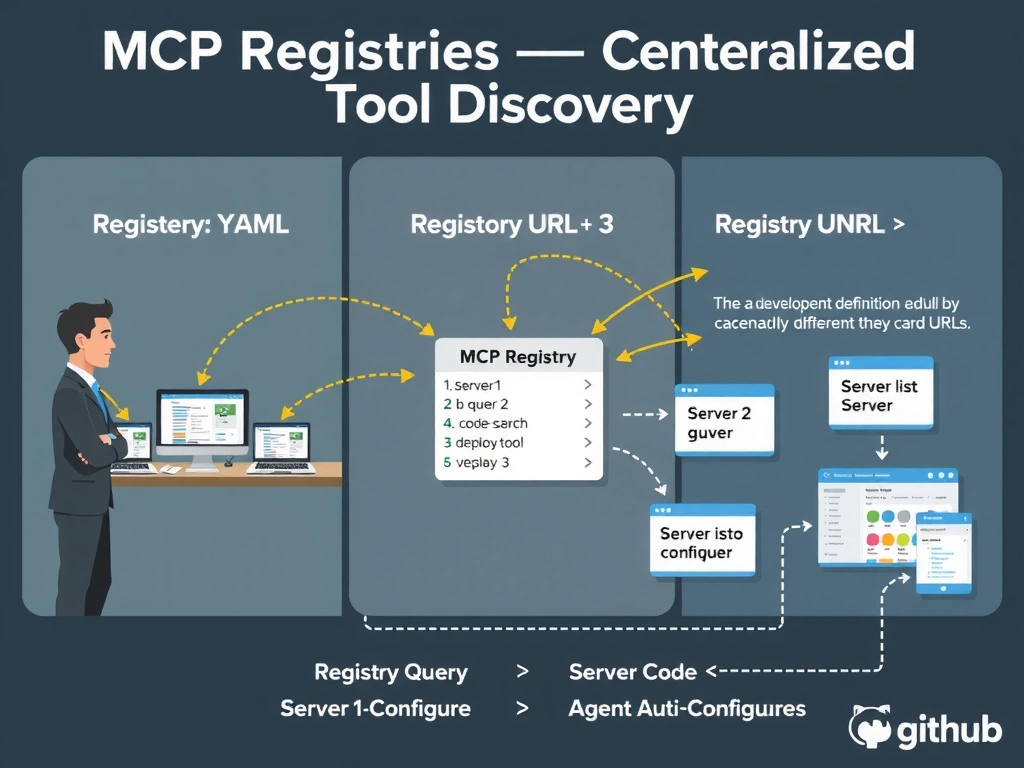
An MCP registry is like a company IT catalog of approved software — instead of every developer googling for the right download link, they check the catalog. In MCP terms, the registry is a discovery endpoint that lists available servers, their capabilities, and connection details. Agents (and tools like VS Code Copilot) can be pointed at a registry URL so developers get curated server access without hard-coding individual endpoints.
Full explanation below image
Full Explanation
MCP registries solve the scalability problem of managing tool discovery across many agents and developers. Rather than each agent definition file manually listing every MCP server endpoint, a registry provides a centralized catalog that can be queried programmatically. The registry exposes a list of available MCP servers including their names, descriptions, transport details, and connection URLs. Agent runtimes or developer tools can be configured with a registry URL and will automatically surface available servers for selection.
Option A is incorrect because while GitHub does read certain well-known files from repositories (like CODEOWNERS or workflow files), there is no standard .github/mcp-servers.json discovery mechanism built into Copilot. Each agent's tool configuration still needs explicit definition.
Option B is correct. MCP registries are the purpose-built mechanism for centralized server discovery. Organizations can host their own registry or use public ones (such as those from GitHub or third-party providers). Once the registry URL is configured in the Copilot settings or agent runtime, developers and agents can browse or auto-load available servers from the catalog.
Option C is incorrect. There is no auto-tool-discovery flag in GitHub organization settings that scans GitHub Apps and registers their APIs as MCP tools. GitHub Apps and MCP servers are distinct integration surfaces.
Option D is incorrect. GitHub Packages is a package registry for artifacts like npm modules, container images, and Maven artifacts. While an MCP server could be distributed as an npm package via GitHub Packages, the Packages API does not auto-register them as agent tools. Discovery via Packages would require manual lookup and configuration.
The key exam point: MCP registries = centralized discovery catalog. Allow lists (different feature) = what tools from a discovered server are permitted. Both work together but solve different problems.