
A team's existing multi-agent workflow has a security scanning agent that consistently produces false positives, causing downstream agents to unnecessarily halt. The team wants to replace it with a more accurate scanning tool. What is the correct sequence of steps to safely replace the agent within the workflow?
Select an answer to reveal the explanation.
Short Explanation and Infographic
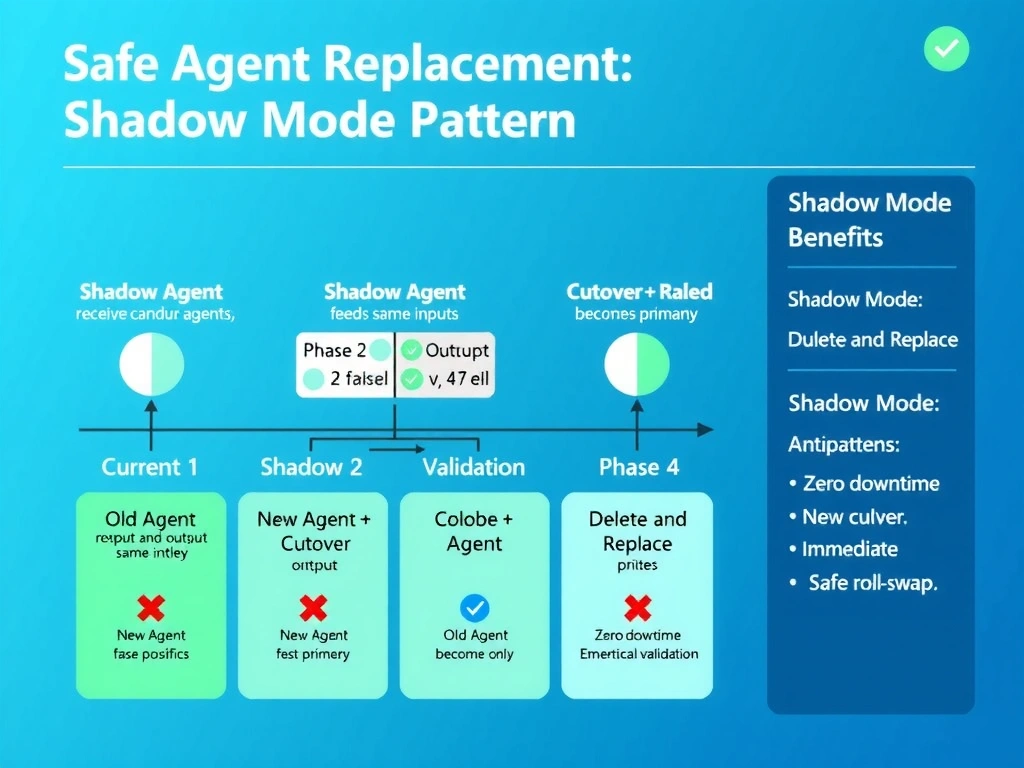
Swapping out a live agent without testing is like replacing a load-bearing wall in a house — you need scaffolding in place before you remove the old structure. Shadow mode lets the new agent run alongside the existing one so you can compare their outputs on real workloads before you trust the new one with production routing. Verify first, retire second.
Full explanation below image
Full Explanation
Replacing an agent in a live multi-agent workflow is a change management problem. The safest approach follows a canonical pattern: introduce → validate → cut over → retire.
Shadow mode (also called parallel validation or canary deployment) means the new agent runs on the same inputs as the existing agent but its output is not yet used to drive downstream decisions. The orchestrator collects both outputs and compares them. This lets the team verify that the new agent: - Produces lower false positive rates on the same inputs - Handles edge cases correctly - Completes within acceptable time bounds - Formats output in a way downstream agents can consume
Only after the new agent is validated does the team update the workflow routing to use its output exclusively and retire the old agent.
Why B is correct: Shadow mode is the established safe pattern for replacing an agent in a running workflow. It eliminates deployment risk by decoupling validation from cutover, and it provides empirical evidence that the new agent is better before any production impact.
Why A is wrong: Deleting the old agent and immediately replacing it with an untested new one introduces the new agent directly into production with no validation. If the new agent has configuration errors or its output format is incompatible, the entire workflow fails.
Why C is wrong: Pausing downstream agents and then immediately resuming after replacement still doesn't include a validation phase. The new agent goes live with no empirical testing against real inputs. The pause only reduces the blast radius slightly — it does not add safety.
Why D is wrong: Running both agents in parallel and accepting whichever finishes first is a race condition design, not a replacement strategy. It doesn't retire the old agent, doubles compute cost, and 'fastest wins' is a terrible criterion for security scanning — correctness matters far more than speed.