
An orchestrator monitors a multi-agent workflow and notices that Agent C has been in 'running' status for 45 minutes with no log output and no tool calls recorded in the last 30 minutes, while all other agents completed within 10 minutes. Which conclusion is most appropriate?
Select an answer to reveal the explanation.
Short Explanation and Infographic
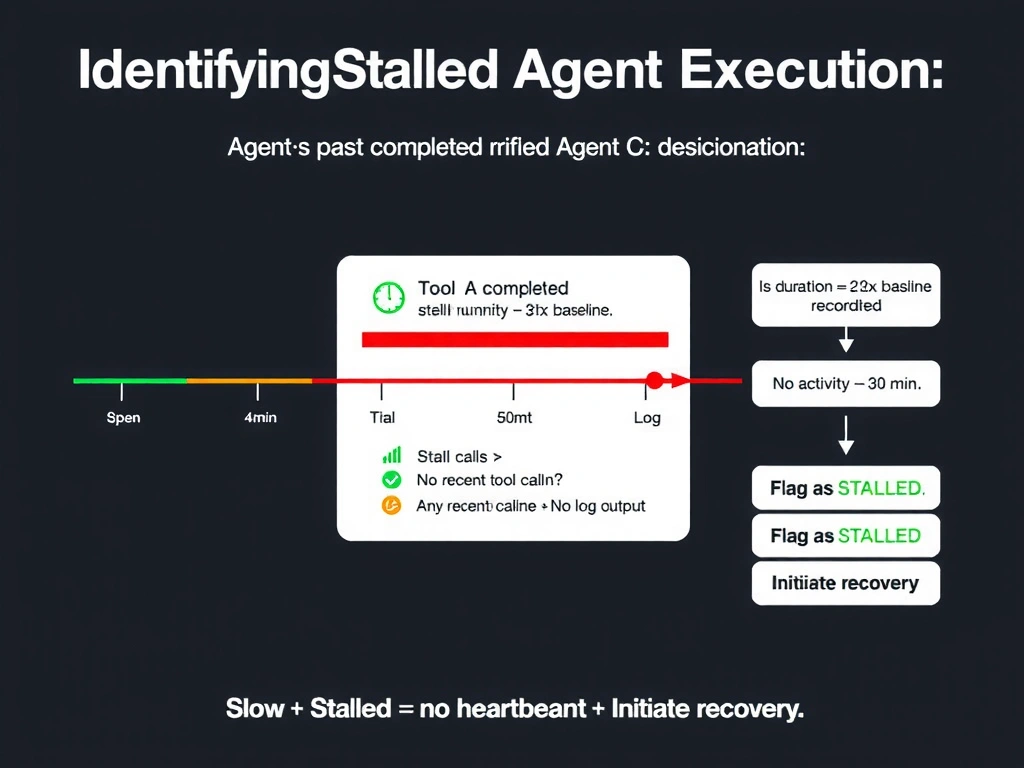
A healthy agent is like a busy worker who keeps checking in — you'd expect regular progress signals: tool calls, log entries, partial outputs. When an agent goes completely dark for 30 minutes while its peers finished in 10, that silence is the signal. No heartbeat, no progress indicators, no outputs — that's a stalled agent, not a slow one.
Full explanation below image
Full Explanation
Identifying stalled or partially-completed agent executions requires monitoring three key signals: time elapsed vs. expected duration, activity indicators (tool calls, log output), and output progress.
A stalled agent is distinct from a slow agent. A slow agent continues to produce activity — tool calls, log entries, intermediate outputs — even if it takes longer than expected. A stalled agent shows a complete absence of activity for an abnormal duration. The key indicators of a stall are:
- No tool calls recorded in the last N minutes (N defined by workflow SLA) - No log output indicating progress - Duration significantly exceeds the baseline for similar tasks (here, 30+ minutes vs. 10-minute baseline) - Status is still 'running' — it has not failed explicitly or succeeded
Why B is correct: The combination of no tool calls, no log output, and 3x the expected duration with status still 'running' is a clear stall signature. The orchestrator should terminate the agent, log the state, and initiate a recovery procedure (retry, rollback, or human escalation).
Why A is wrong: While it's possible Agent C has a legitimately large workload, the absence of any activity signals (not just slow output, but zero tool calls for 30 minutes) rules out normal slow processing. A processing agent would still emit intermediate logs or tool invocations.
Why C is wrong: API rate limiting typically manifests as error responses with retry delays, which would appear in the tool call log with error codes. Complete silence is not consistent with rate limiting behavior, which still generates log entries for retries.
Why D is wrong: If Agent C completed silently, it would have emitted a completion status change and final output. A 'running' status with no recent activity and no output is not consistent with silent completion — it's consistent with a hung process.