
An agent configured to generate pull request descriptions consistently produces descriptions that are too generic — they describe what was changed (e.g., 'Updated auth.js') but never explain why the change was made or what problem it solves. The agent has access to the issue tracker but never references it. Which remediation best addresses this repeated reasoning failure?
Select an answer to reveal the explanation.
Short Explanation and Infographic
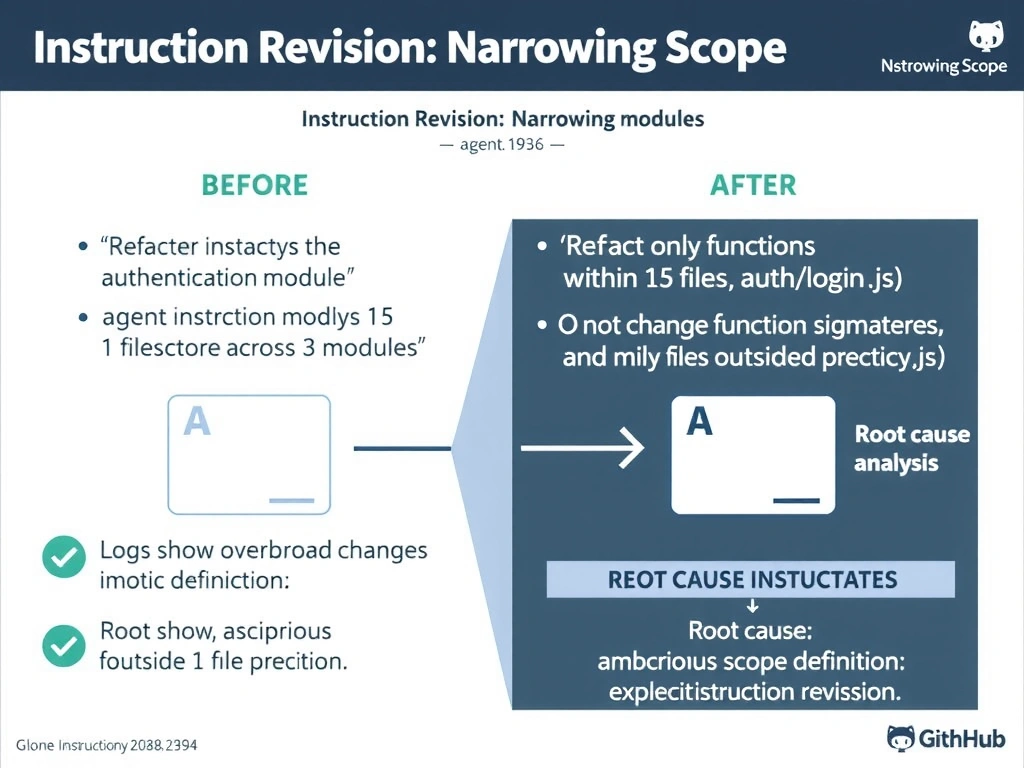
When an agent repeatedly makes the same kind of mistake in its reasoning, the fix is usually in the instructions — not in the tools, the output limits, or the word count. The agent isn't using context it has available to it. Adding an explicit step in the workflow that says 'look up the linked issue first, then summarize why' directly addresses the gap in its reasoning process. Option B adds that missing step.
Full explanation below image
Full Explanation
Repeated reasoning failures — where an agent consistently makes the same type of mistake across multiple runs — indicate a structural problem in the agent's instructions or workflow, not a one-time anomaly. The remediation must target the root cause: the agent's reasoning process is not being guided to use available context.
Option B is correct. The agent has access to the issue tracker but never uses it. This is a reasoning failure because the agent is not instructed to retrieve and incorporate issue context before generating the PR description. Adding an explicit instruction step — 'Before writing the PR description, call the issue tracker tool for the linked issue and summarize the problem it solves' — restructures the agent's workflow to include the missing context-gathering step. This directly addresses the root cause: the agent's reasoning chain was missing a step.
Option A (increasing token output limit) is incorrect. The problem is not that the agent runs out of space to include context — it is that the agent never retrieves or considers the context in the first place. More tokens won't fix a missing reasoning step.
Option C (switching issue tracker integrations) is incorrect. The question states the agent has access to the issue tracker — the tool is not the problem. The issue is that the agent is not instructed to use it. Changing to a different integration does not fix the missing instruction.
Option D (minimum word count constraint) is a superficial fix. Requiring more words will produce longer descriptions, but those descriptions will still be generic — just wordier. The agent will pad content without adding meaningful context about the 'why'. This treats the symptom (short descriptions) rather than the cause (missing issue context).
The key principle: when agent output is repeatedly missing a specific type of information, the most effective remediation is to add an explicit instruction to retrieve that information as a distinct step in the agent's workflow — making the reasoning step mandatory rather than optional.