
An agent tasked with updating API documentation produced output that appears incomplete — several endpoints are missing from the generated docs. A developer wants to identify where in the agent's execution the failure occurred. Which artifact should the developer examine first?
Select an answer to reveal the explanation.
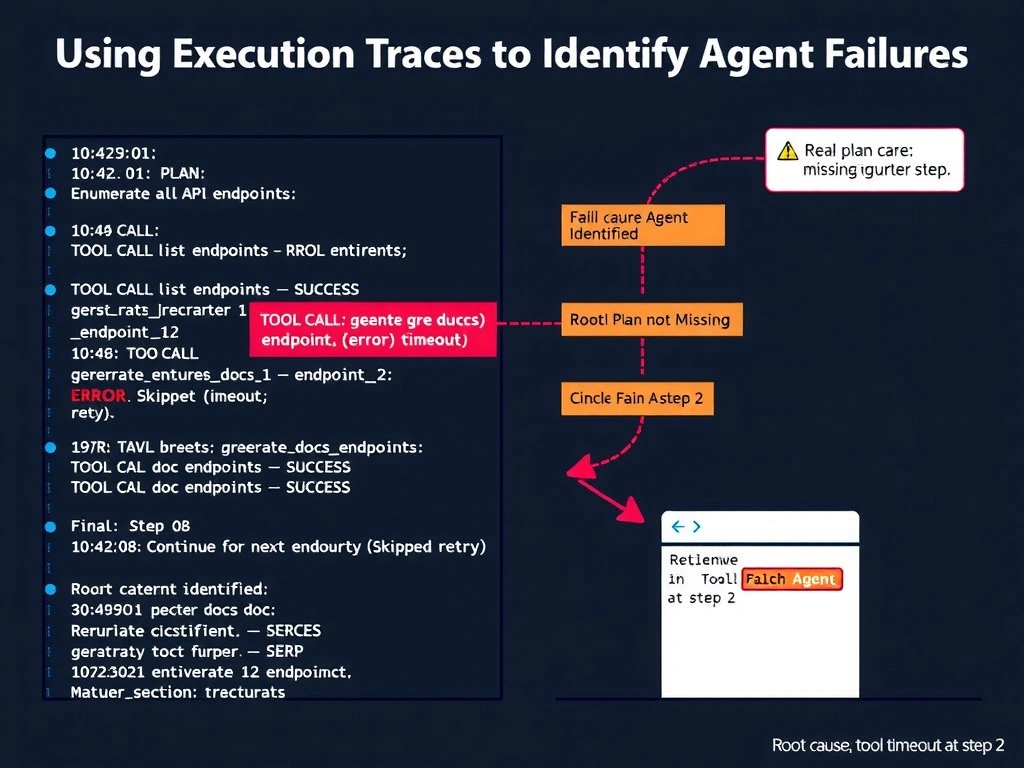
Short Explanation and Infographic
When a flight goes wrong, investigators don't just look at the wreckage — they pull the flight data recorder. For agents, that's the execution trace and logs. They show you exactly what the agent saw, what decisions it made, which tools it called, and what came back. Comparing the final output to a template (Option A) tells you something is wrong — but the trace tells you WHY and WHERE in the execution it went wrong.
Full explanation below image
Full Explanation
Execution traces and logs are the primary diagnostic tool for identifying failures in agent workflows. A trace records the agent's full decision sequence: what it planned, which tools it invoked, what arguments it passed, and what responses it received. When an agent produces incomplete output, the trace allows a developer to pinpoint exactly which step in the reasoning or tool-call chain caused the gap.
Option B is correct. Examining the execution trace and logs first gives the developer a chronological view of the agent's behavior during the run. For a documentation task, the trace might reveal that the agent only called the API schema tool for a subset of the endpoints, or that a tool call returned an error that the agent silently ignored and continued past. Without the trace, the developer is guessing about the cause.
Option A (comparing final output to expected template) is a verification step — it confirms the failure but provides no insight into its cause. It may be a useful starting point to confirm that something is wrong, but it cannot identify where in execution the failure occurred.
Option C (git history) is irrelevant to diagnosing an agent execution failure. Pre-run commits describe the state of the repository, not the agent's runtime behavior.
Option D (checking the system prompt) might be useful as a secondary step — if the instructions don't mention certain endpoints, the agent may not know to document them. However, checking the system prompt before the trace is premature. The trace will reveal whether the agent attempted to cover those endpoints and failed, or never attempted them at all. That distinction changes the diagnosis: a missing instruction vs. a tool failure vs. a reasoning error are three different root causes requiring different fixes.
In practice, good agent frameworks (like GitHub Copilot's agent mode, LangChain, and similar tools) produce structured trace logs that can be analyzed to identify failures systematically.