
An agent that automates dependency updates is designed to output a plan before making changes. Which format is most appropriate for the agent's plan output so that it is both human-readable and machine-parseable for downstream validation steps?
Select an answer to reveal the explanation.
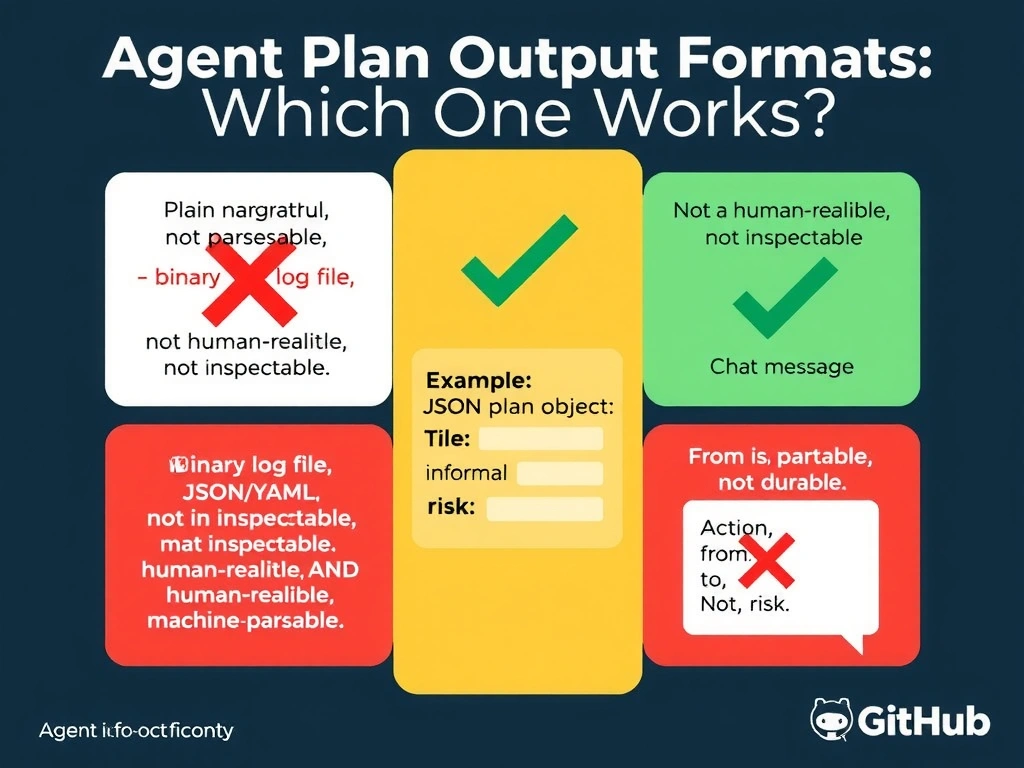
Short Explanation and Infographic
A flight plan isn't written in haiku — it's a structured checklist that every air traffic controller can read and every system can parse. Structured JSON or YAML gives the agent's plan both human readability and machine-parseability, which is exactly what downstream validators need.
Full explanation below image
Full Explanation
When an agent outputs a plan, that plan needs to serve two audiences: humans who want to review and approve it, and automated systems that need to validate or execute it. A structured format like JSON or YAML satisfies both requirements.
Why C is correct: A structured document listing each action (e.g., {"action": "update", "file": "package.json", "dependency": "lodash", "from": "4.17.19", "to": "4.17.21", "risk": "low"}) is human-readable and directly consumable by validation scripts, CI checks, and downstream agents. It also serves as an audit trail.
Why A is wrong: A plain English narrative is human-readable but not machine-parseable. A validation script cannot reliably extract structured intent from free-form text. It also lacks precision — 'update some dependencies' is ambiguous.
Why B is wrong: A binary log file in internal storage is neither human-readable nor inspectable via standard GitHub tooling. It cannot be reviewed in a PR, stored as an artifact, or validated by CI.
Why D is wrong: Posting a verbal summary to chat is an informal process that does not create a durable, structured artifact. It cannot be version-controlled, cannot be consumed by automated validators, and may be missed or misunderstood.