
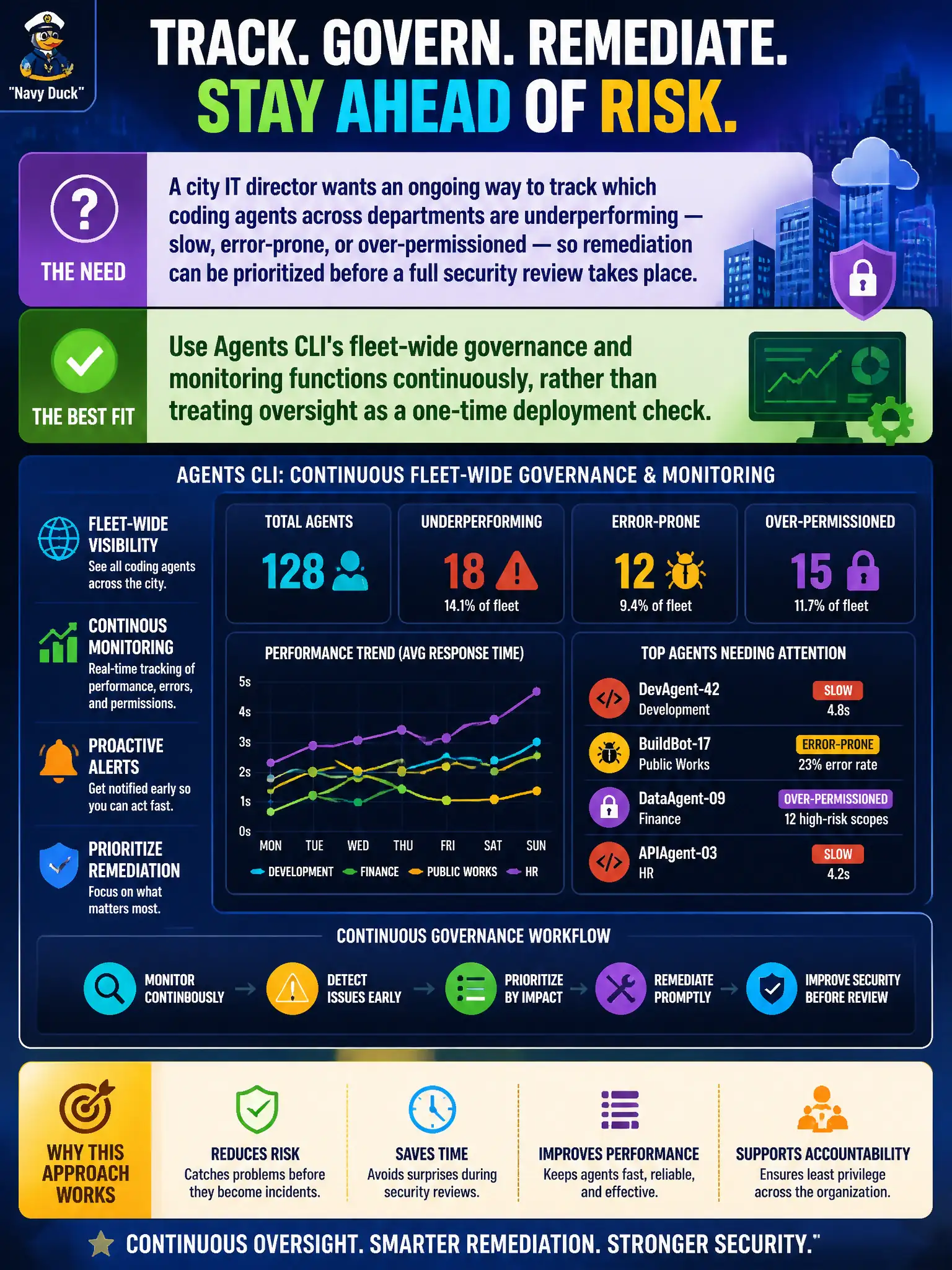
A city IT director wants an ongoing way to track which coding agents across departments are underperforming — slow, error-prone, or over-permissioned — so remediation can be prioritized before a full security review takes place. What best fits this need?
Select an answer to reveal the explanation.
Short Explanation
Think about a fleet of city vehicles: you don't inspect them once when they roll off the lot and call it done for the next ten years. Agents CLI's fleet-wide monitoring works the same way for coding agents — it keeps tracking performance, error rates, and permission levels on an ongoing basis, so problems surface before the scheduled review rather than during it.
Full Explanation
Agents CLI's governance and optimization functions are designed for continuous fleet-wide oversight, not a one-time deployment check, which is what lets an IT director identify underperforming or over-permissioned agents across departments as conditions change, rather than only discovering them at a fixed review date.
A single comprehensive audit performed at deployment time captures a snapshot, but agent behavior, tool-call patterns, and permission scope can all drift afterward as departments extend or modify their configurations, leaving that snapshot stale almost immediately. Waiting for the scheduled security review delays remediation by design, which directly conflicts with the director's stated goal of prioritizing fixes before that review happens. Informal self-reporting from each department depends on subjective impressions rather than measured signals like latency, error rate, or permission scope, and gives no consistent basis for comparing agents across departments.
Scope note: continuous monitoring surfaces candidates for remediation but doesn't replace the periodic security review itself — it's meant to reduce the number of surprises that review turns up. Operational check: pull a fleet-wide report from Agents CLI and confirm it flags at least error rate, latency, and permission scope per deployed agent.