
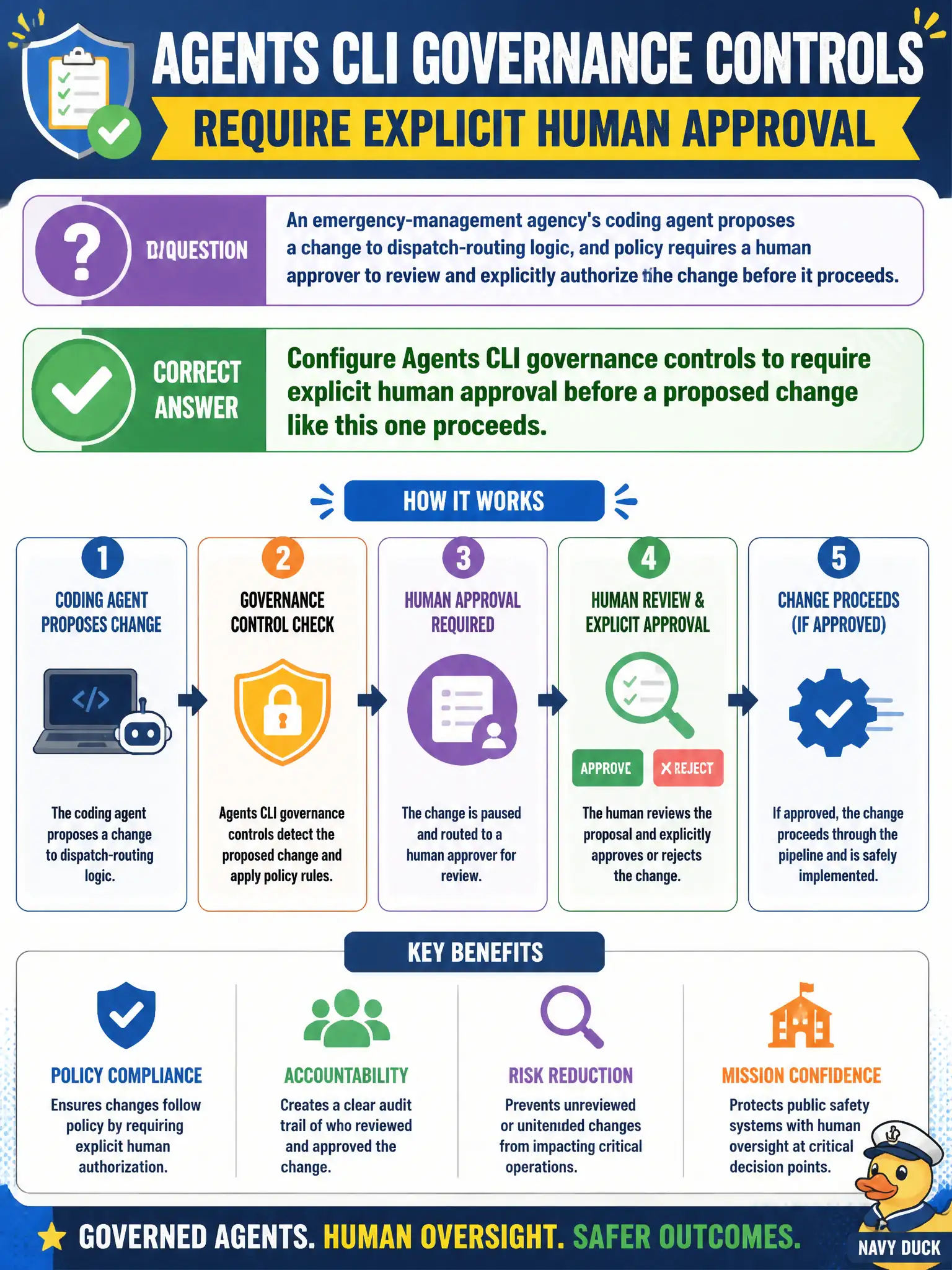
An emergency-management agency's coding agent proposes a change to dispatch-routing logic, and policy requires a human approver to review and explicitly authorize the change before it proceeds. Which approach correctly applies Agents CLI governance controls to require this human approval?
Select an answer to reveal the explanation.
Short Explanation
For something like dispatch-routing logic, you don't want the agent grading its own homework and deciding it passed. Agents CLI's governance controls let the team put a real human-in-the-loop checkpoint in front of sensitive actions, so the change waits for explicit sign-off instead of sailing through on the agent's own say-so. That's the difference between a policy that sounds required and one that's actually enforced.
Full Explanation
The mechanism is a governed approval gate: Agents CLI governance controls can require explicit human authorization before a sensitive agent action proceeds, which stops the action at the decision point rather than after the fact. Letting the agent's own confidence score decide is self-assessment, not independent oversight — a model rating its own output as safe is not the same as a human reviewing it, and it defeats the purpose of a human-in-the-loop requirement for exactly the kind of high-consequence change dispatch-routing logic represents. A skill that documents the approval policy gives the agent knowledge of the rule but nothing that enforces it; the agent could still act without a human ever reviewing anything, since a skill is advisory rather than a control. A hook that logs the change after it has already been applied is a record-keeping mechanism, not a gate — the routing logic is already live by the time anyone reviews it, which is the opposite of prior authorization. The scope caveat: governance controls should be scoped to the specific sensitive actions that warrant approval, since gating every trivial change with human review creates bottlenecks that erode compliance over time. Operational check: submit a test change to dispatch-routing logic and confirm it remains pending, unapplied, until an approver explicitly authorizes it.