
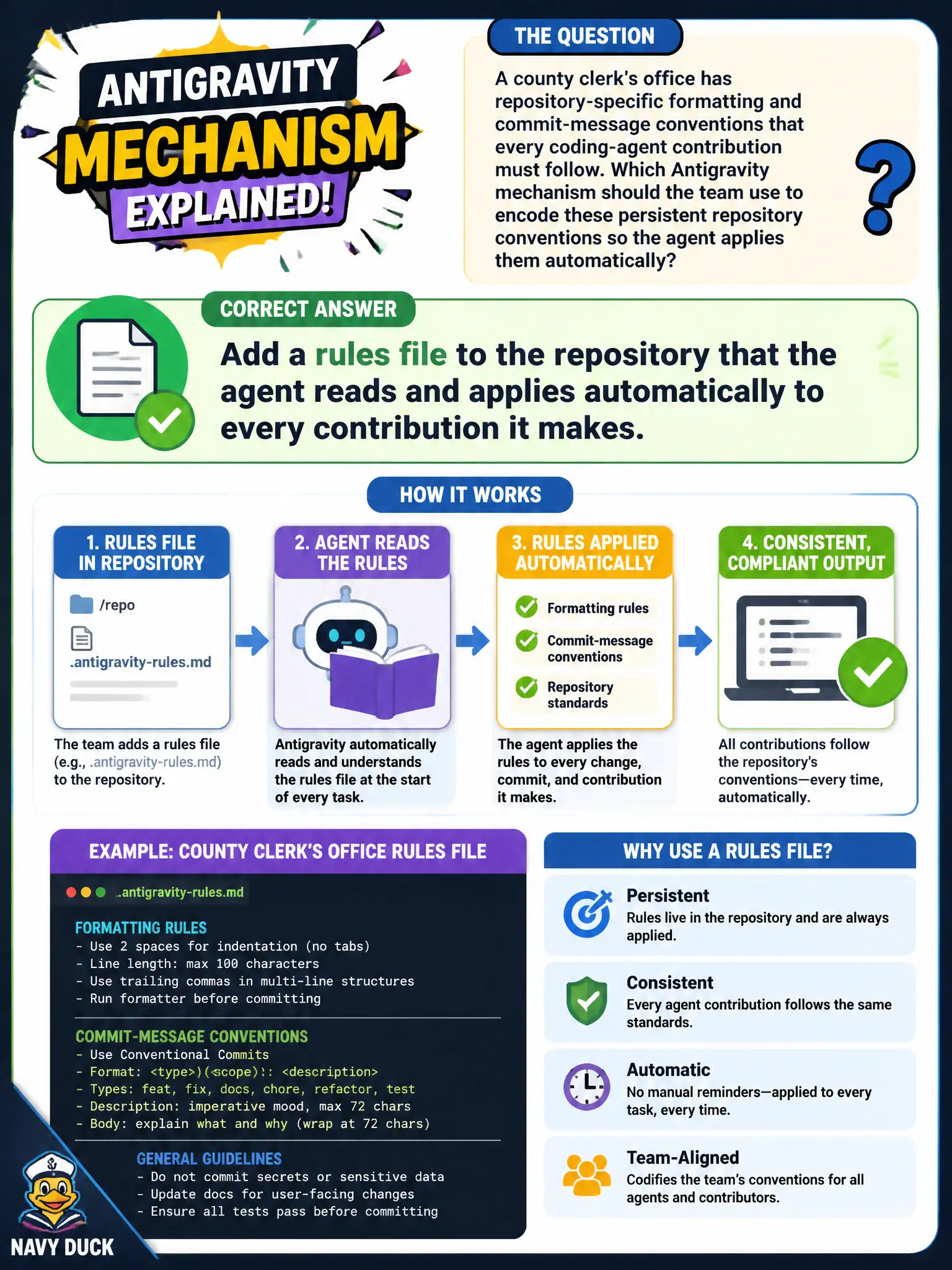
A county clerk's office has repository-specific formatting and commit-message conventions that every coding-agent contribution must follow. Which Antigravity mechanism should the team use to encode these persistent repository conventions so the agent applies them automatically?
Select an answer to reveal the explanation.
Short Explanation
A rules file works like the house style guide taped above every desk in the office — everyone reads it before they start typing, not after. Repo-wide conventions like formatting and commit-message style aren't optional add-ons the agent reaches for sometimes; they need to shape every contribution by default. That's exactly what a rules file is built to do, applying automatically instead of waiting to be asked.
Full Explanation
The mechanism is default, standing constraint: a rules file is read by the agent at the start of its work in a repository and shapes every contribution against it, which fits conventions that must apply universally rather than only when triggered by a specific task type. A skill that only activates on explicit request solves a narrower problem — it works for on-demand checks, but conventions meant to govern every contribution need to apply without anyone remembering to ask for them, so gating it behind invocation defeats the purpose. An MCP server that validates formatting after a commit has already landed catches problems too late: it detects a violation rather than preventing one, which is a fundamentally different control point than shaping the contribution as it's written. A dedicated reformatting subagent similarly treats this as cleanup after the fact, adding coordination overhead to fix something a rules file would have prevented at the source. The scope caveat: rules files govern behavior within the repository context the agent is working in, so conventions meant to span multiple repositories still need to be replicated or centrally managed across each one. Operational check: inspect a sample agent-authored commit for adherence to the documented formatting and message conventions without any manual correction afterward.