
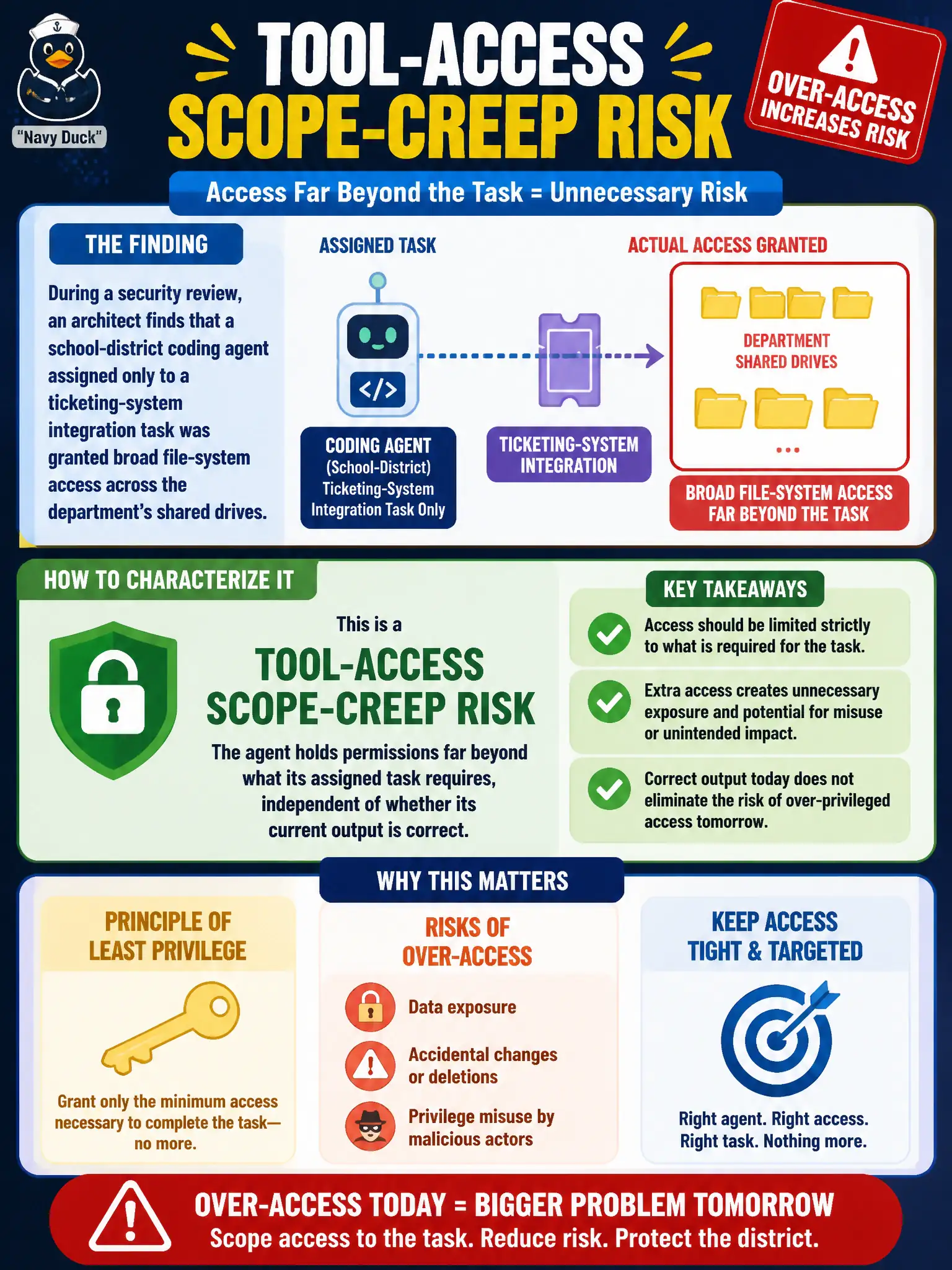
During a security review, an architect finds that a school-district coding agent assigned only to a ticketing-system integration task was granted broad file-system access across the department's shared drives. How should the architect characterize this finding?
Select an answer to reveal the explanation.
Short Explanation
Think of it like a courier hired to deliver one envelope who somehow got a master key to the whole building. Whether the envelope gets delivered correctly has nothing to do with the risk of that master key, the risk is the access itself, sitting there waiting for the wrong moment. Correct output today doesn't shrink the blast radius of permissions the agent never needed for that job.
Full Explanation
The mechanism is that access scope and functional correctness are separate axes: an agent can produce perfectly correct ticketing-integration output while simultaneously holding file-system permissions that have nothing to do with that task, and the second fact is a governance and security finding on its own, regardless of the first. Scope creep matters because the excess permissions represent unused capability that a prompt injection, a bug, or a compromised session could exploit, whether or not anyone has exploited it yet.
Treating this as low-priority because current output is correct confuses functional testing with access review, correct behavior today says nothing about what the agent could do tomorrow with the same credentials. Framing it as a data-quality issue misattributes the risk to output reliability, when the actual exposure is that unrelated shared-drive content, potentially including other departments' records, is reachable by a workload with no assigned reason to touch it. Dismissing file-system access as categorically different from database access ignores that both are just resources an over-privileged identity can read or modify, the same governance question, does this permission map to an active task, applies to either.
Scope caveat: this applies specifically to standing access, a temporary elevated grant for a defined maintenance window is a different risk profile if it expires automatically. A concrete check: enumerate the agent's granted file-system paths and confirm each is required by an in-progress ticketing task.