
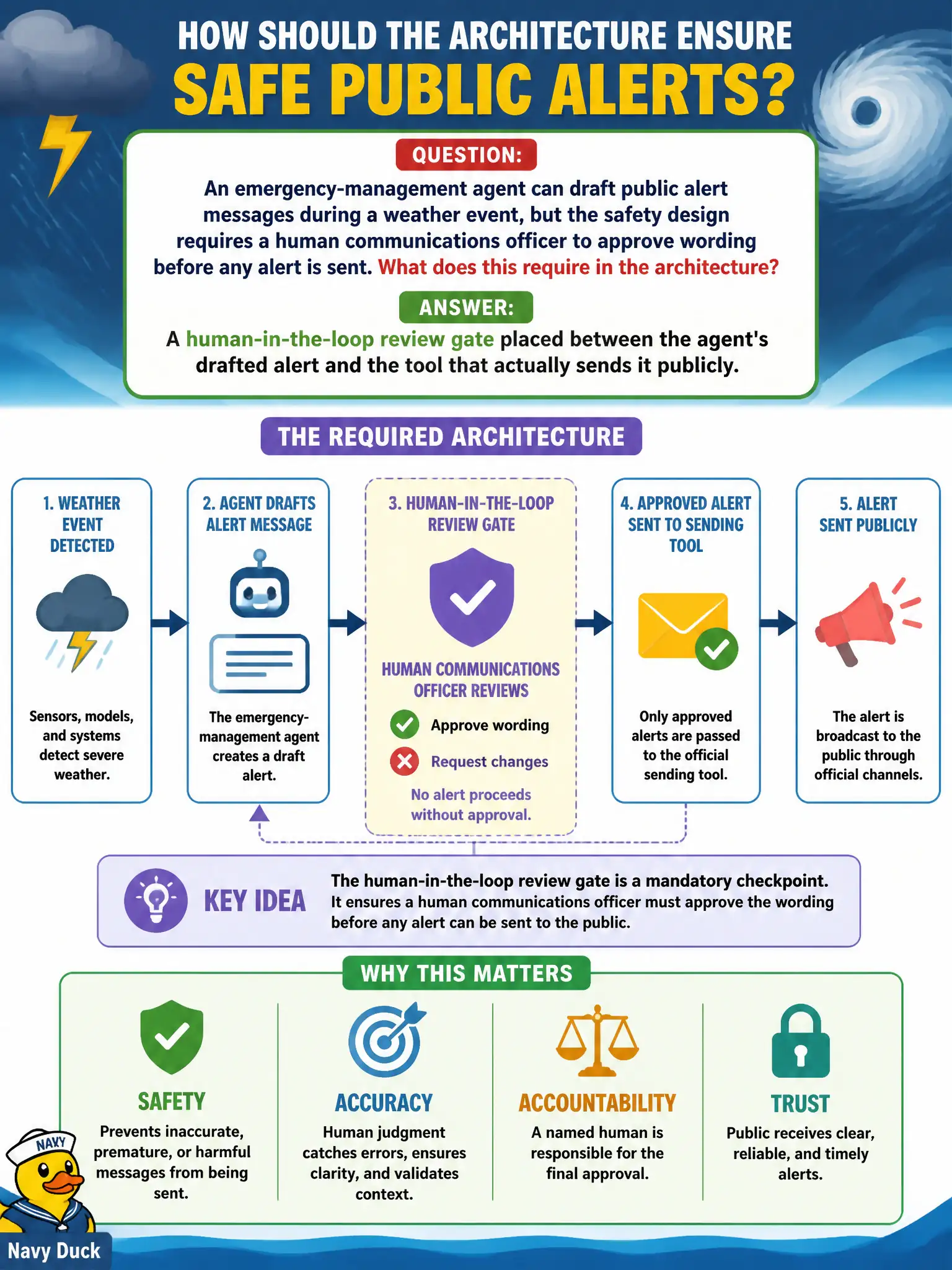
An emergency-management agent can draft public alert messages during a weather event, but the safety design requires a human communications officer to approve wording before any alert is sent. What does this require in the architecture?
Select an answer to reveal the explanation.
Short Explanation
A public alert going out with a wrong word choice is a mistake you want caught before it reaches every phone in the county, not fixed with a correction afterward. A human-in-the-loop gate is the pause between drafting and sending, where the officer actually reads the wording first. An automatic rewrite filter, a cap on draft counts, or a retraction plan all miss that approval must happen before send.
Full Explanation
A human-in-the-loop review gate positioned between the agent's draft and the send action ensures the communications officer's approval is a required step in the path, so no alert reaches the public without that human sign-off, which is exactly what "before any alert is sent" demands. A Model Armor filter that automatically rewrites alarming wording still results in an autonomous send, just with different wording; it removes the human decision entirely rather than inserting one, so it doesn't satisfy a requirement for officer approval of the final wording. An Agent Gateway rate limit capping how many drafts the agent generates controls volume during a high-activity event, which might reduce noise for the officer to review, but it does nothing to require that any single draft actually gets reviewed before it sends. A post-send retraction process accepts that inaccurate or poorly worded alerts might already have reached the public and only issues a correction afterward, which is the opposite of a pre-send approval requirement and leaves the original flawed alert live in the interim. A scope caveat: a review gate only protects the outcome if the officer has enough time and context to meaningfully evaluate wording during a fast-moving weather event, so the workflow should be designed for a realistic review window. As an operational check, an architect can generate a test alert and confirm the send tool remains blocked until an explicit officer approval action is recorded.