
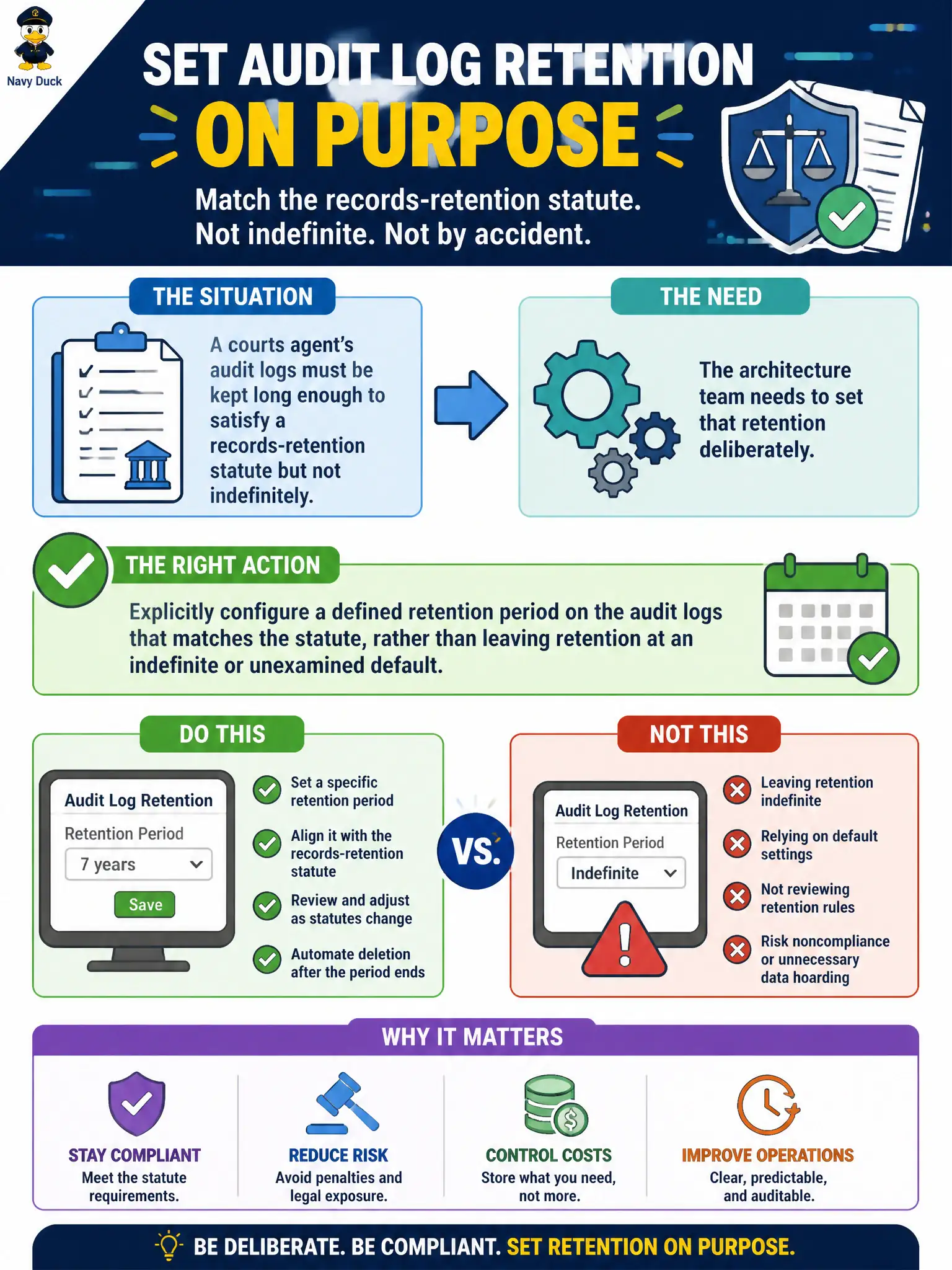
A courts agent's audit logs must be kept long enough to satisfy a records-retention statute but not indefinitely, and the architecture team needs to set that retention deliberately. What should the team do?
Select an answer to reveal the explanation.
Short Explanation
A records-retention statute is like a lease with a fixed term — you don't want to leave the fridge running in that apartment forever, and you don't want to clear it out before the lease is up either. Setting a deliberate retention period matches the log's lifespan to that lease exactly. Leaving the default in place, or clearing logs out early, both risk missing that term in one direction or the other.
Full Explanation
Explicitly configuring a defined retention period on the audit logs, set to match the statute, gives the architecture team direct control over both ends of the requirement: logs persist long enough to satisfy the legal minimum and are removed once that period passes rather than accumulating indefinitely. Leaving the logging service at its default setting assumes, without verification, that the default happens to align with the specific statute governing this courts system, which is a risky assumption since defaults are typically generic and not tuned to any particular jurisdiction's legal requirement. Deleting audit logs as soon as a case closes conflates "no longer needed for active review" with "no longer needed at all," which is exactly backwards for a records-retention statute that likely requires logs to survive well past case closure for compliance and audit purposes. Storing audit logs only in the agent's own conversational memory repurposes a working-memory mechanism, not built for durable, queryable, retention-governed storage, as a compliance log, which is both fragile and unlikely to meet the durability or query needs of an audit. A scope caveat: the correct retention period depends on the specific statute in force, so an architect should confirm the exact duration with legal counsel rather than estimating it. As an operational check, an architect can inspect the logging configuration and confirm the retention value in days or years matches the number specified by the governing statute, not a platform default.