
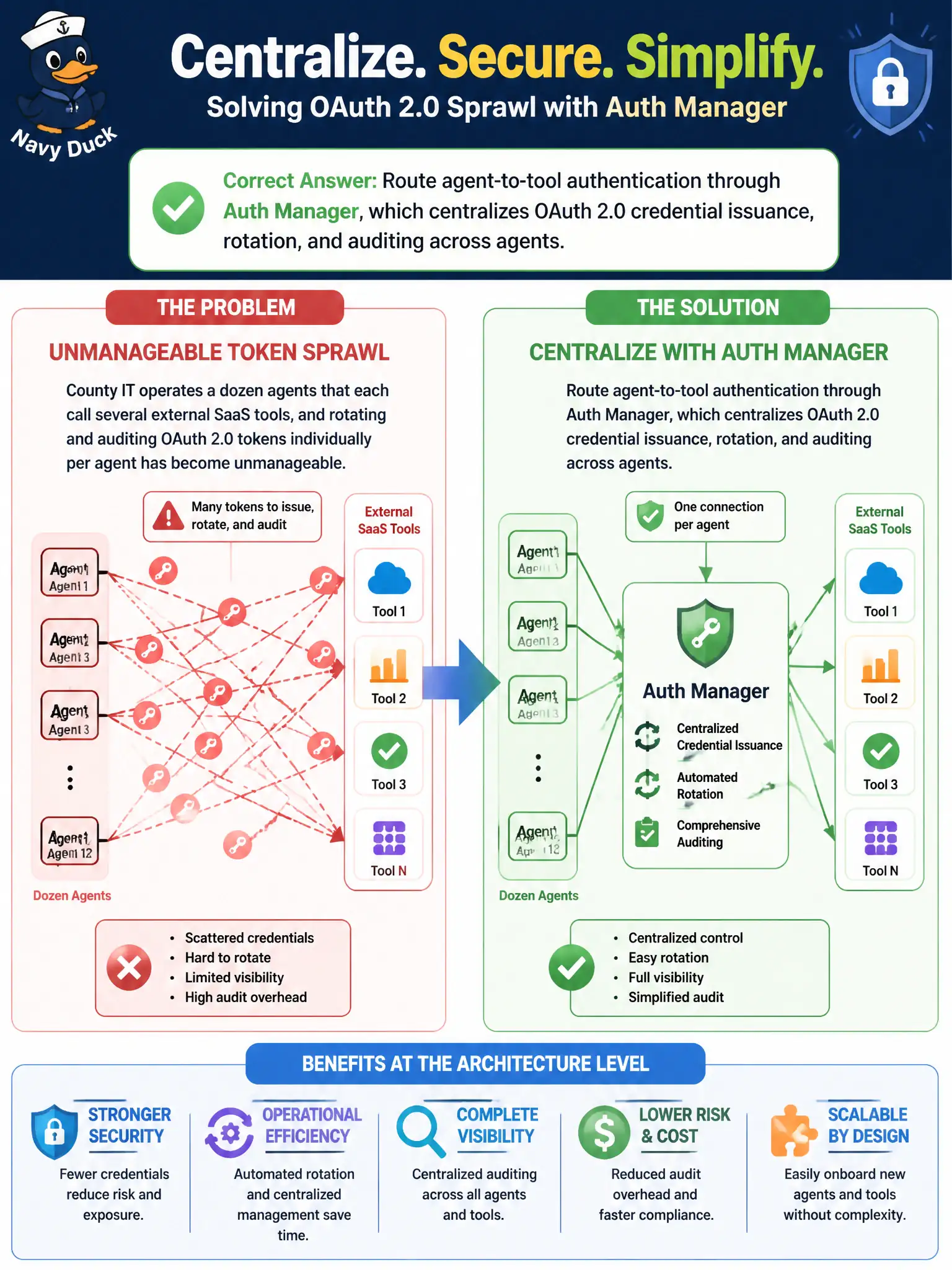
County IT operates a dozen agents that each call several external SaaS tools, and rotating and auditing OAuth 2.0 tokens individually per agent has become unmanageable for the security team. Which approach addresses this at the architecture level?
Select an answer to reveal the explanation.
Short Explanation
Twelve agents each juggling their own OAuth tokens is like every department keeping its own key cabinet — nobody can see the whole picture, and a lost key takes forever to trace. Auth Manager is the single key cabinet with a log book: one place issues, rotates, and audits every credential. That beats hoping each team's homegrown spreadsheet stays current.
Full Explanation
Auth Manager centralizes OAuth 2.0 credential management for agents calling external tools, giving a security team one place to issue, rotate, and audit tokens instead of chasing a dozen separate implementations. That centralization is what actually solves the stated problem: unmanageable per-agent rotation is a coordination failure, and a shared credential layer removes the need for each team to reinvent rotation logic correctly. Letting each agent team run its own local credential store looks locally reasonable but reproduces the exact fragmentation causing the pain, and it scales the audit burden linearly with every new agent. Agent Gateway's traffic monitoring can observe that a token looks unusual, but observing a symptom after the fact is not the same as owning issuance and rotation; it doesn't reduce the underlying management burden. Lengthening token validity windows trades the security team's rotation workload for a larger standing exposure window if any one credential leaks, which is the wrong tradeoff for a security-motivated request. A scope caveat: centralizing credential management doesn't remove the need for each tool integration to request only the scopes it actually uses. As an operational check, an architect can confirm that a token revoked centrally immediately stops working for every agent that held it, rather than needing a per-agent update.