
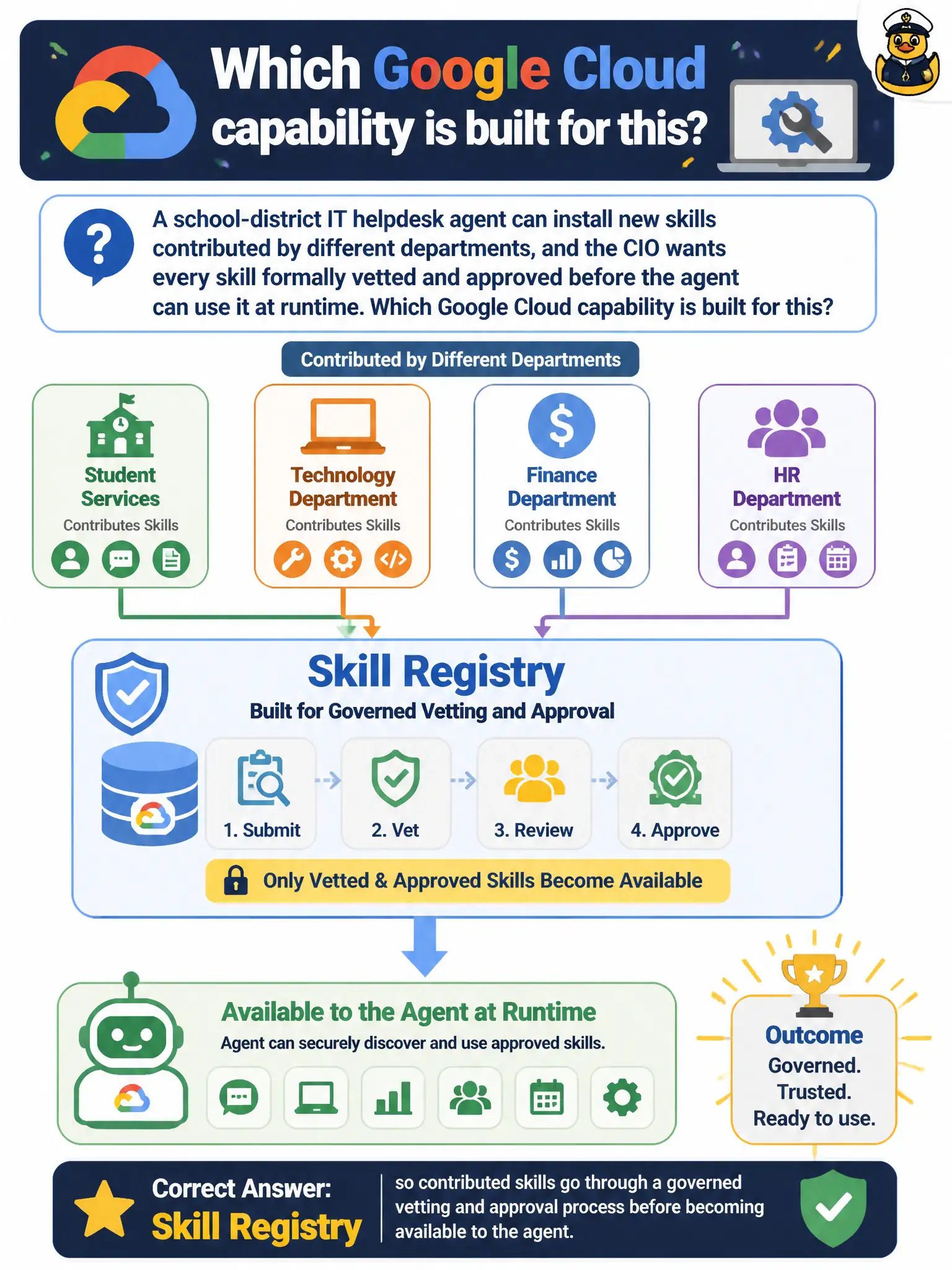
A school-district IT helpdesk agent can install new skills contributed by different departments, and the CIO wants every skill formally vetted and approved before the agent can use it at runtime. Which Google Cloud capability is built for this?
Select an answer to reveal the explanation.
Short Explanation
A skill is like a new tool an employee wants to bring into the building — you don't just let anyone start using it because it says it's helpful. The Skill Registry is the inspection desk: a skill gets checked and approved there before it's ever handed to the agent. That's a different job from tracking which agent version is running or who the agent is acting as.
Full Explanation
The Skill Registry governs capabilities at the skill level: it holds the catalog of vetted, approved skills a district can draw from and gates whether a newly contributed skill becomes available to an agent at runtime. That is a narrower and earlier checkpoint than agent-level governance. Agent Registry tracks agent builds and versions — which agent is deployed where and when — but it doesn't evaluate whether an individual contributed skill is safe to expose; two different departments' skills could both be wired into an approved agent version without either skill itself having been vetted. Agent Identity answers a different question entirely: it establishes the principal an agent acts as for authorization purposes, not whether a capability it might call has passed review. Model Armor screens content flowing through prompts and responses for manipulation or leakage, which matters after a skill is already live, not before it is admitted. A useful scope caveat: vetting a skill once doesn't cover future edits to it, so registries should key approval to a specific skill version. As an operational check, an architect can confirm that any skill lacking Skill Registry approval is unreachable from the agent's tool list at runtime, not merely flagged as unapproved.