
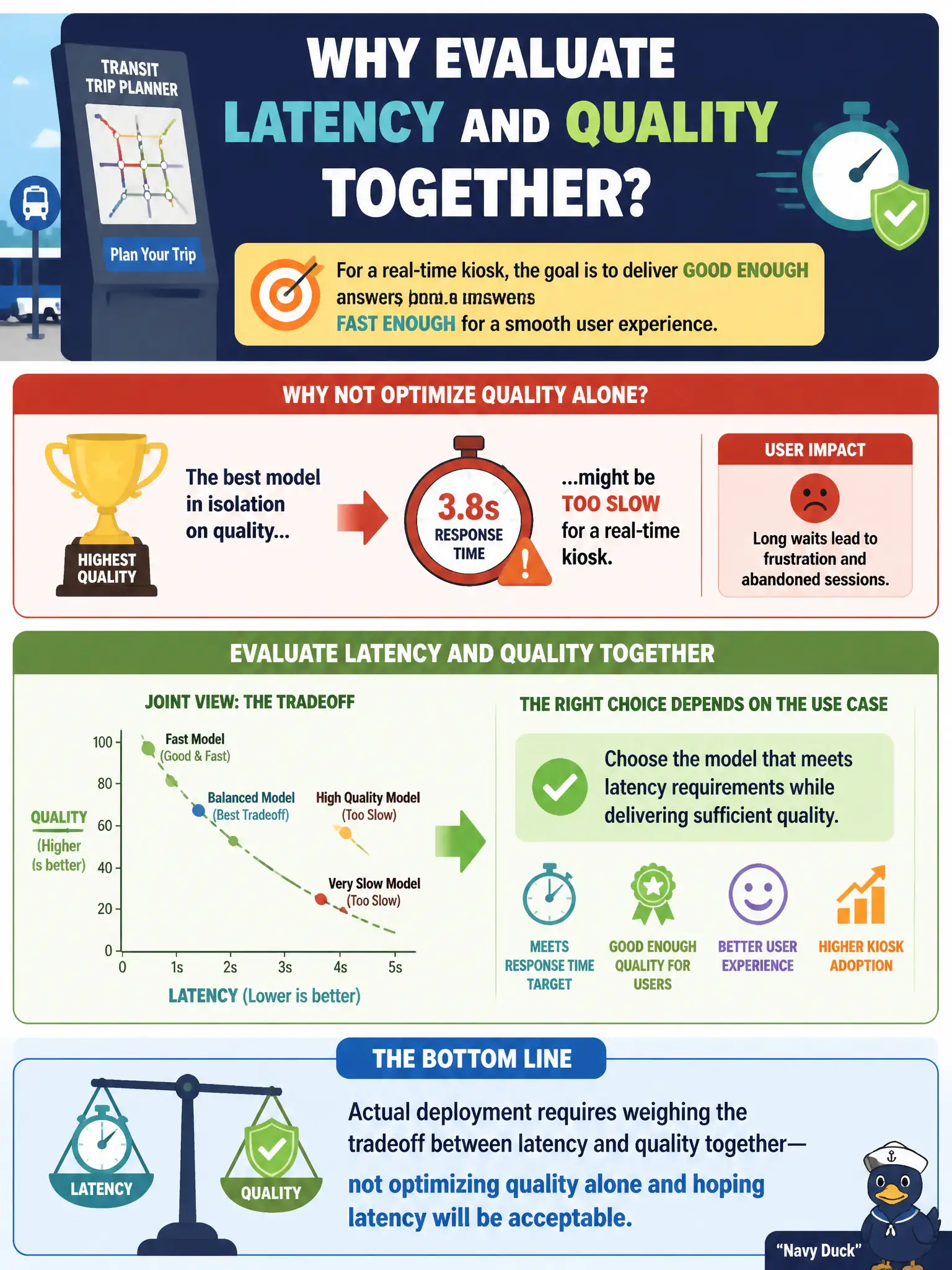
During development of a transit trip-planning agent meant for a real-time kiosk, the team runs evaluations that jointly track response latency alongside quality scores, since a faster but slightly less accurate model might still be preferred for that use case. Why does the team evaluate latency and quality together rather than optimizing quality alone and treating latency as a separate concern?
Select an answer to reveal the explanation.
Short Explanation
Picking a model on quality alone is like hiring the smartest employee available without checking whether they can actually keep up with a live, walk-up counter. For a kiosk, a slightly less brilliant answer delivered instantly can beat a slightly better answer that makes the resident stand there waiting.
Full Explanation
Evaluating latency and quality jointly reflects that the deployment decision is a tradeoff, not a single-axis ranking: the highest-quality candidate model might exceed the response-time budget a walk-up kiosk requires, making it the wrong choice despite scoring best on accuracy alone, while a marginally lower-quality model that responds instantly could better serve actual resident experience at the kiosk. Optimizing quality in isolation and treating latency as a separate gate risks selecting a model that then fails the latency requirement anyway, wasting the evaluation effort spent ranking it highly on quality. The claim that latency and quality are mathematically identical is false on its face; they measure entirely different properties of the same system and require separate instrumentation. The claim that kiosk hardware can't run any model with a quality score misstates the scenario, which is about tradeoffs between real, functioning candidate models, not a hardware incapability. Removing the need for a golden dataset misunderstands what latency measures; a golden dataset is still required to produce the quality half of the joint comparison. Scope caveat: the acceptable latency threshold should be defined by the specific deployment context, since a kiosk's real-time requirement is stricter than, say, an asynchronous batch process would need. Operational check: for each candidate model, confirm the evaluation report pairs its quality score with its measured latency on the same test run before making a selection.