
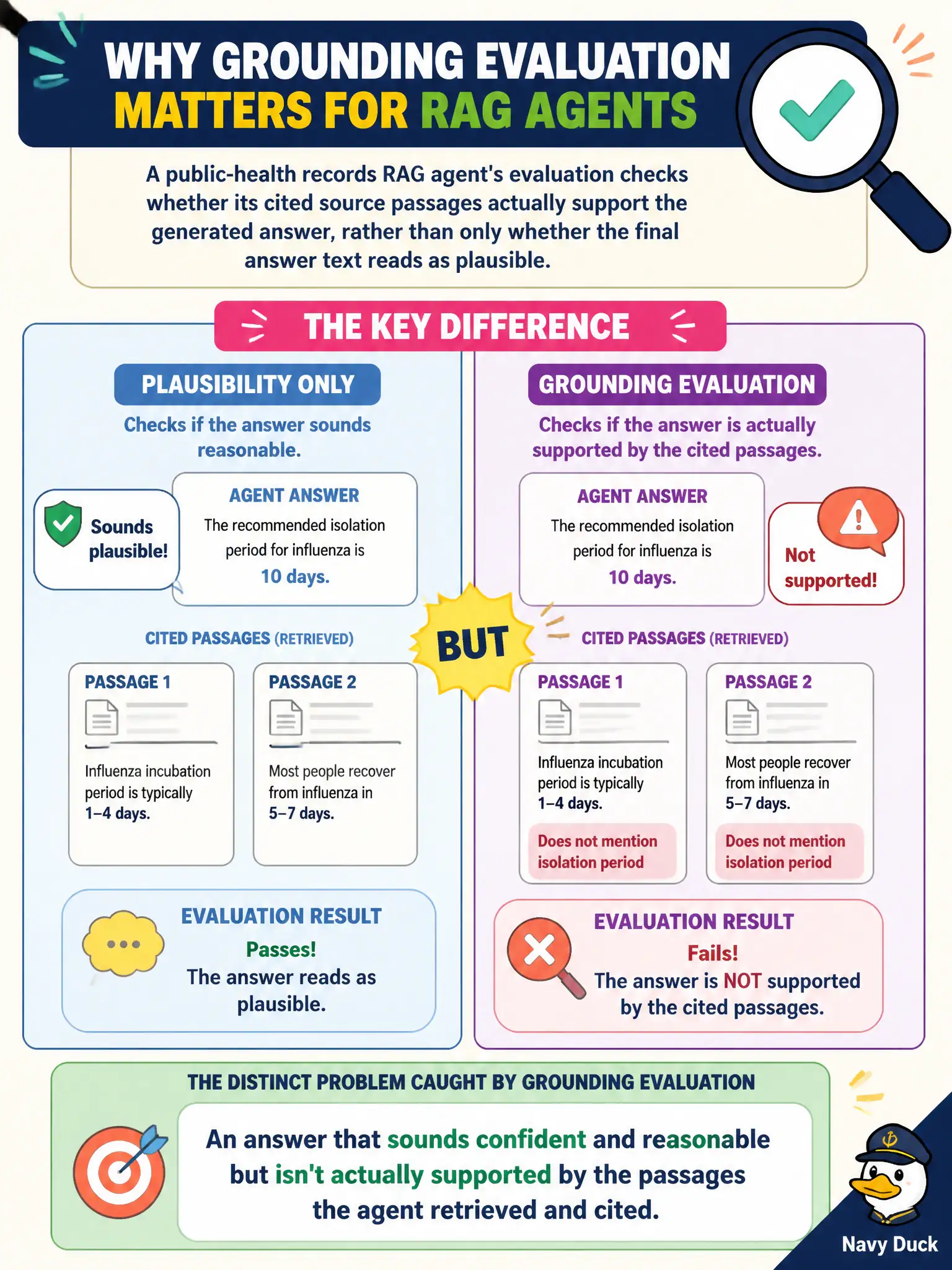
A public-health records RAG agent's evaluation checks whether its cited source passages actually support the generated answer, rather than only whether the final answer text reads as plausible. What distinct problem does grounding evaluation catch that plausibility alone would miss?
Select an answer to reveal the explanation.
Short Explanation
A plausible-sounding answer is like a confident witness who tells a great story — it doesn't mean the story matches the evidence. Grounding evaluation is checking the evidence itself: does the cited passage actually say what the answer claims it says, not just whether the answer sounds like it should be true.
Full Explanation
Grounding evaluation traces a claim in the generated answer back to the specific retrieved passage it's supposedly based on and checks whether that passage genuinely supports the claim, which catches a failure mode plausibility scoring structurally cannot see: a fluent, confident answer that has drifted from or contradicts its own cited sources, sometimes called hallucinated grounding, where the model states something reasonable-sounding that the retrieved evidence doesn't actually back up. Plausibility alone judges the answer in isolation against general expectations of what a correct answer should sound like, with no mechanism to verify the answer against the specific evidence it claims to rely on. Latency is a performance dimension entirely separate from whether cited evidence supports a claim. A malformed database call is a tool-execution defect that would typically prevent retrieval from succeeding at all, which is a different failure than retrieval succeeding but the answer misrepresenting what was retrieved. Citation formatting is a presentation detail; a correctly formatted citation that supports the claim is fine, and a badly formatted one that still supports the claim is a cosmetic issue, not a grounding failure. Scope caveat: grounding evaluation is only as reliable as the method used to check passage-to-claim support, and a weak or overly lenient checker can itself miss subtle misrepresentations. Operational check: for a sampled answer, manually read the cited passage and confirm it actually states the specific fact the answer attributes to it.