
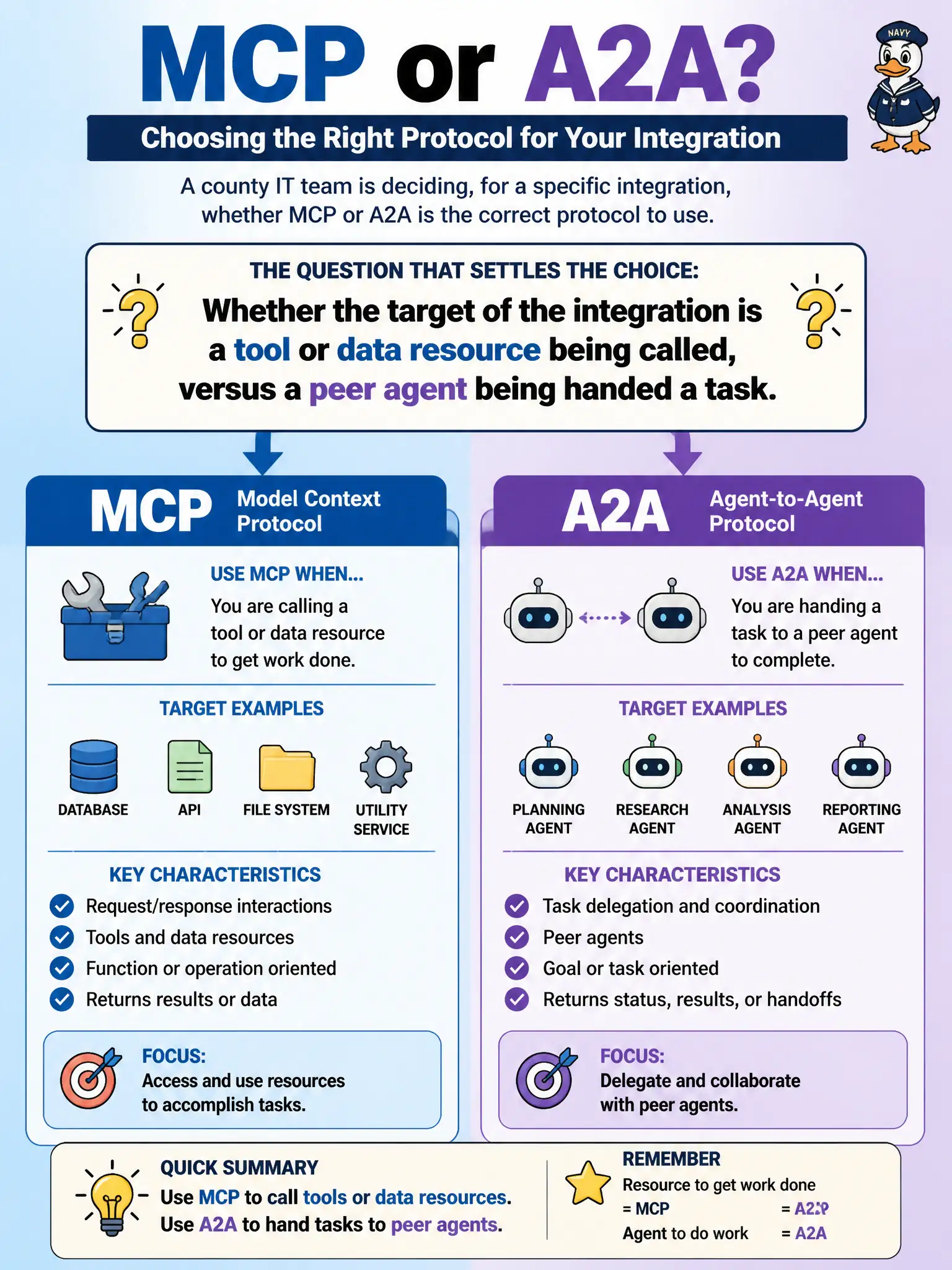
A county IT team is deciding, for a specific integration, whether MCP or A2A is the correct protocol to use. What question should settle the choice?
Select an answer to reveal the explanation.
Short Explanation
The choice between MCP and A2A comes down to one question: are you reaching for a tool, or handing work to a peer? A calculator isn't a colleague — MCP is for the calculator, A2A is for the colleague.
Full Explanation
The deciding factor is the nature of what's on the other end of the integration: MCP is designed for an agent calling a tool or data resource that executes a function and returns a result, while A2A is designed for handing a task off to another agent that has its own reasoning, state, and autonomy. Once the team identifies which of those two shapes fits the target system, the protocol choice follows directly. Budget and latency are real engineering concerns worth tracking, but they don't determine which protocol is architecturally correct for the integration's structure — a budget constraint doesn't turn a tool into a peer agent or vice versa. Whether Antigravity or another coding agent is used to build the integration is a development-tooling question, unrelated to which runtime protocol the finished integration should speak. Assuming newer systems default to A2A treats protocol choice as a matter of system age rather than of what the target actually is — an old or new system could equally be a plain tool or a full peer agent, and that's what should drive the decision. Scope note: some integrations genuinely need both — MCP for the agent's own tool calls and A2A for handing off to a collaborating agent. Operational check: describe the target system's role in one sentence; if the sentence says 'executes a function,' lean MCP, if it says 'makes its own decisions,' lean A2A.