
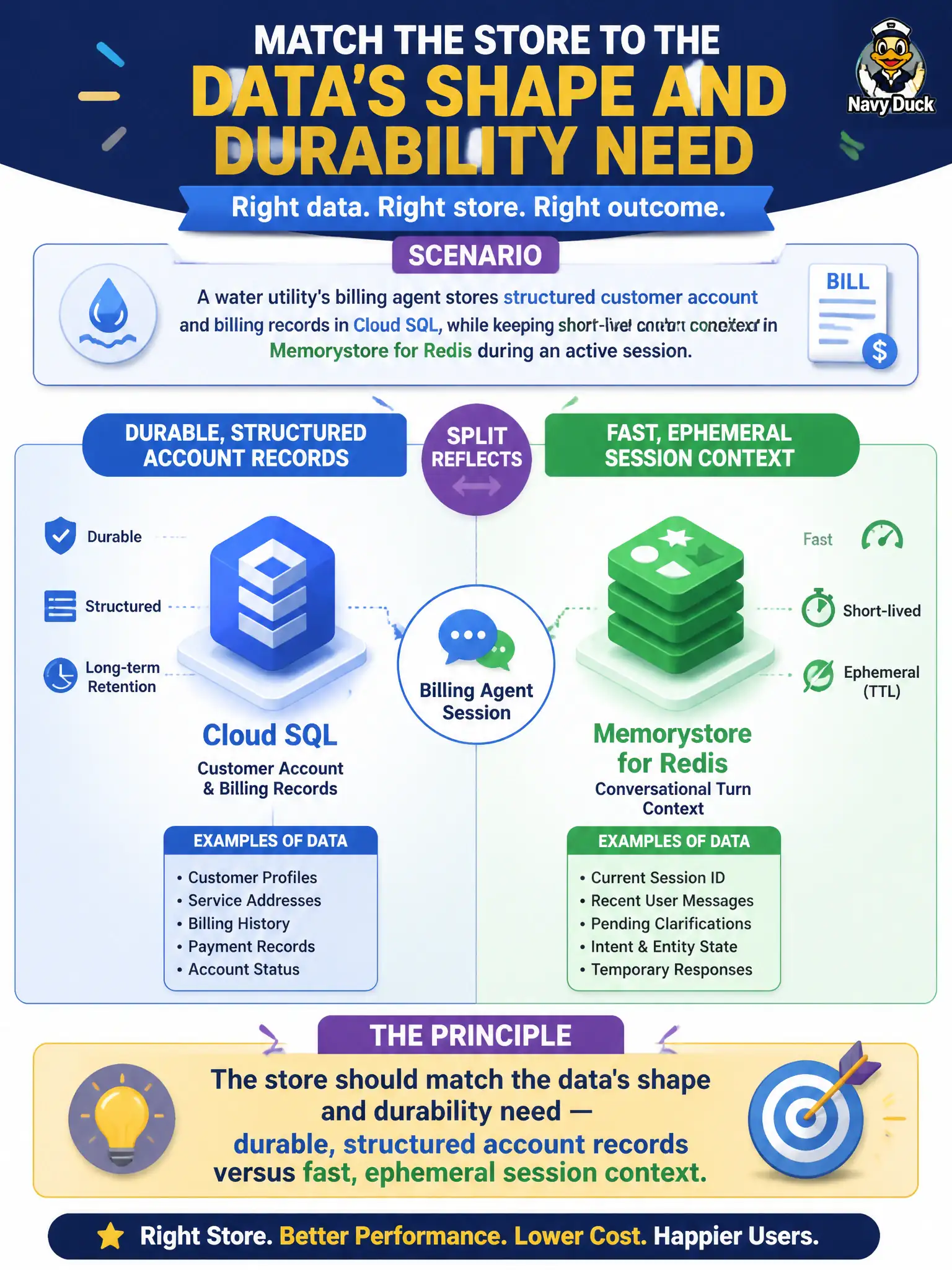
A water utility's billing agent stores structured customer account and billing records in Cloud SQL, while keeping short-lived conversational turn context in Memorystore for Redis during an active session. What principle does this split reflect?
Select an answer to reveal the explanation.
Short Explanation
Think of it like a filing cabinet versus a sticky note: billing history needs to survive for years, while what the customer said two turns ago only needs to stick around for the conversation's length. Cloud SQL is the filing cabinet for durable account data; Memorystore for Redis is the sticky note - fast, in-memory, fine to lose once the session ends. Matching the store to the data's shape and lifetime is the actual design principle here.
Full Explanation
Choosing between Cloud SQL and Memorystore for Redis comes down to two properties of the data: how structured it is and how long it needs to survive. Billing and account records are relational, need to persist indefinitely, and benefit from Cloud SQL's durability and query capability. Turn-by-turn conversational context is short-lived, accessed at very low latency, and doesn't need the durability guarantees of a relational database, which is exactly what an in-memory store like Memorystore is built for. Treating the two services as interchangeable ignores that durability and access pattern, not managed-service status, is what should drive the choice. Claiming Memorystore is required for RAG retrieval misattributes its role - retrieval grounding typically runs through a vector store or Agent Retrieval, not a Redis cache, and Cloud SQL is a general-purpose relational store, not a logging destination. And framing Cloud SQL as lower-latency than Memorystore inverts their actual performance characteristics: an in-memory store is the faster of the two for ephemeral reads. The scope caveat: some architectures do cache hot Cloud SQL rows in Memorystore for speed, but that's a caching layer in front of the durable store, not a replacement for it. A concrete check: confirm which store the design calls the source of truth for account balances - it should be Cloud SQL, not the session cache.